

Solutions Architect / Frontend Architect / Technical Manager
Portugal
Joined September 2010
- Tweets538
- Following95
- Followers41
- Likes59


Stonehenge, kings, empire… and a train that’s still late. 🇬🇧
My latest song takes a slightly cheeky trip through England’s history. Tea, a little rain, and an orderly queue.
“God Save the Queue” 🎬
youtu.be/GHZNrO9JiJk
🇫🇷 «On a gagné ? Révolution ! On a perdu ? Révolution !»
From the Gauls to the TGV: France’s history in a satirical song. Discover «Révolution».
🎬 youtu.be/vni8cl9JtwY
AI-generated images and music.
#France #Révolution
🤖 Made with AI
🇮🇹 From ancient Rome to modern Italy in one satirical song.
«Eppur si muove», the new Westmost Studio film.
«Abbiamo fatto il Rinascimento… e il ponte? Un momento!»
youtu.be/lyjVKg0BGbw
AI-generated content.
#Italy #StoriaDItalia
🤖 Made with AI

ALT Cover of «Eppur si muove», a satirical song about Italy by Westmost Studio. A singer in a blue headscarf and a lemon-patterned outfit smiles, with Italian architecture behind her.
🇵🇹🇪🇸 Ahead of Spain’s National Day on 12 October, a musical salute to nuestros hermanos: history, humour and rumba flamenca from Westmost Studio.
¡Viva España! Full film: youtu.be/7jiD6JJKAgg
AI-generated content. #España
🤖 Made with AI


Huge nerf by Anthropic in the usage of claude -p, it's one of the models that allowed us to have the "Software Factory" dream running. It will become very expensive at tokens rate.
I'll keep using it but without using Opus on it. Seems a shot in their own foot.

"Gemini 2.5 generated this response due to high traffic on Gemini 3"
I see what you did here Google :)
design.md is interesting… but isn’t this something CSS already solved years ago?
It’s lowering the barrier for non-technical people to describe UI.
This isn’t replacing CSS, it's more like a bridge, no revolution yet.

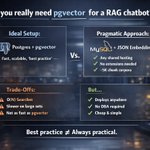
Do you really need pgvector for a RAG chatbot?
Probably yes… at scale or if not...
This is the typical setup:
→ run MySQL
→ on shared hosting
→ with phpMyAdmin
So I tried a simpler approach:
store embeddings as JSON + compute cosine similarity in the app layer.
Works fine for:
• FAQs
• docs
• small corpora (<5k chunks)
Trade-offs:
• O(N) search
• slows past ~10k
• nowhere near pgvector performance
But it deploys anywhere...
Best practice ≠ always practical. Go with what you have and make the client happy :)

Anyone has any idea why Google doesn’t have company subscriptions like OpenAI and Anthropic are doing? Their Google One is for personal use only, without invoices being given. @addyosmani any lights on this? I really wanted to try Veo, etc but Google is not making it easy.
I’ve been testing Qwen3 Next Coder, an open-source coding model, and decided to try a simple benchmark: generating a Pong game in a single prompt.
Surprisingly, it one-shotted the implementation and produced a fully working version. For an open-source model, that’s genuinely impressive and shows how quickly the ecosystem is evolving.
That said, in my day-to-day workflow i still rely mostly on frontier models, which remain more consistent for complex reasoning, large refactors, and multi-step coding tasks.
I don’t think Qwen3 Next Coder is quite ready to replace my daily drivers yet but it’s a strong signal of where open-source models are heading.
The gap is clearly shrinking.
Curious to see how these models evolve over the next few releases.

Codex limits are blowing up pretty fast now compared with the pre-GPT-5.4 release. It’s consuming ~3× more than Claude for similar work.
When the 2× Codex usage promo ends in April, the gap will be huge between the two (and Codex has always been the most generous).
Could someone from @OpenAI please check into this issue?
I'm sharing agent-coding skill:
• Clear task scoping
• Explicit assumptions (infra + business)
• Test-before / test-after
• Dependency justification
• Verification gates
• Context control
GitHub: github.com/Zokor/agent-codin…
Skills: skills.sh/zokor/agent-coding…
Feedback welcome.

I’ve released a structured skill to enforce discipline in AI coding agents:
skills.sh/zokor/agent-conven…
agent-conventions codifies the principles i use when working with Codex, Claude and agent-based workflows:
Feedback and improvements are welcome :)

Claude Opus 4.5 → 4.6
Codex 5.2 → 5.3
No meaningful change on Opus code quality.
What changed:
- Higher token burn
- 1M context ( API only )
Best usage:
• Opus - tooling + UI
• Codex - deeper reasoning, more edge-case detection
Different strengths & thinking styles.

OpenAI released GPT-5.3 Codex
Anthropic launched Claude Opus 4.6
Hightlights:
- Codex → better token efficiency (spends less) + improved accuracy
- Opus → huge context (up to 1M tokens) + agentic teams (beta)
Testing the new toys like a 6yo with presents :D
Feedback soon.

Codex App quick take:
- No image generation in subscriptions
- Can’t copy file paths
- Skills/MCPs not global vs project
- Automation setup is solid
- Skills/MCP install is easier than external tools
- Worktrees
Promising, with room to grow.
Automation is the killer feature.

