

Population Geneticist, particularly interested in Ancient DNA Group Leader, MPI Leipzig Assistant Professer, University of Rochester
🇺🇸Rochester NY;🇩🇪 Leipzig
Joined July 2012
- Tweets590
- Following346
- Followers1.2K
- Likes1.1K







If you need more exciting news about Denisovans, check out our paper on Denisovan ancestry in modern humans through time, out today in Current Biology: cell.com/current-biology/ful…! #Denisovan #ancientDNA

The most surprising insight is that the Jomon, early inhabitants of the Japanese Archipelago, have much less Denisovan ancestry than all other East Asians - thus the Jomon (partially) descend from a lineage that predates the gene flow between modern-humans and Denisovans

Also check out the dispatch by Shigeki Nakagome: cell.com/current-biology/ful…, and (of course) our new preprint on the genome of a 200,000 year old Denisovan biorxiv.org/content/10.1101/…


The first paper is a systematic survey of Neandertal ancestry through time; a joint effort with @moorjani_priya ’s lab at UC Berkeley, co-led by @IasiLeonardo and @M_Chintalapati. Leo has a great summary of our main findings here:

Out today in @sciencemagazine, we've journeyed into our shared history with Neandertals by analyzing over 300 present-day and ancient modern humans, including 59 individuals who lived between 2,000 and 45,000 years ago.
science.org/doi/10.1126/scie…

Today is a very big day for our research group, with two of my students, @arevsumer and @IasiLeonardo publishing papers on the same day! science.org/doi/10.1126/scie… nature.com/articles/s41586-0… #Neanderthals #Geneflow
Benjamin Peter retweeted

9) We searched for candidates of adaptive selection using an outlier approach. We found that many previously published candidate regions related to skin pigmentation, metabolism, and immunity were immediately selected, with some regions becoming adaptive at a later stages.

Benjamin Peter retweeted
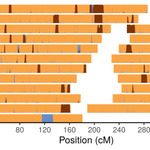
8) We examined the distribution of Neandertal ancestry over time and found that the ancestry landscape, including the Neandertal deserts, were formed quickly after the gene flow supporting theoretical predictions. We infer the initial Neandertal gene flow may have been >5%.

Benjamin Peter retweeted
7) Our data supports a single extended pulse of Neandertal gene flow that took place around 47,000 years ago, with a duration of around 6,000 years.

Benjamin Peter retweeted
6) Digging deeper, we infer the timing of Neandertal gene flow per individual by studying the ancestry covariance across the genome.

Benjamin Peter retweeted
5) The Early out of Africa individuals including Oase1, Ust’ Ishim and the Bacho Kiros have the highest unique Neandertal ancestry and significantly different matching profile to sequenced Neandertals than later modern humans- a possible indication of diversified gene flow.

Benjamin Peter retweeted
4) By exploring the colocalization of Neandertal ancestry segments and contrasting it to genome-wide allele sharing, we uncovered that most (>90%) Neandertal ancestry is shared among individuals and follows the overall population structure.

Benjamin Peter retweeted
3) We inferred Neandertal segments in the individuals using admixfrog (github.com/BenjaminPeter/adm…), and used the ancestry covariance for dating (github.com/MoorjaniLab/Proba…).

Benjamin Peter retweeted
2) We use genomic data from 59 ancient modern human individuals ranging between 45,000–2,200 yBP with 275 diverse present-day individuals from worldwide populations forming 16 clusters for our analysis.

Benjamin Peter retweeted
1) Previous studies characterized the Neandertal ancestry segments in present-day populations and found a non-homogeneous distribution. But how did this distribution look like in the past?

Benjamin Peter retweeted
In a collaboration between @M_Chintalapati ,@SkovLaurits , Alba Bosoms Mesa, @MatejaHajdi , @benmpeter and @moorjani_priya , we've journeyed into our shared history with Neandertals by analyzing over 300 genomes spanning 50,000 years. A thread 🧵🧬
biorxiv.org/content/10.1101/…

Benjamin Peter retweeted

Come join us at @MPI_EVA_Leipzig! The Dept of Primate Behavior & Evolution is looking for a lab manager/coordinator to integrate our molecular genetic, cell culture, and field-based labwork. Details here: tinyurl.com/2p83xj4p

Benjamin Peter retweeted

Newly published paper by myself and @LoganCorina, @DieterLukas, and @popgenchen on the range expansion of the great-tailed grackle, and range stability of the boat-tailed grackle! peercommunityjournal.org/art…
#TheGrackleProject
@PeerComJournal