

Experimental Filmmaker & Visual Artist https://xitter.cf/t.co/1q1qFRI9hL
Paris
Joined November 2010
- Tweets7.8K
- Following4.2K
- Followers16.9K
- Likes11.5K



Benjamin Bardou retweeted
To paint time, to approach the very texture of memory, its substance and its transformations.
The past is not fixed. It never ceases to give rise to new forms, as though it were simply waiting for us to look more closely to reveal them.
To paint time, to approach the very texture of memory, its substance and its transformations.
The past is not fixed. It never ceases to give rise to new forms, as though it were simply waiting for us to look more closely to reveal them.
Benjamin Bardou retweeted
Merci. J'ai toujours été fasciné par ces ambiances.
Je faisais déjà ce genre d'images il y a une dizaine (!) d'années.
L'espace latent ouvre là encore de nouvelles voies d'exploration.

Artificial Cities mentioned in @RtClick_Save ❤️

DIGITAL ART SHOWS TO SEE DURING ART BASEL PARIS
From Vera Molnar’s early abstracts to David Salle’s latest AI paintings, the French capital is home to a compelling array of art made with technology
By Louis Jebb (@JebbL)
rightclicksave.com/article/d…


Benjamin Bardou retweeted

1/5
Introducing "L'Horloge ou la Mécanique des Seuils" by @benjaminbardou, one of the works presented in Heterotopies, our upcoming group show at DANAE
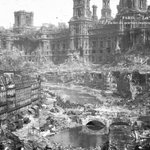
PARIS. — Les Villes Artificielles.
209 Vue sur les ruines d’un grand magasin — B. Bardou.
🖼️ Come discover the series, on public display for the very first time at @Danae__io , next Tuesday, October 20. 👇


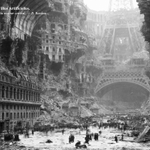
PARIS. — Les Villes Artificielles.
91 Perspective sur le réservoir souterrain au pied des remparts — B. Bardou.
🖼️ Come discover the series, on public display for the very first time at @Danae__io , next Tuesday, October 20. 👇

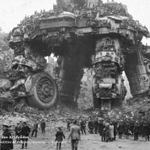
Artificial Cities compose an imaginary geography of abandoned cities, ruined monuments, and architectures whose origins and functions seem to have been lost. These landscapes recall the architectural capricci of Francesco Guardi, the ruins of Hubert Robert, and the visionary architectures of Piranesi. In each of these representations, architecture breaks free from its historical reality to become a space of mental projection.
Like architectural capricci, these images bring together fragments of different places and eras within spaces that have never existed. The ruins do not necessarily bear witness to a past catastrophe: they seem to belong to a suspended world, where civilizations succeed one another, disappear, and are endlessly reborn. The past sometimes takes on the appearance of a distant future, as though time had ceased to follow a single direction.
These imaginary cities thus maintain an ambiguous relationship with utopia. They depict impossible places, situated outside history, which may evoke both the remnants of a lost paradise and the promise of a world yet to come. The ruin is no longer merely a sign of disappearance, but also of possible rebirth. It simultaneously contains the memory of what once was and the possibility of what might still emerge.
Artificial Cities thus appear as fragments of a mythology without a definite origin. Places that seem to have always existed, destined to disappear and reappear, in a movement reminiscent of the myth of eternal return. Not the remnants of a world irretrievably lost, but images of a world that never ceases to begin again.
Benjamin Bardou retweeted
I'm delighted to be part of Heterotopies, opening October 20 at @Danae__io , Paris.
Hope to see you there! 👇
I'm delighted to be part of Heterotopies, opening October 20 at @Danae__io , Paris.
Hope to see you there! 👇

Artificial Cities compose an imaginary geography of abandoned cities, ruined monuments, and architectures whose origins and functions seem to have been lost. These landscapes recall the architectural capricci of Francesco Guardi, the ruins of Hubert Robert, and the visionary architectures of Piranesi. In each of these representations, architecture breaks free from its historical reality to become a space of mental projection.
Like architectural capricci, these images bring together fragments of different places and eras within spaces that have never existed. The ruins do not necessarily bear witness to a past catastrophe: they seem to belong to a suspended world, where civilizations succeed one another, disappear, and are endlessly reborn. The past sometimes takes on the appearance of a distant future, as though time had ceased to follow a single direction.
These imaginary cities thus maintain an ambiguous relationship with utopia. They depict impossible places, situated outside history, which may evoke both the remnants of a lost paradise and the promise of a world yet to come. The ruin is no longer merely a sign of disappearance, but also of possible rebirth. It simultaneously contains the memory of what once was and the possibility of what might still emerge.
Artificial Cities thus appear as fragments of a mythology without a definite origin. Places that seem to have always existed, destined to disappear and reappear, in a movement reminiscent of the myth of eternal return. Not the remnants of a world irretrievably lost, but images of a world that never ceases to begin again.