
🎓 Stanford AI/CS 🤖 | 📈 8-Fig Brand Builder 🚀 CEO of @archive_dot_com 🛍️ AI-Driven Social Commerce | 🔗👇
Miami
Joined November 2010
- Tweets964
- Following776
- Followers2.5K
- Likes1.2K






Pinned Tweet
We just closed a strategic round for Archive, co-led by @antifund and @floridafunders.
Anti Fund is @jakepaul and @LoganPaul's fund. Two of the biggest creators in the world just backed the platform brands use to run creator marketing.

Our agents can now run influencer programs end to end for brands. At script review, the agent does the first read against the brief we calibrated together, a human on our side checks its notes for taste, and the marketer says whether they agree. The final say stays human.

One of the biggest beauty companies told us their reporting gap: "we get the number of responses, but we don't know what those responses are talking about or telling us." Our Deep Research reports hand over every comment. They can build the purchase intent chart themselves.

Glad we are buttoned up w/ Numeral for this.

Getting close to January 1st - California's go-live on SB 122 - most prewritten software and SaaS will become taxable for the first time
If you're selling to CA-based customers, you probably need to collect sales tax
@numeral can help you
I updated my Raycast extension. It used to send tasks to Linear. Now it can send them to Slack and start a Hermes session, and the agent starts working right away. When it's done, I get a ping like a colleague finishing a project. It has made my life dramatically better.
Reactive creator marketing: when a story moves on social, your creators post about it within days. 'Tomorrow we gotta get this out' never works. Put someone on Instagram or run weekly deep research reports, pre-clear creators, brief Monday night, live by Wednesday or Thursday.

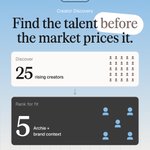
A reporter asked me how brands push back when creators hold the negotiating leverage. Once a creator is priced to perfection, a rate calculator won't save you. Great social listening finds up-and-coming creators before the market prices them.

We rebuilt Competitor Insights on a new storage engine. No visual change, but every number now calculates live, never stuck or incomplete. Soon, fast dynamic filters will let you build precise Deep Research reports on what a competitor did in the last 24 hours or last week.
An exec at one of the largest agencies told me his teams log into 5 tools and he can't tell if any of it makes them faster. So they're building their own. Too many disconnected tools were the problem. Now MCPs glue everything together. That's why Archive has an API and an MCP.

We're building managed agents at Archive. The agent runs a large amount of the creative and influencer work, and someone on our team installs and runs it for you.
We don't make money on assets your team isn't jamming in the ads account.
Fired up about this one.

1/ The fastest growing AI companies and labs are all going to creators. They need humans to tell their stories, and that demand created the craziest pricing shift we've ever seen in creator marketing.
2/ This is not an efficient market. Brands are getting the best and the worst deals, and so are creators. Every outcome depends on the specific interaction.
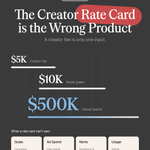
3/ One creator got $5,000 for a video from an AI coding company and guessed they spent $10,000 boosting it. They spent $500,000. Against $500,000 a month of ad spend, that video was the deal of the century. No rate card can price it.
4/ The brands that win come in with specific goals and build their own probabilistic model of what they'll pay. Then they reach out to 25 creators instead of 5, before the good ones are priced to perfection, and run real price discovery.
5/ Generic rate calculators give false comfort. Landing $50 under the calculator's number means nothing when the data behind it ignores your business.
6/ The biggest gap is usage. Creators can't track it and can't see the spend behind their content. Whatever replaces the rate card has to know your goals, your spend, the niche, and how the content will run before it outputs a number.

Everybody's asking whether AI will shrink the creator market. It's expanding on both sides at once. People scroll Instagram while they wait for ChatGPT, and AI tools make it easier for anyone to create. Creator inventory is becoming almost infinite.
Ad load can't keep up. Facebook can't stuff more ads into Instagram without pushing people to other platforms, so the new supply piles up as organic content that can be influenced and marketed, eventually billions and billions of pieces a day.
How the hell is a brand going to manage that with a team of humans? The alpha goes to whoever manages the flood of organic content well.
A creator says she's booked until October. The follow-up is already drafted, timed to the window she gave us. Nobody set a reminder, and nobody is running a spreadsheet.
We have brands using early versions of our Archive agents on creator comms, brands spending hundreds of thousands of dollars on creators. Natalia, who helps them run these programs, posted an unprompted write-up in Slack last week on what the agents already handle for her.
The follow-up overhead went first. A creator who's interested but can't collaborate for one to three months used to mean manual reminders and a spreadsheet somebody keeps alive. Now the agent drafts the follow-up around the exact timeframe the creator mentioned, "without me doing anything."
The second thing she called out is the check-in nobody has time for. When a client sits on feedback, creators are left waiting, and the agent drafts the apology-and-update messages before the client has even responded. Those are exactly the messages that fall through the cracks when one person is carrying that many moving pieces, and they're the difference between a creator staying warm and quietly disengaging.
If you're thinking about putting AI on creator comms, the part you probably fear is the writing, an agent sounding off and damaging the relationship. Natalia's write-up says the message quality is already strong, and her edits were never about fixing it. One draft went to a creator whose husband had recently passed away, and she called it "thoughtful, empathetic, and completely appropriate for the situation."
Her edits go somewhere else: "At this stage, most of my edits are less about fixing the writing itself and more about teaching the agent the strategy behind influencer marketing conversations."
The agent owns the memory and the timing now. Natalia moved up a level. Her time goes to steering negotiations toward better partnerships and stronger terms, and the operations underneath that work are just gone.
A small audience can be expensive to reach because its members have to trust you before they'll buy.
That's the argument in my new byline for The Drum on B2B creator economics.
Consumer creator pricing gives marketers familiar benchmarks. You can compare views and cost per thousand, then decide whether the audience is worth the fee. Bring those benchmarks into a B2B negotiation and you can badly misprice the creator.
The people who matter are a VP of procurement and the committee weighing a vendor purchase. A creator who's earned credibility with those people gives a brand a way into a conversation its ads struggle to enter.
I see the rates every week inside these deals. A fitness creator with 80,000 followers gets $500 for a shoe reel. An AI company will pay that same creator $20,000 to $30,000 for a single video.
A narrow audience alone doesn't justify that price. The creator has to have earned standing with the people making the purchase. The brand is paying to borrow a reputation that took years to build.
thedrum.com/opinion/consumer…

We're hiring a BDR at Archive in New York, in office 5 days a week, coached daily by Michael Lee, our Head of Sales. You'll do real outbound work and use AI in everything you do. Get your foot in the door and be at the forefront of AI in sales. Comment or DM me and we'll chat.

Creator rates in AI aren't climbing because creators got greedy. Every fast-growing AI company and lab realized at once that they need humans to tell their stories. It's the craziest pricing shift I've ever seen in the industry. If you're budgeting a launch, budget for scarcity.
1/ A marketer at one AI company has somewhere between 300 and 500 pieces of creator content going live every month. She reached out to us because she's in the market for a CRM for creators.
2/ She already has a link tool for partners and affiliates, and it does the affiliate job fine. It's not suited for sponsorships. Each sponsorship carries its own brief, deliverables, terms, and go-live date, and her team runs all of it manually.
3/ A contact list can hold every creator she works with. It can't run 300 to 500 live deliverables a month. That manual work is what we're building Archive's agents to absorb, so her team spends its time on great creators.
An influencer lead at a B2B fintech told me sourcing and outreach eat most of her week, exactly where her judgment matters least. That's what we're going after with Archie, our creator search agent. It takes sourcing end to end. Still early, and we're onboarding customers.
We don't have company values at @app_archive. We define culture with the Archive Standards, and Customer Obsession is standard number one. A business is a way to create value people are excited to pay for. Lose the obsession with your customers and everything degrades.

A company is a machine that spends money. It's really hard to spend money well.
Marketing is the same machine: money in, campaigns and influencer programs in the middle, pipeline and brand awareness out.
A bigger budget won't fix a machine that can't convert.