

Building @EmpiricalHlth - don't die of heart disease. Previously @AppCardiogram, @GetSift, @HealthCareGov rescue team, @BrexHQ, & @Google AI.
NYC
Joined May 2010
- Tweets3.8K
- Following2.3K
- Followers2.6K
- Likes7.9K






FDA is reviewing Grails @GalleriTest test Wednesday. Its accuracy is highest for cancers with no current screening guidelines:

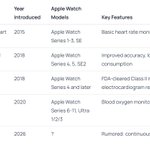
The new Apple Watch will track heart rate continuously. This enables at least 20 applications across medicine, stress, sleep, and fitness:

Apple is rumored to be upgrading the Watch's heart rate sensor tomorrow. If so, this would be the first major upgrade since 2020:

Brandon Ballinger retweeted

ENOUGH PESSIMISM IN AI PLEASE
I feel that we have become unreasonably pessimistic in our field.
1. I keep hearing AI engineers saying we have to make money quickly because there’s only like 2 years left before we’re automated. Depressing.
2. I see a constant obsession with “having a moat”. This is an incredibly sad mental frame.
3. I keep hearing “we have to catch up”. Soulless.
And so on. People: Every solution creates the possibility to attack new real problems. We face gargantuan engineering challenges in our world. How to capture carbon? How to get rid of teflon and plastics in water? How to invent batteries that are at least 30 times more efficient? How to solve clean energy? Better solar cells? Better ways of producing clean energy so we stop wars and famine? How to eradicate hundreds of diseases? Cures for addiction? And so on. Real engineering is about being brave and truly attacking the many problems we face, to engage with a true desire to improve the lives of others and our environment.
Good engineering is not about protecting your product to make money at the expense of progress (moat thinking). Good engineering is about ensuring your children and grandchildren will be proud of the choices you made in 30 or 50 years. It is about empowering others. It is about advancing science. It is about being one step ahead. Always, one step ahead, meaningfully, proudly.
These are great times. Let’s start thinking positively about all the wonderful things we could achieve together.
Imaging found arterial plaque in 34.6% of men in their 30s. By 60-70, it's 98.1% for men and 91.9% for women:

Brandon Ballinger retweeted

Big labs don’t have a monopoly on AI research.
More than 20 YC startups have published research recently at top conferences like NeurIPS, ICLR, and ICML.
empirical.health/blog/yc-sta…

93% of cardiologists are now reviewing patient wearable data. Only 11% of those are integrated into their EMR workflows.

Brandon Ballinger retweeted

i disagree with Dario's medical takes, but i think there's kind of a failure of imagination with the responses to him. there is, i think, an okay steelman for “ai will figure out solutions to a good chunk of diseases” if you believe superintelligence can solve the delivery problem entirely. that is: it will be able to design drugs that target arbitrary places in the body, and nowhere else.
lots of medicine is bottlenecked by this problem!
let’s suppose we had such a machine, which, given a particular biomolecule, tells us which tissues it reaches and nothing else.
with such a machine, you can...
1. cure a fairly large chunk of rare diseases, which are mostly monogenic mutations that are solvable with current genetic-engineering technology, given good-enough delivery vehicles produced by the machine. yes, you won’t undo all the damage caused by a lifetime of disease, but still!
2. put a pretty big dent in—if not outright eliminate—any solid tumor. how? just go all in on radionuclides that, magically, target only cancer cells. the radiation burden eventually kills it without harming the patient (much). nearly-pan-cancer cure; none of the usual “cancer is actually many diseases” nuance needed. you might say that some cancers are a problem because they’re discovered too late, rather than because they’re hard to cure, but solving the delivery problem helps with that too. highly selective PET ligands would let us regularly and non-invasively monitor for small lesions, then treat them with with matched radioligands whenever something suspicious turns up.
3. cure at least some severe autoimmune diseases. we already know that wiping out B-cell lineages via cell therapy can do that, but it’s too toxic to scale. with our magic delivery-solver ai, we could make therapies that remove the particular autoreactive B-cell and plasma-cell populations we dislike, leaving most useful immunity intact. and for some autoimmune conditions, the relevant autoantigens and autoantibodies are well established!
there: three broad classes of diseases that get tidied up with access to a superintelligence that can solve one singular problem. and you probably get more than this too!
of course, much like Dario, i’m doing a little handwaving here myself. truly solving the “delivery problem”—beyond the basic ability of distinguishing one cell from another—involves solving a dozen bundled problems: blood-brain delivery, preventing an immune response, avoiding liver and spleen sequestration, getting through the cell membrane and then escaping the endosome
but i dont know. is it really so unachievable? the delivery problem feels like a pretty legible issue, no secret knowledge of biology required beyond more data collection from the obvious sources + mulling over the results. if we really put our minds to it—and many people are—it seems well within the realm of possibility. it's also not terribly slow to run this through clinical trials; the tech stack for genetic editors, radionuclides, and immune depletion does already kinda exist.
now, i think it's fair to still say solving the delivery problem is somewhere on the spectrum of impossible (too hard to distinguish stuff, the biological knobs just dont exist) to intractable (there actually is secret knowledge about biology we need to uncover before we solve it). im somewhere in these two camps personally, but i wouldn't find it insanely shocking if i turn out to be wrong
Brandon Ballinger retweeted

An internal version of Astra, @OpenAI’s next major model family, solved 10 major open problems in mathematics, quantum complexity, and theoretical computer science.
We believe it will be a major step for scientific reasoning. openai.com/index/ten-advance…


Right now only 1% of eligible patients use injectable PCSK9 inhibitors, but that's going to change since the FDA just approved the first PCSK9 pill, enlicitide.
Cuts LDL cholesterol/ApoB by 50-60% AND reduces Lp(a) by 28%:

Brandon Ballinger retweeted

I have been working a lot in rare disease again, and it is such an important and hard problem. I think rare disease diagnosis is a great problem for LLMs, so I have been working on side project, SecondLook, to see what's possible. Check it out and give feedback! (1/7)

I went through @ycombinator when I was 27, and again at 39. It was arguably more useful the second time around. YC is the YC for founders 35+.

YC this.
YC that.
What about YC for founders 35+?
The average successful startup founder is around 45.
By that point you’ve spent years learning an industry, shipping products, managing people, building a network, and figuring out which problems are actually worth solving.
Yet startup culture still seems obsessed with the young founder archetype.
Feels like there’s room for an accelerator built specifically for experienced operators who finally decided to start something.
Who’s building this?
This same dynamic is playing out in AI for health right now. Startups that price on outcomes (VBC, Medicare ACCESS), rather than fee for service, give themselves the incentive to invest in software that compounds.




Apparently Vitamin D acts more like a hormone than a vitamin. Regulates 1,000 to 2,000 genes (5-10% of the human genome).
Brandon Ballinger retweeted

The “data for AI in bio” discourse is shifting from “we need data” to “what's the right data for this problem?”, and then how to produce it.
Right now there's a key gap between stated goals of curing disease and ongoing data generation efforts. We gravitate towards rapid and scalable experiments, even when those will never tell us how to treat Alzheimer's or aging.
The default path is that intelligence will explode, and cures will be stuck waiting for data that can't be accelerated.
There is work we should start today if we want to avoid that.
I wrote out thoughts on how we can identify data that will/won't let us cure disease, and how to overcome the technical and physical barriers to making it.
