

WWII battlefield guide based in The Netherlands. I lead tours across Europe, sharing the stories of the men who fought, where they fought.
The Netherlands
Joined January 2010
- Tweets3.5K
- Following308
- Followers12.6K
- Likes10.8K


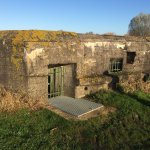


The German guns covering this stretch of Omaha Beach stood just forty yards from the high-water mark.
This is Le Cavey, at the eastern end of Omaha Beach, in the American Fox Green sector. The German strongpoint, Widerstandsnest 61, housed an 88mm anti-tank gun in a concrete casemate, now converted into holiday accommodation.
According to American accounts, two Sherman tanks knocked out the 88mm within half an hour of the landings. But a 50mm gun in an open emplacement continued firing along the beach.
Staff Sergeant Raymond Strojny of F Company, 16th Infantry Regiment, 1st Infantry Division, watched it destroy three Shermans. After taking over a bazooka, he crossed a minefield alone and fired six rockets from a forward position. The final round detonated ammunition near the gun, silencing it.
Strojny received the Distinguished Service Cross for his actions on 6 June 1944.

None of the buildings held by the British at the north end of the Arnhem bridge survived the battle. That includes the large private house where Lieutenant Colonel John Frost set up the headquarters of the 2nd Parachute Battalion on the evening of 17 September 1944.
He chose it for the view from its upper rooms. Brigade headquarters took the office building next door. On the Monday Frost moved across to command the whole force at the bridge. On 20 September he was wounded in the leg and carried down to that building's cellar, among some two hundred wounded. That evening, with the building on fire, a truce was arranged to bring them out.
Today we stood on this spot with two American guests on our Arnhem tour.

Easy Company crossed the Wilhelmina Canal at Son on planks laid over the wreckage of a blown bridge. The tanks behind them needed something stronger, and British engineers built it overnight.
They The Germans blew the road bridge as the 506th Parachute Infantry reached it on 17 September 1944. The Guards Armoured Division got to the canal at about 21:00 the next evening, and Royal Engineers started bolting a Bailey bridge across the gap. At 06:15 on 19 September the first tanks rolled over it. That afternoon Panthers of Panzer-Brigade 107 got within 150 metres of the new bridge before a single 57mm anti-tank gun, just landed by glider, stopped them.
Today we stood here with a Dutch group on an Easy Company tour for Joel Stoppels Battlefield Tours.

Easy Company veterans came back to the Bois Jacques on 10 June 2005 for the unveiling of this monument. Seventeen of them made the journey.
It stands where the old Bastogne railway, now a cycle path, crosses the road from Foy to Bizory. In December 1944 this was the right flank of the 101st Airborne's 506th Parachute Infantry Regiment, where it met the 501st. Easy Company dug its foxholes in the woods to its right on 20 December. The left plaque names fourteen men of the company. Thirteen were killed in the fighting around Bastogne. The fourteenth, Eugene Jackson, died on a night patrol at Haguenau in February 1945, the last man Easy Company lost in the war.
We stood here today with a group from England on our Bastogne tour.

Four days after France signed the armistice in June 1940, the man who had just conquered it came back to look at this bunker. Twenty-four years earlier he had carried messages along this ridge as a lance corporal.
The concrete command post stands in the fields behind Fromelles, on Aubers Ridge, built by the 13th Bavarian Pioneer Company. Between March 1915 and September 1916 runners of the 16th Bavarian Reserve Infantry Regiment, the List Regiment, brought orders here. One of them was Adolf Hitler. On 26 June 1940 he returned with Max Amann, his old sergeant major, and Ernst Schmidt, a fellow runner, and Heinrich Hoffmann photographed the visit for the press.
Whether the bunker existed when he served here is less certain than the local story. Some researchers date it to after the List Regiment left for the Somme in September 1916, which would mean he first saw it in 1940.

Easy Company’s last fight under Dick Winters as its commander was fought here, at the Crossroads between Heteren and Randwijk.
Before dawn on 5 October 1944 Winters took a squad of 1st Platoon to find the Germans who had fired on one of his patrols. With reinforcements he had about thirty-five men. He found at least a company behind the dike, attacked with fixed bayonets and broke it. Corporal William Dukeman was killed before the charge. Eighteen more men were wounded by German artillery as the platoon pulled back to the dike.
On 9 October Winters left the company to become executive officer of 2nd Battalion. His successor, Lieutenant Moose Heyliger, was shot by one of his own sentries within weeks. Easy Company went into Bastogne under Lieutenant Norman Dike.
We walked this field today on an Easy Company tour with two Americans.

Easy Company never stayed at Schoonderlogt. The picture of Dick Winters under this gate made the estate famous anyway.
The farm stands on the Island near Elst, the low ground between the Waal and the Lower Rhine that the 101st Airborne held after Market Garden. From late October 1944 it housed the headquarters of the 506th Parachute Infantry Regiment. Winters was a captain by then, moved up from Easy Company on 9 October to executive officer of the 2nd Battalion. Four days earlier he had led thirty-five men of Easy and Fox Companies against a far larger German force at the Crossroads near Randwijk.
Today we stood at the gate with a guest from the States on our Easy Company tour.

Sixteen columns, one for each Allied aircraft that came down in Neder-Betuwe during the Second World War. Between them they carried 132 men. Sixty-six were killed. 1/4

Flak set it on fire and left the pilot, Lieutenant James Spurrier, unconscious. His co-pilot, Second Lieutenant Edward Fulmer of the 43rd Troop Carrier Squadron, held it steady until the paratroopers had jumped. 3/4


In the Airborne Museum in Oosterbeek, the sling beside his whistle and Colt was tied on Major Bruce Dawson by a medic around midday on 20 September 1944. He went on fighting in it.
Dawson was Brigade Major of 4th Parachute Brigade, Brigadier Hackett's chief of staff, and already held the Military Cross from France in 1940. That day the brigade was trying to fight its way through the woods west of Oosterbeek to reach the rest of 1st Airborne Division.
Dawson led several small attacks to keep it moving and was hit in the right shoulder. Soon afterwards German tanks broke into the column and set the transport alight. He was shot through the head trying to rally Brigade HQ. He was 27.
Hackett, writing his diary in a German-held hospital in Arnhem, called his conduct beyond praise.
We stopped at his display today with a couple from the United States, on a wet day out on the Arnhem battlefields.

Original wartime vehicles of the Screaming Ducks, a Kübelwagen and two Willys jeeps, parked at the Waal crossing memorial in Lent.
Beyond them, members of the Ducks gather at the memorial stone. It lists the Americans killed crossing the river here on 20 September 1944. Behind it runs De Oversteek, the road bridge opened in 2013 and named after the crossing. Its 48 pairs of lamps light one pair at a time at sunset, one for each man killed.
The boats came across in the distance, under the power lines. Twenty-six canvas boats carried the 3rd Battalion of the 504th Parachute Infantry, 82nd Airborne, under Major Julian Cook, into fire from this bank. Only about half came back for the next wave. Cook went in the first wave and was awarded the Distinguished Service Cross. By evening both Nijmegen bridges were in Allied hands.

The 79 soldiers named on this stone fought the Battle of Arnhem from the open door of a transport aircraft.
They were air despatchers of the Royal Army Service Corps. Between 18 and 25 September 1944 they flew in the Stirlings and Dakotas resupplying the 1st Airborne Division, pushing panniers out over the drop zones while the pilots held the aircraft straight and level through the flak. Of about 1,500 tons dropped, only 7.4 per cent reached British hands.
The aircrew were remembered after the war. The despatchers largely were not. This memorial beside the Airborne Cemetery was unveiled on 18 September 1994, fifty years to the day after their first resupply drop.
Oosterbeek is a stop on our Arnhem and Oosterbeek tours.

I spent almost five years on the waiting list before I could adopt this grave at Margraten.
Staff Sergeant Richard L. Walsh served in K Company, 330th Infantry Regiment, 83rd Infantry Division. He enlisted straight out of high school in Indiana in 1943. He landed in Normandy on 18 June 1944 and was wounded by a mortar round on 22 July, which earned him the Purple Heart. By the autumn he was back with his company. On 4 January 1945, attacking near Manhay in the Belgian Ardennes, he was killed by a German shell as his squad went down a wooded slope in the snow. He was 20. His family chose to leave him at Margraten.
Visited today with the National WWII Museum, the last stop of our Market Garden pre-tour.

Eighty-two years ago today, American bombers dropped the road bridge at Arnhem into the Lower Rhine.
The bridge that stands here now opened on 9 May 1950, rebuilt in the style of the original.
On the evening of 17 September 1944, about 740 British airborne troops under Lieutenant Colonel John Frost, built around his 2nd Parachute Battalion, reached and occupied the northern end of the bridge. They held it until the early hours of 21 September, waiting for XXX Corps.
With the bridge back in German hands and being used to move troops and equipment south into the Betuwe, B-26 Marauders of the USAAF’s 344th Bomb Group attacked it on 7 October. Direct hits brought the main span down into the Lower Rhine.
We were at the bridge today with The National WWII Museum, on day three of the Market Garden pre-tour.

Sixteen paratroopers took this bridge over the Maas at Grave, because the rest of their company had jumped too early. Since 2004 it has carried the name of the lieutenant who led them.
On 17 September 1944 Company E, 504th Parachute Infantry Regiment, 82nd Airborne Division, was to land south of the river and seize the southern end.
Only Lieutenant John Thompson's stick came down close to it. He attacked at once rather than lose surprise waiting for the others. His men worked forward through drainage ditches, at times up to their necks in water, under fire from a 20mm flak gun in a tower on the southern approach. Private Robert McGraw fired three bazooka rounds at it. Two hit the top of the tower and the gun stopped firing. By mid-afternoon the southern end was secure and the bridge was in American hands, intact.
Today we visited the bridge with a group from The National WWII Museum.

The bridge over the Maas-Scheldt canal at Lommel in Belgium was Market Garden's start line, taken a week before the operation began. It has been rebuilt since the war, but it still carries the name it earned on 10 September 1944: Joe's Bridge.
That evening, tanks and infantry of the Irish Guards, Guards Armoured Division, rushed the crossing before the Germans could blow it. Lieutenant-General Brian Horrocks was so impressed that he named the bridge after their commander, Lt Col J.O.E. Vandeleur.
On 17 September, Horrocks's XXX Corps launched its advance towards Arnhem from this bridgehead, with the Irish Guards in the lead.
We visited the bridge today with a group from the National WWII Museum.

The front of this gun barrel came from another tank. According to the December 44 museum, it is a length of Panther barrel with its muzzle brake, taken from one of the tanks Skorzeny's men disguised as American vehicles and left near Malmedy.
The original was shot away in December 1944. This is Tiger II 213 of schwere SS-Panzer-Abteilung 501, fighting with Kampfgruppe Peiper of the 1st SS Panzer Division. Under SS-Obersturmführer Dollinger it held the high ground at the Wérimont farm outside La Gleize, alongside Tiger 221. Around midday on 21 or 22 December, accounts differ, fifteen tanks of the 3rd Armored Division's Task Force McGeorge came up from Roanne. Neither Tiger scored a hit. American fire blew off the front third of 213's gun, both crews bailed out, and Dollinger, wounded in the head, sheltered in the farm cellar. When Peiper's men left La Gleize on foot on the night of 23 December, the tank stayed behind. In July 1945 Jenny Geenen-Dewez bought it from the American salvage crews for a bottle of cognac.
We stopped here today on the second day of a Battle of the Bulge tour with four friends from the UK.

This Panther spent almost four years upside down in the river Ourthe.
It now stands on a plinth in the centre of Houffalize, a Panther Ausf. G of the 116th Panzer Division, turret number 111. The division came through the town on 19 December 1944 on its drive west. How the tank ended up in the river is not known.
Veterans and residents later said the blast from Allied bombs falling on the town tipped it in, but no record confirms it. Engineers lifted it out on 20 September 1948, and the town kept it.
Today we stood beside it on the first of two days in the Bulge with four friends from the UK.
