

Founder of Reeno — integration reliability for SaaS. Know when the services your app depends on break before customers do. Building in public.
Remote/Global
Joined June 2026
- Tweets570
- Following493
- Followers102
- Likes104




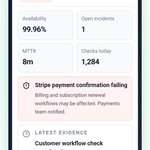

Stripe can be Operational.
GitHub can be Operational.
OpenAI can be Operational.
And your SaaS can still be breaking for customers.
Expired credentials.
Permission changes.
Webhook failures.
Rate limits.
A specific API operation failing.
Provider status doesn't tell you what's happening inside your integration.
That's the problem Reeno is built to solve.
reeno.dev

Your customers don’t care that your OAuth provider went down.
They care that your app stopped working.
Reeno helps SaaS teams detect broken integrations, deduplicate incidents, notify the right people, and confirm recovery.
Know when your integrations break before your customers do.
→ reeno.dev
#SaaS #DevTools #BuildInPublic
IsDown/StatusGator answer:
“Is this external service down?”
Reeno asks a different question:
“Is this integration actually working for MY application?”
Stripe can say Operational.
Meanwhile, your app is getting:
"401 Unauthorized"
Reeno detects it.
GitHub can say Operational.
Meanwhile, your OAuth integration is returning:
"invalid_grant"
Reeno detects it.
Slack can say Operational.
Meanwhile, your webhook delivery is failing.
That’s not an “is Slack down?” problem.
It’s:
The vendor is healthy.
Your integration isn't.
That’s the problem Reeno is built to solve.
We just caught something interesting while testing Reeno in production.
A SaaS can have a perfectly healthy application, but a critical dependency can still break the workflow that matters.
In our own case, Reeno detected a live payment failure when Paddle's API returned a 403 forbidden while creating a transaction.
The important part wasn't just seeing a 403.
Reeno captured the failure, the exact error, and the request ID so we could investigate what actually broke.
That's exactly the problem I'm building Reeno to solve:
Don't just monitor whether a service is up. Verify whether the operation your product depends on actually works.
We're investigating the Paddle issue now.
@Paddle
Request ID: 4f02d09d-b8ca-4806-8ee1-c700bc958aa4
Building Reeno → reeno.dev
Your SaaS doesn't need another dashboard full of green checks.
What matters is whether the workflows your customers depend on are actually working.
A dependency can be reachable and still be failing at the operation your product needs.
That's why I built Reeno.
It checks the critical operations behind your SaaS, keeps evidence when something fails, connects the failure to the affected workflow, and verifies when things recover.
Reeno is live.
Now I'm looking for SaaS teams willing to put it through a real production environment.
reeno.dev

Your SaaS can be “up” while one of your most important customer workflows is already broken.
Stripe can be reachable.
OpenAI can be reachable.
Your database can be healthy.
But if the specific operation your product depends on is failing, your customers don't care that everything else is green.
That's the problem I'm solving with Reeno.
Reeno tests the actual operations your SaaS depends on, detects when they fail, keeps the evidence, and tells you which workflow is affected.
Not “is the service up?”
“Is the thing my customers depend on actually working?”
Building for SaaS founders who'd rather know first.
reeno.dev
Most SaaS teams know when their own servers are down.
The harder problem is when everything looks healthy, but something your product depends on isn't.
Stripe.
OpenAI.
Resend.
Auth providers.
Webhooks.
Third party APIs.
Your application can be running normally while a customer-facing workflow is quietly breaking.
That's the problem I'm building Reeno to solve.
Not just: “Is the service up?”
But: “Is this dependency actually working for the operation my product depends on?”
And when something breaks,
I want to know what failed, what it affected, and when it recovered.
Building this one customer workflow at a time.
reeno.dev
I built Reeno, launched it, got early usage, and I'm now converting the first customers while raising.

Reeno just crossed 10,000 pageviews in a month.
Still early, still a lot to prove, but it feels good to see people paying attention to what we’re building.
The next goal is simple: turn that attention into teams actually using Reeno to catch dependency failures before their customers do.
Back to work.

The scary part of third-party dependencies isn’t when they go down.
It’s when they partially break.
A provider can be online.
Your servers can be healthy. Your monitoring can be green.
And one important operation can still be failing.
Those are the incidents customers notice first.
That’s the problem Reeno is built to catch.
reeno.dev
Your monitoring says Stripe is healthy.
Your logs look normal.
Your server is running.
But customers are still failing at checkout.
This is the gap Reeno is built for.
We don't just monitor the dependency.
We test the operation your product actually relies on.
Because “Stripe is up” doesn't necessarily mean your checkout is working.
One of the hardest things about building a SaaS product today:
You don't control most of the systems your product depends on.
Stripe.
OpenAI.
AWS.
GitHub.
Resend.
Clerk.
Your code can be perfectly fine and your product can still break because something outside your code changed.
The more dependencies you add, the harder this becomes.
That's the problem I'm building Reeno to solve.
Your Stripe account can be healthy while your checkout is broken.
OpenAI can be operational while your AI feature is failing.
GitHub can be up while your deployment workflow is stuck.
That’s the problem I’m building Reeno around.
Dependency uptime is not the same as product health.
Your monitoring should tell you when the thing your customers actually use stops working.

Building a SaaS that depends on Stripe, OpenAI, Clerk, GitHub, Resend, etc. means you’re also depending on things you don’t control.
The frustrating part isn’t knowing a provider has an issue.
It’s knowing your customers are being affected before you do.
That’s the problem I’m building Reeno around.
Still early. Shipping, testing, and learning every day.
Spent more time today thinking about one question:
What does Reeno actually need to know when a dependency fails?
“Stripe is down” isn't enough.
I want Reeno to tell me:
→ what operation failed
→ which part of my product is affected
→ what evidence it found
→ and whether the workflow is working again
That’s the product I’m building.
Still early.
Still testing.
Still learning.
Most monitoring tells you when something failed.
Reeno is being built around a different question:
“What was supposed to happen next — and did it actually happen?”
A webhook can return 200. Stripe can be healthy. Your API can be green.
And the customer can still be stuck.
That gap between provider health and customer workflow health is what I’m building Reeno to catch.
Not more logs.
Not more noisy alerts.
More context.

The integration can be “working” while your customers are already broken.
Your Google OAuth is green.
Your webhook provider is green.
Your API is responding normally.
But 17 customers can still be unable to connect their accounts.
And you may not know until they start sending support messages.
That’s the dangerous part of SaaS integrations:
The failure often happens at the customer level, not at the server level.
Reeno is being built to detect these integration failures before they become customer complaints.
Detect → investigate → notify → recover.
If your SaaS depends on OAuth, webhooks, or third-party APIs, this is a problem worth paying attention to.
