

founder of The Thinking Company. angel investing (pre-seed @elevenlabsio, @salespatriot_, @viktor_com, @kickfinance, @Wordware_ai, and many others)
Joined March 2008
- Tweets8.2K
- Following1.6K
- Followers5.7K
- Likes25K







Our bet at The Thinking Company: a transformation firm can do Big Four-scale work with far fewer people and better results, if agents do most of the investigation and implementation and senior people answer for the result.
We're building Runstate for that. Agents investigate the business problem, design the changed process and help put it into operation.
Where a consulting firm would hire, we improve the product, so a client's transformation budget buys more change, not more consultants.


I'm hiring Transformation Partners at The Thinking Company.
We're building a company that combines our own software, Runstate, with services delivered by small teams of senior people and our AI agents. You'll use both the product and the agents daily, taking a CEO's business problem through to a deployed result.
We work with CEOs, boards and private equity operating partners on how AI changes the economics of their businesses.
You'll start with our existing client relationships and take responsibility for winning and growing your own. Building TTC is part of the job.
I'm looking for someone who has led whole engagements at a top consulting firm and can explain the decisions they made. You should understand technology well enough to challenge technical choices, and use AI enough to know where it fails.
Warsaw-first, with Poland-based hybrid possible for an exceptional candidate. Fixed pay plus variable compensation for work delivered and sold.
DM me or reach out to us (link in the comments) with a short note on why this move makes sense and an example of work you personally owned.

Bartek Pucek retweeted

Exciting update!
We've hit $50M in annualized revenue. After just 7 months!
BUT we're not even 0.002% into our mission.
We're just getting started.
Bartek Pucek retweeted

EA AI safetyism increasingly looks like Marxism-Leninism for the algorithmic age.
The old vanguard claimed privileged knowledge of the inevitable course of History. The new one claims privileged knowledge of the probabilistic course of Humanity.
Both use an elaborate intellectual framework to reach the same political conclusion: a small group of enlightened people must constrain everyone else for their own good.
That has never lead to anything except monumental human suffering.
Bartek Pucek retweeted

Today, we're introducing @lato_ai, backed by @ycombinator.
We are changing how investments are made.
Our first focus is commercial due diligence (CDD): currently private equity spends on a McKinsey report ~$500k which takes weeks.
To give you the scale: 36k CDDs were done in 2025, which is c.$18bn spent a year.
Based on 200+ experts calls and multiple studies over last 4 weeks our agents did, we know that:
1) Voice agents do better expert calls than people
2) Research agents find more relevant information and synthesise it systematically
With our approach we do research on any company or market in days at a fraction of the cost.
We already work with leading funds that push the frontier.
Learn more at latolabs.io or email [email protected] to get in touch.
Watermarking AI-generated text sounds like transparency at first, but it's just measuring the wrong thing. AI involvement is not the same as AI authorship.
A watermark may appear when a model only proofread, translated, summarized or reformatted human-origin work. At the same time, AI-generated text may lose its detectable mark after heavy editing, paraphrasing or being mixed with other writing. The mark can signal that a tool processed the content but it cannot establish who created the work.
Provenance needs two layers: origination and transformation. Who formed the idea, made the consequential decisions and accepts responsibility for the result? Which tools later proofread, translated, formatted or otherwise changed it?
The first layer matters for authorship and responsibility and the second matters for traceability. Collapsing them into one AI-generated label confuses the toolchain with the creator and author. The more common AI assistance becomes, the less informative a label based only on AI involvement will be.
But also what Ben Thompson said:
"What the E.U. is doing is stealing the last thing humans have — creation — and demanding it be bundled with substantiation, effectively giving AI the credit. That the human gave AI the text to proofread — or even the prompt to generate writing — doesn’t matter to the bureaucrats. Everyone is worried about being replaced by AI; the E.U. is mandating it."

Two companies could deploy the same AI model and have meaningfully different systems a year later.
Continual AI learning soon will produce more diverse AI minds. The enterprise version of that prediction is interesting.
Leading models often feel more similar than different today, but once they learn from deployment, the experience starts to shape them. A model used in healthcare will see different mistakes and constraints than one used in a logistics company. Even two competitors in the same industry will teach their systems differently.
The thinking organization becomes part of the training setup.
The quality of feedback matters. So does who can correct the model, what outcomes the company measures and which behavior it rewards.
Weak operating habits do not improve when a model learns them faster.
The vendors and AI labs supply the starting model and the company supplies much of the education.
Someone inside the company will have to decide what its AI should learn from, and who gets to teach it.
We are creating thinking companies.
An open-weight model is one a company can download and run outside the provider’s service. That sounds like control, but the open versus closed labels tells us little about who actually controls what.
A company can run an open model and still be locked in. If a vendor owns the data pipeline, evaluation set, workflow traces and improvement loop, the company has access to the model but does not own the learning around it.
The reverse can also be true. A closed model may be replaceable if the company owns those layers and can move them to another provider.
Models will keep getting cheaper. A company’s accumulated knowledge of what works in its own business is much harder to reproduce.
What matters is what remains with the company after each deployment. If the data, evaluations and improvement loop stay with the vendor, so does the advantage.

Enterprise AI lock-in is easy to recognize today.
Your data sits in a proprietary format or your workflows depend on one API or moving the underlying infrastructure is painful. Pretty obvious.
There's a much harder form of lock-in: an AI that learns through months of work will absorb what no doc captures. It will learn which exceptions matter, what a good answer looks like, who needs to be involved and where projects usually fail.
Changing model providers would mean losing that accumulated judgment. It would feel less like replacing software and more like replacing an experienced employee.
Access to raw data will not solve this. Companies will need ways to move memory, evaluation history, workflow traces and learned preferences.
We spent years arguing about data portability. Continual AI learning will force the same argument about learning itself. Otherwise, every useful correction improves the system and raises the cost of leaving it.
2010: SaaS = Software as a Service. You rented the tool and did the work.
2026: SaaS = Services as Agentic Software. The software does the work and you buy the result.
The product stopped being the tool. It became the labor.
AI tokens are under 5% of total expense at the most companies. The panic about exploding AI bills is aimed at the wrong number. What matters is which team returns the most value per token.
As agents take on more of the work, whoever runs them is spending real money, usually with no limit and no record of who is burning what. One engineer can point the most expensive model at writing unit tests for a weekend, and you hear about it when the bill arrives. The fix is pretty simple: a loss limit, and a number that ties the spend to what it made.
Tokens are capital. Companies still book them as an IT expense.
Until you can say what a team got for its tokens, you're value guessing.
Bartek Pucek retweeted

If, when you say regulation, you mean the dead and clammy hand of the commissar—the gentleman who has never in his life built a single thing, drafting rules to govern a thing he cannot define, to be enforced by men who cannot read them; if you mean the form in triplicate, the impact assessment upon the impact assessment, the compliance officer who breeds, in the warm dark of the org chart, further compliance officers unto the third and fourth generation; if you mean the moat—the deep cold moat that the giant digs around his own castle and christens, with a perfectly straight face, public safety—the drawbridge he hauls up behind himself the very instant he is across, lest any hungrier and hungrier man should follow; if you mean the precautionary principle, which, had it governed our grandfathers, would have banned the wheel pending further study of the hill, and left us yet shivering and raw in the mouth of the cave, blessing its excellent ventilation; if you mean the European disease—that magnificent open-air museum of a continent, which produces in our time precisely two things in great abundance, and they are regulation, and the eloquent and well-footnoted regret of cultivated men explaining at length why they have produced nothing else; if you mean the license required to think, the permission slip for honest arithmetic, the king’s wax stamp pressed upon the forehead of every new idea before it may draw its first breath; if you mean the agency dispatched, with trumpets, to slay a single dragon, which arrives at the cave, surveys the accommodations, and moves in—and spends the ensuing century laying eggs and devouring the very villagers it was sworn to defend; if you mean the startup that perishes not of the market’s honest verdict but of the filing fee, the genius decamping by the next tide to a freer and warmer shore; if you mean the law that arrives, faithful as the swallows, exactly one whole epoch too late—helmeted, plumed, and magnificently armed—to regulate the stagecoach—then certainly, my friends, I am against it.
But—but, my friends—if, when you say regulation, you mean instead the humble steel guardrail upon the mountain road at midnight, the very thing you curse on the easy days and bless on your knees the one night the fog comes down; if you mean the brakes—for it is the brakes, and not the engine alone, that permit a sane man to drive fast and yet arrive alive—and the buttress, without which no cathedral was ever flung so high, but only in spite of which, but because of which; if you mean the meat inspector, who is the single homely reason a man may eat a sausage in this republic without first composing his last will and testament; if you mean the firebreak cut clean through the forest before the dry season of the burning, the smallpox cordon, the buoy that marks the channel, the rule of the road that lets ten thousand strangers hurtle past one another in the dark at fearful speed and arrive, by its quiet grace, every one of them home; if you mean the honest scale and the true weight, the reason a pound is a pound and a dollar a dollar from Natchez to Nome; if you mean the firm and decent wall between the counterfeit voice and the widow’s bank account, between the deepfaked candidate and the ballot box on the eve of the vote, between the loosed and loveless machine and the schoolyard it neither knows nor pities; if you mean the simple plank of law that says the strong shall not, in the gray dawn, feed the weak quietly into the furnace and sell the rising smoke as progress; if you mean, in the end, the one slender thread of trust without which no citizen will ever dare to use the marvelous thing at all—for where there is no rule there is no trust, and where there is no trust there is no commerce, and a miracle that no man dares to touch is no miracle, but only a handsome and expensive ghost—then certainly I am for it.
This is my stand. I will not retreat from it. I will not compromise one inch of it.
Watch any serious AI team for a few weeks and a strange thing becomes clear. A huge percentage of what is being built right now is scaffolding around the limits of the current models.
Orchestration layers. Routing rules. Retry loops. Validation passes. Memory hacks. Custom workflows that exist almost entirely because the model on its own cannot quite hold the shape of the task.
Some of that work is necessary. A lot of it will age badly.
As models get more capable, pieces of today's infrastructure are going to quietly stop earning their keep. Workflows that take a week of engineering to stabilize today may collapse into a single prompt next year.
Which makes the design problem genuinely uncomfortable. The more carefully you optimize around a current weakness, the more you risk locking yourself into complexity that has no reason to exist once the weakness goes away.
The teams I respect are doing something slightly different. They build for replaceability. They invest in evaluations more than in pipelines. They assume the system underneath them will keep moving and try not to over-fit to where it sits today.
That mindset will matter more than any specific architecture choice as the underlying capability keeps shifting.
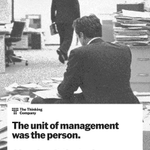
The unit of management was the person. SaaS made it the seat. AI makes it the task.
For a century, companies paid for their smartest people's best hours by buying all their hours. The analyst who cracks the pricing model on Tuesday morning spends the rest of the week in meetings and status updates. You can't hire another Tuesday morning; you hire the person.
With agents you can. A model holds your context and customer history, and you summon it one task at a time: routine work to a small model, the hard problem to a frontier model.
That turns a hiring plan into a capital allocation plan. Intern, PhD, small model, frontier model, decided task by task.
Most companies can't make those decisions yet. They know their salary bands and meeting cadence. Almost none knows which tasks consume the intelligence they pay for.

Bartek Pucek retweeted

Everyone who over-hired or lowered the bar too much in the 2021-2023 wave, or isn’t growing as fast as budgeted, now pretends they’re laying people off “due to AI productivity.”
Bartek Pucek retweeted

One of the cleanest and most beautiful European cities I’ve been to. The energy is electric here. ⚡️ – at Warsaw, Poland

Two Poles and a bet that voice could change everything.
The @ElevenLabs butterfly effect will be seen for years.
The homecoming.


