Creators of the Technology that Underpins the Constant Product AMM 💬 https://xitter.cf/t.co/XpZ73UshzP • https://xitter.cf/t.co/2rJjzM5qRx
Joined January 2017
- Tweets8.9K
- Following52
- Followers145K
- Likes15.3K







Checking the price during dinner. Before bed. First thing in the morning.
If you already know where you want to buy or sell, why are you waiting to do it manually?
On @CarbonDeFixyz, you program your trade in advance. Your order remains live with no expiry, and completed fills don’t reverse when the market does.
You don't need to be present when the market reaches your price, and you don't need to withdraw as soon as your order fills.

Need to adjust your trading strategy?
On most DEXs, that means canceling your position and starting over.
On @CarbonDeFixyz, you edit it in place.

ALT Five Carbon DeFi strategy types: Limit Order, Range Order, Recurring Order, Concentrated Liquidity, and Full Range Liquidity. All are adjustable without canceling and recreating your position.
Removing the need to monitor every price movement doesn't mean giving up control over your trades.
On @CarbonDeFixyz, the maker remains in control, even when they're not watching.
They define the prices, ranges, budgets and spreads in advance.
The strategy executes according to those instructions and can be adjusted or paused onchain at any time.

The price of a limit order should be the execution price, not a preference or a suggestion.
Yet many onchain limit orders ask the user to define both a desired price and a minimum acceptable amount.
A Limit Order on @CarbonDeFixyz is an executable onchain offer at the maker’s exact price.
Full fills execute at that price.
Partial fills execute at that price.
Every unit filled executes at the rate defined by the maker.

You place a buy order, wait for it to fill, take those funds and place a sell order. When that fills, you start again.
Recurring strategies on @CarbonDeFixyz run that loop for you. You set your buy price. You set your sell price. These two orders are linked.
As the buy fills, those tokens go straight into the sell order. As the sell fills, the proceeds go back into the buy.
The two sides keep feeding each other, with no withdrawing, re-depositing or new orders to place.
Adjustable prices, budgets, and strategy types – all native to the protocol with zero third party dependencies.
Carbon DeFi's solver executes 200x faster than previously published arbitrage algorithms. Here's what that means for your strategies 👇
Every strategy on Carbon DeFi (limit, range, recurring, concentrated, full range) is broadcast to the entire blockchain the moment it goes live.
They're open and fillable by anyone: traders, bots, and Carbon DeFi's built-in solver, which runs continuously and pulls liquidity from all major DEXs on the same chain.
Built on Marginal Price Optimization, a new approach developed by Bancor, the solver runs pairwise, triangular and multi-hop arbitrage, adjusting to market conditions in real time.
The result: the solver helps efficiently fill orders and keep strategies actively trading, without relying on a single liquidity source or a handful of resolvers.
Building on @ethereum, @SeiNetwork, @Celo, @COTInetwork, or @TacBuild?
DM @here2DeFi to get your DEX integrated.
🥪❌ MEV bots can't sandwich you if it's impossible to backrun you.
Every sandwich attack relies on three things:
⒈ Frontrunning your trade, buying before you.
⒉ Pushing the price up with its own trade right before yours executes, so you buy at a worse price.
⒊ The bot selling its tokens back to the pool at that inflated price.
On a standard AMM:
The liquidity pool is symmetrical and bidirectional, meaning the same curve that sells tokens to the front-runner buys them back a moment later, after your trade has pushed the price up.
The bot buys low - pushing the price up, forcing you to buy high - then sells high, keeping the difference.
This is impossible to perform on @CarbonDeFixyz.
👉 Asymmetric liquidity: each strategy has a separate buy curve and sell curve, set by the maker at distinct price ranges.
👉 Unidirectional curves: each curve trades in one direction only. A sell curve sells. It doesn't automatically reverse and buy back.
👉 No profitable sell-back: tokens a bot buys from a maker's sell curve can't be dumped back into that curve at the inflated price.
The only buyer is the maker's buy curve, at the lower price the maker chose.
A bot can still try the front-run, but the back-run doesn't pay. And a sandwich without its second leg is just an expensive trade.
#MEV #sorrynotsorrybots

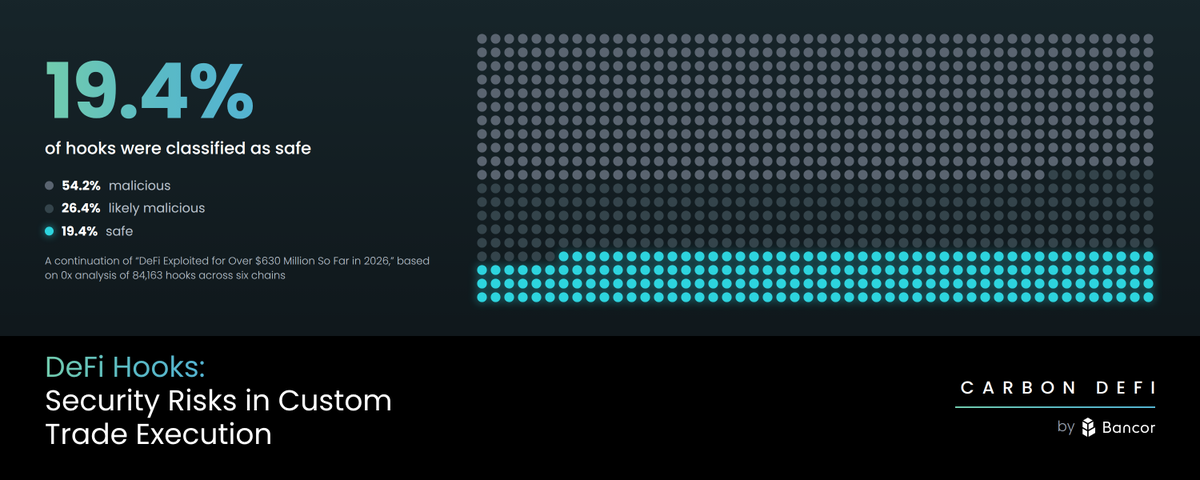
.@0xProject analyzed 84,163 hooks across six chains.
Only 19.4% were classified as safe.
This article examines how malicious hooks alter execution – and whether that functionality needs an external dependency at all.
See your token trading against chainwide liquidity in just a few steps.
Create a permissionless market on @CarbonDeFixyz:
1. Paste your token’s contract address & choose a pair
2. Select your strategy:
Limit
→ Available to trade at a single price
Range
→ Available to trade within custom price parameters
Recurring Orders
→ Non-overlapping orders, linked together.
→ One order strictly sells.
→ The opposite order strictly buys.
→ As one order fills, tokens acquired automatically fund the opposite linked order.
Full Range or Concentrated Liquidity
→ Provide liquidity across the full price range or a custom range.
3. Set your price
4. Fund your position and go live
All positions are customizable, with adjustable prices, budgets, and strategy types.
Live on Ethereum, Sei, Celo, COTI, and TAC.
DM @Here2DeFi for more information.

Centralized exchanges are often treated as the benchmark for what DeFi should become.
But onchain markets can offer capabilities that go beyond copying a CEX orderbook.
On @CarbonDeFixyz, makers define separate buy and sell prices and ranges, with a custom spread.
With a Recurring strategy, buy and sell orders are linked together. The tokens acquired through each fill automatically fund the opposite side, continuing the strategy without placing new orders after every trade.
All with no maker fees – no matter how many times your strategy trades.
Bancor Project Lead Dr. Mark Richardson (@MBRichardson87) challenges the idea that "DeFi can't hold a candle to traditional centralized exchanges."
Concentrated Liquidity: 0.28% ROI.
Recurring Orders: 33.61% ROI.
The market can move through the same prices and leave you with very different results.
Same pair. Same historical period. Different setups.
This backtest shows what changes when you separate your buy and sell ranges using Recurring Orders, exclusively on @CarbonDeFixyz.
Watch the walkthrough. Read the full comparison below.
👇

What helps keep DEX prices aligned on new blockchains?
The Arb Fast Lane executes arbitrage across major DEXs chainwide, turning price discrepancies into onchain trades that consume gas, help fill Carbon orders and bring prices back into alignment.
@CarbonDeFixyz gives makers more ways to participate: custom markets, exact-price limit orders, one-directional range orders and automated recurring buy and sell orders – all with immunity to MEV sandwich attacks.
Bancor provides the infrastructure for both.
Building an EVM chain? Let’s connect. Reach out to @Here2DeFi.
Bancor retweeted

You're Invited! Join us this Weds Septs 30th for another incredible Spaces!
Join the discussion with these OG Projects, as we dive into Rewriting the Rules of DeFi.
Speakers: @QuickswapDEX, @zksync, @Bancor, @auroraisnear
and @1inch
See you there!

If a position can trade back in the opposite direction without you first withdrawing, you’re not placing an order.
You’re actively managing a reversible liquidity position to approximate one.
A Range Order on @CarbonDeFixyz is one-directional by design.
The maker chooses the token pair, budget and price range. As the order fills, acquired tokens are not automatically offered back to the market if the price reverses.
No monitoring the market for the right moment to withdraw.
No separate action required to prevent the position from trading back.
See the full comparison 👇

What a leading market maker says token projects should understand:
→ What market makers actually do.
→ What they look for.
→ What centralized exchanges expect.
→ Why your market may need to start onchain.
For most of DeFi’s history, becoming your own market maker meant depositing two tokens into a standard liquidity pool.
The protocol determined how that liquidity traded, not you. Buying and selling followed the same pricing curve, with liquidity distributed across the entire price range.
Then came concentrated liquidity. It allowed makers to choose a narrower range, but it didn’t allow for independent buy and sell instructions. Buying and selling still occurred within the same range. If the market moved outside it, you – or an external manager – had to reposition the funds to keep the liquidity active.
Then Bancor introduced a different model with @CarbonDeFixyz: Asymmetric Liquidity.
Instead of using one shared curve for both directions, Carbon uses two independently configurable curves, one for buying and one for selling. Each curve is funded with one token and executes in one direction.
The maker defines separate prices, ranges and budgets for each side, including the spread between them. When the two orders are linked in a Recurring Strategy, tokens acquired through one automatically fund the other.
Buying and selling are no longer determined by the same range. The maker defines how each side of the market behaves.
Adjust the strategy onchain as the market changes – without rebuilding it or relying on a keeper or hook to maintain its behavior.
You no longer have to outsource the creation or ongoing management of your market. Set the prices, provide the liquidity and make the market yourself – all through functionality built natively into the protocol.
A trading strategy is only as reliable as every system it relies on to function.
If it depends on an oracle, the data must remain accurate and free from manipulation.
If it depends on a keeper, the keeper must remain operational, correctly detect when an action is required and successfully submit the transaction – without being exploited or creating a privileged execution path that an attacker can exploit.
If it depends on a hook, the externally deployed contract must not be malicious and its code must behave as expected every time the order trades.
Each third-party dependency introduces another point of failure.
On @CarbonDeFixyz, all five strategy types and their functionality are native to the protocol.
☑️ The maker defines the prices, ranges, budgets and direction.
☑️ Orders remain one-directional.
☑️ Recurring Orders automatically rotate proceeds between linked buy and sell orders.
☑️ Concentrated Liquidity automatically adds earned fees back into the position.
No oracle, keeper or hook is required to maintain those behaviors.
The maker defines the strategy. The protocol enforces it natively.

Arbitrage and sandwich attacks are both categorized as MEV, but they have fundamentally different effects: one improves market efficiency, while the other exploits user transactions.
Arbitrage responds to price discrepancies that already exist. It brings prices across markets back into alignment.
A sandwich attack creates an artificial price movement around another user’s transaction, forcing them into a worse execution.
Bancor’s infrastructure treats them accordingly.
@CarbonDeFixyz's one-directional orders are immune to sandwich attacks by design.
The Arb Fast Lane searches for arbitrage opportunities across Carbon DeFi and all major DEXs on a network to help fill orders, keep strategies actively trading, and maintain price alignment across the chain.
One manufactures market inefficiencies.
The other corrects them.