

Conversations that may change the way you see the universe. https://xitter.cf/t.co/3QEA2vadpX
Delhi/Noida
Joined December 2021
- Tweets11.8K
- Following743
- Followers916
- Likes16.9K




“I told him that while I was prepared to work with the head of the department, I did not find his works very appealing.”
That is Amal Kumar Raychaudhuri, in his own diary, on what he said to Meghnad Saha.
Saha was the Director of IACS in Calcutta, one of the giants of Indian science. Raychaudhuri was a young researcher, and his job letter said he must “work on problems to be suggested by the Director and the Head of the Department.”
Saha could not see the use of relativity. And this is the same Saha who, in 1920, translated Einstein’s relativity papers into English with S. N. Bose.
Sunil Mukhi has some sympathy for Saha. India was six years old and needed science that fed people. But Raychaudhuri’s note on metals barely got cited. The cosmology paper he worked on alongside it, received in December 1953 and published in 1955, gave us the Raychaudhuri equation.
“We can’t do it under some kind of instruction and order from above.”
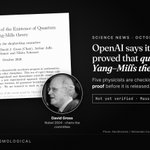
OpenAI says its AI has proved that quantum Yang–Mills theory exists. 1,147 pages.
No one outside has seen it. A committee chaired by David Gross will check it first.
kitp.ucsb.edu/sites/default/…

Raghu Mahajan, back in June: quantum gravity isn’t the right target for AI yet. Maths problems are well-defined and checkable. In quantum gravity, the concepts themselves are still evolving.
TheoPhysEval this month fits his picture. Agents solved 49 of 50 unpublished physics problems, and the authors still point to “the current lack of agent-led breakthroughs in theoretical physics.”
Maybe the bottleneck in quantum gravity was never solving the problem. It’s knowing what the problem is.
Dyson wrote that some mathematicians are birds and others are frogs. He called himself a frog, yet unifying Feynman and Schwinger's QED was pure bird work.
I wonder about today. Models now fly over every field in seconds, but someone still has to sit in the mud and understand why one thing works.
Maybe the best people now are frogs who learned to fly.
7
304
.@curiouswavefn on why we shouldn't make every scientist think the same way:
Some scientists are extremely rational, extremely methodical. They do everything step by step.
Others are very intuitive. They just jump a few steps ahead.
Feynman was like that. A lot of the time he would jump ahead and calculate something, and even he didn't really know how he'd arrived at the result. Then he'd fill in the steps backwards.
If we don't respect this diversity, we risk losing a lot of good discoveries, because we're trying to fit every scientist into one kind of thinking.
The same goes for fields. Don't say everyone needs to work on AI. Or physics. Or biology. Scientists should be free to work on whatever they want. That's how great discoveries are made.
What strikes me is that his second point is the first one at a bigger scale. Push everyone into one field and you've pushed them into one way of thinking.
In 2015, the Cabinet approved the India-based Neutrino Observatory (INO) in Theni, Tamil Nadu. It was meant to sit under about 1,200 m of rock, precisely to shield it from radiation.
Today, it still hasn’t been built.
I asked @thebdasgupta why. He told me the scientists held outreach sessions in Tamil and the local language. Even so, many people believed the lab would release radiation, when it was designed to keep radiation out. As he sees it, it was mainly a communication gap that couldn’t be closed in time.
What if two points in space, separated today, could become the same point tomorrow?
That’s the strange beauty of space-time.
As Sunil Mukhi explains, Raychaudhuri’s equation is essentially Einstein’s equations rewritten to describe how space-time evolves.
5
101
I asked @curiouswavefn simple question: if everyone had to read just one book right now, which one?
His answer? A book about the atomic bomb.
A bomb book. For the age of AI. Sounds odd, na? Wait till he explains.
Richard Rhodes wrote it in 1986, and it won the Pulitzer in 1988. On paper, it's the story of the Manhattan Project. But Ash reads it as a guide for every moment when a powerful new technology suddenly lands in our hands, and we have to figure out two things at once: how to use it for good, and how to stop it from doing harm.
And how did people handle it back then? In Ash's words: "They did not react the right way. They set off an arms race." By 1986, the world had about 70,300 nuclear warheads.
"I think it applies to any age when a new and sudden technology confronts you."
— Ash Jogalekar, on The Making of the Atomic Bomb
Ayushphy Cosmological retweeted
One year ago, LLMs couldn't do graduate level physics calculations. now they can.
But Suvrat Raju draws a sharp line: being fast at processing information isn't the same as having vision.
Breakthroughs in theoretical physics come from compression and conceptual reframing, not from crunching more data. Right now LLMs are great research assistants pulling up a calculation from "some textbook somewhere" in seconds instead of days.
Whether they ever get to the conceptual leaps, the actual new ideas, nobody knows yet. could saturate. could not.
Problem-solving abilities are only one of the skills that theoretical physicists require. The main aim of the field is to construct theories of the physical world.
Second, it is necessary to ask the “right” high-level questions of the theory. Third, it is necessary to convert these questions into concrete calculations. Therefore, it is only at a late stage in the scientific process that one is faced with a concrete calculation with a verifiable answer.


Kolar, INO, and why India needs big experiments
In 1965, a TIFR-led team caught neutrinos made in Earth's own atmosphere, 2.3 km down the Kolar Gold Fields. It was one of the first two detections of atmospheric neutrinos anywhere in the world. A team in a South African mine got there the same summer.
Sixty-one years later, India has no large neutrino detector.
I asked Prof. Basudeb Dasgupta of TIFR Mumbai @thebdasgupta what the India-based Neutrino Observatory, INO, was meant to find.
𝗪𝗵𝗮𝘁 𝗜𝗡𝗢 𝘄𝗮𝘀 𝗳𝗼𝗿
Cosmic rays hit the top of our atmosphere all the time. The particle showers they set off make neutrinos, called atmospheric neutrinos. They rain down from every direction and pass straight through the Earth as if it were not there.
INO was designed to catch them in a cavern under a mountain. Rock blocks almost everything else, but not neutrinos.
𝗧𝗵𝗲 𝗾𝘂𝗲𝘀𝘁𝗶𝗼𝗻 𝗶𝘁 𝘄𝗼𝘂𝗹𝗱 𝗵𝗮𝘃𝗲 𝗮𝗻𝘀𝘄𝗲𝗿𝗲𝗱
Neutrinos come in three mass states. Experiments have measured the gaps between those masses, but not their order. Either two are light and one is heavy ("normal ordering"), or one is light and two are heavy ("inverted ordering").
As Basu puts it: both are theoretically possible, but nature will choose one. INO would have helped us find out which.
It is not a trivia question. The ordering changes:
• what searches for neutrinoless double-beta decay should expect (is the neutrino its own antiparticle?)
• what the neutrino burst from an exploding star should look like in our detectors
• how small the total mass of neutrinos is allowed to be
𝗪𝗵𝗮𝘁 𝗵𝗮𝗽𝗽𝗲𝗻𝗲𝗱 𝘁𝗼 𝗜𝗡𝗢
• 2010–11: the site moves to the Bodi West Hills in Theni, Tamil Nadu. Forest clearance comes in October 2010, environmental clearance in June 2011.
• Jan 2015: the Union Cabinet approves INO at about ₹1,583 crore. The plan is a 50,000-tonne magnetised iron detector under more than a kilometre of rock. Its magnet could tell neutrinos from antineutrinos.
• 2015: the clearance is challenged at the National Green Tribunal, and the Madras High Court's Madurai bench rules that no work can start until the Tamil Nadu Pollution Control Board consents.
• 2017–18: the tribunal suspends the clearance; a fresh one is granted in March 2018 and the tribunal upholds it. The fight moves to the Supreme Court.
• 2022: Tamil Nadu tells the Supreme Court it will not allow construction, because the site sits in the Mathikettan–Periyar tiger corridor.
• 2026: still not built. INO's 85-tonne prototype, mini-ICAL, was switched on in Madurai in 2018.
Meanwhile, China's JUNO broke ground the same month INO was approved, and it has been taking data since August 2025. It is a different kind of detector: it watches neutrinos from nuclear reactors in a tank of liquid scintillator. But it is chasing the same question.
𝗧𝗵𝗲 𝗳𝘂𝗹𝗹 𝗰𝗹𝗮𝘀𝘀
This one is not a regular podcast episode. It is a class, in Hindi. Basu explains neutrinos from zero, and I ask the questions people are too shy to ask in a classroom:
• Why physics needed the neutrino in the first place
• How a particle "impossible to catch" was caught
• A one-cubic-kilometre telescope in the South Pole ice: IceCube, which won Francis Halzen this year's Nobel Prize in Physics
• Kolar, INO, and why India needs big experiments
Basu is a theoretical physicist at TIFR who works on neutrinos from exploding stars and on dark matter. He won the Shanti Swarup Bhatnagar Prize in 2022.
Images: NASA; ESO/H.H. Heyer (CC BY 4.0).
People keep arguing about whether AI does science, and most of the argument is about the word “science” itself. The more useful question is what “discovery” means.
@curiouswavefn points to a distinction most people skip. When you look back at Planck’s quantum hypothesis, or Watson and Crick’s DNA structure, it looks like a neat fit of ideas to data. But he says that picture is misleading. Those scientists weren’t short of data. The hard part was deciding which data mattered and which to ignore. That’s the step that looks simple only in hindsight.
His point about AI: language models can read the entire internet, every textbook and paper, and still don’t reliably know which pieces of it matter.
Choosing what to fit is still the hard part.
Ayushphy Cosmological retweeted

The Nobel Prize in physics goes to Francis Halzen for contributions to the IceCube experiment and the discovery of astrophysical neutrinos
You can learn more about the IceCube experiment here: @uw_icecube

BREAKING NEWS
The Royal Swedish Academy of Sciences has decided to award the 2026 #NobelPrize in Physics to Francis Halzen “for decisive contributions to the IceCube Neutrino Observatory and the discovery of high-energy neutrinos of astrophysical origin.”

"The value of critical thinking is always going to stay constant."
Kids in SF already know what's coming. Kids in a village in India don't. What are we supposed to teach them?
@curiouswavefn has a view on this:
If every book after 2022 might have had a model involved in writing it, does that change what you should be reading?
@curiouswavefn thinks it does: