

Frameworks, frictions, and field notes at the intersection of institutional real estate, capital markets, and the weird things that humans do.
Los Angeles, CA
Joined May 2012
- Tweets4K
- Following1.6K
- Followers1.8K
- Likes4.1K






My take on whether you should ask for that 5% acquisition fee. Happy to be told I'm wrong if you disagree.
avikm.substack.com/p/the-imp…


Now this makes sense to me - why let CRE PE jokers pick up the value creation vs. keeping it for yourself: Publix Expands Shopping Center Ownership Strategy to 550 Properties
Publix paid $83.25M for Air Park Plaza near Miami International Airport and acquired Shops at Quail Roost, bringing its owned portfolio to 550 properties (40% of its 1,400+ stores). The grocer generated $322M in lease income last year, up from $253M in 2023, by owning entire shopping centers rather than just store locations. This contrasts with Kroger's individual-store ownership and H-E-B's develop-only approach.
H/t Trepp

And so it begins? “Oracle reportedly issued a “force majeure” notice about Project Jupiter, a data-centre being built for it in New Mexico, citing potential problems securing power. The American tech company hopes to delay payment if the project does not come online in 2028, as planned. The decision reverberated around the market for AI-infrastructure financing—Oracle has bet big on a pivot from software to data centres.” H/t Economist
US manufacturing... "Apollo estimates that restoring the combined US manufacturing and defense capital stock to its share of GDP in the 2000s would require approximately $2 trillion of incremental investment. Returning to the levels seen in the 1980s would require roughly $6.5 trillion."


Brutal take on Portland by CBRE:
Portland has 56 million square feet of office but needs perhaps 18 million. Multnomah County's 3.8% income tax on earners above $250K has driven 2,000+ high earners out. The suburbs (Hillsboro, Beaverton, Happy Valley) are flourishing thanks to median home prices around $550-560K vs. $940K in Puget Sound.
H/t CBRE Weekly Pod
Interesting data/framing being put out by CBRE - not sure if it is right though… A potential shift to zero or very low immigration would be negative for real estate, especially inner cities, since 45% of US population growth in recent decades came from legal immigration; and 20% of the current population are first-generation immigrants whose geographic and housing preferences shape markets.
H/t CBRE Weekly Pod
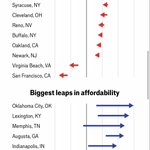
CBRE stating San Francisco and San Jose flipped from the worst US multifamily markets in 2020-2024 to the number one rental growth markets today, driven by the AI jobs boom. They believe the extreme volatility is due to both demand-side swings and California's constrained supply side, which makes standard error much higher than other metros. The difficulty of building amplifies every cycle.
All I know is that the SF multi trade is no different than every other real estate momentum trade; it is the same every cycle - massive boom, then massive bust...
Gwynne Shotwell on the All-in Pod made the case for data centers in space: free real estate, deep-space radiative cooling, and constant solar exposure without day-night cycles. She noted ground-based data center costs have exploded: land prices jump from $3K to $180K per acre once announced; and permitting timelines are years long. SpaceX plans to launch AI compute satellites next year alongside V3 Starlink broadband and next-gen mobile satellites.
So let’s assume for a second that she is wrong and it takes 3-5 years for them to launch these “AI compute satellites”… doesn’t that mean the 6.0-8.0% ROC deals that all the big boys like KKR, BX etc. are funding are functionally obsolete with little to no residual value even before these new terrestrial data centers get built?
Data Centers as Rural Economic Engines
Nadella on the All-in Pod cited 20-year data from Microsoft's Quincy, Washington data center: tax revenues up 12x, local taxes down by a third, 1,200 sustained construction jobs, a new school, hospital, and town center.
Trickle down AI economics:
1. Meta launched a five-week fast-track training program for data center jobs (fiber technicians, welders, electricians) that pays trainees full wages during training and guarantees a job upon graduation. 40,000 Americans applied, 250 have graduated with 90% retention. The program addresses a gap of 500,000 open skilled-trade jobs, with welders earning $100-120K annually in markets like Pittsburgh.
2. Google's Ruth Porat is building a cross-industry workforce alliance that Meta and BlackRock have joined. GM's Mary Barra has requested 1,000 trained workers. The initiative reflects industry consensus that companies should compete on models and products but collaborate on workforce development, with training credentials portable across any company's data center sites.
H/t All-in Pod


"A blazer says I tried. A hoodie says I didn't," he told Business Insider. "The quarter-zip somehow says, 'I didn't try and still look better than you,'…” 😂
businessinsider.com/quarter-…


Avik M retweeted

Robotaxis won’t just kill short haul flights. Once you can sleep in them, they’ll cannibalize long routes too.
Imagine getting into your Tesla in Austin at 10 PM, make the lie flat seat/bed comfortable, and going to sleep.
While you sleep, the car drives, charges itself, and keeps going.
You wake up at 9 AM in Aspen, refreshed.
The key is perceived travel time.
A 10-hour robotaxi trip where you sleep for 8 hours may feel shorter than a 3-hour flight that requires an Uber to the airport, arriving early, security, boarding, the flight, baggage claim, and another Uber.
Autonomous cars won’t just compete with driving.
They turn sleep into transportation.

Avik M retweeted

A dead car is worth $500 at the scrapyard. A dead boat is worth negative $10,000. That single number explains the abandoned fleet in Marina del Rey better than anything about the economy.
Fiberglass is a resin-and-glass composite that can't be melted down like aluminum or steel. Separating the materials costs more than they're worth, so there is no scrap market for hulls. Disposal estimates in Europe run about $1,000 per meter of boat, which means scrapping a 35-footer costs more than most 35-footers sell for.
Now add slip fees. A slip in Marina del Rey runs $600 to $2,000 a month. Once a boat needs more in repairs than it would fetch, the owner is paying rent on an asset worth less than nothing, with a five-figure exit fee waiting at the end. Walking away stops the bleeding the same day.
And the wave is just starting. The fiberglass boating boom ran through the 1970s and 80s, and those hulls are all crossing 40 years old at once. The US retired 1.5 million recreational boats between 2003 and 2012. One industry study found 54% of end-of-life boats simply get abandoned.
The county side compounds it. LA's vessel disposal program lost half its grant funding, and only one vendor is authorized to haul boats out of Marina del Rey. So impounded hulls sit rafted together in the water, queued behind a single contractor.
France saw this coming and put an eco-tax on every new boat sold since 2018 to fund scrapping the old ones, because the last owner of a fiberglass boat always walks.
Fiberglass built the middle-class boating dream because it never rots. Nobody priced in that it also never dies.

