





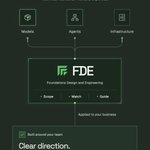


It's becoming increasingly apparent that getting meaningful value out of AI in the form of agents is a high-agency and high-IQ task. I'm sure as things mature it'll get easier, but I just don't think that the AI gap is going to meaningfully shrink via more exposure and awareness. It's not that people haven't seen the latest generation of AI, it's more that they're just too dumb to be effective with more than a chatbot or copilot... and frankly I don't think they ever will be.
AI will be a tool for some and a babysitter for others.
aviel retweeted

I've managed fully remote engineering teams for ~7 years, from small teams to rapidly growing orgs spanning 10+ countries.
I've developed some pretty strong opinions about what makes remote work actually work:
1. YOU MUST GET "THE TEAM" TOGETHER ONCE A QUARTER, NO EXCEPTIONS. The faster the team/company is growing, the more critical this is. If you follow no other piece of advice follow this one. Remote work is built on a foundation of trust which for most humans can only be built in person. Think about a person you know well who has extremely dry humor. Would you be able to detect that characteristic if you met them for the first time over SMS or slack? Bonds are built over dinner, a beer, an in person hackathon. And those bonds carry forward to the rest of the time spent remote. **for some definition of "the team" - can be a mix of immediate team, org, company-wide, all are useful at different cadences.
2. Managers must be pros and must be highly technical. Many non-technical managers rely on lazy half-ass signals like "who left the office last". As a remote manager you literally have no option other than to inspect the concrete outputs to understand what is going on. This tip is also very useful to non-remote teams 🙂
3. No juniors except for exception cases. Exceptional cases are obviously exceptional. Gotta build the muscle before you play on hard mode - for mere mortals at least. Don't expect someone to learn "how to remote" and "how to engineer" simultaneously. It is too much.
4. Establish a physical center of gravity, ideally 20-30% of staff. Company can still be fully remote and have "an office" where company events are held, some fraction of local employees cowork once a week even if on different teams.
5. Regardless of critical mass, all meetings must be remote first. None of this conference room with 10 people dialing into a zoom meeting with 3 other people nonsense. 100ms latency of conversation is real and you are at a disadvantage if you are trying to interject remotely into a room of in person attendees.
6. Hire managers into the critical mass (or who are willing to travel a lot). There will be lots of good reasons for the manager to make their way in on occasion (once a week, twice a month) to the home of critical mass for one reason or another
7. Onboard senior hires and leaders in person. I have seen new leaders, ICs, managers, design/pm/marketing leaders crash and burn over lack of building good relationships in the first 3 months. If you're bringing on a new leader for god's sake make sure they spend a few days in person with the other leaders they have to collaborate with.
8. Hire within a deliberate, manageable timezone range!!! This becomes more important the more varied the experience level is within your team. Is it possible with absolute engineering pros and remote veterans? Yes! But you need to ask yourself if your team is ready to coordinate work across Australia, UK, NYC, SF, Japan, and India timezones. Think hard about this one. My team is US west coast through Czech Republic. Teammates spanning every part of the US, Brazil, UK, Portugal, Denmark, and more.
8.a. Have a clearly established schedule for "time the whole team must be online". For us this is 8:30 - 10:00am Pacific, but many Europeans choose to work shifted schedules to have more overlap with their peers. I advertise this upfront in every hiring manager screen. Make expectations clear and let people decide. We're all adults and we're more likely to commit and make things work when we make a decision with complete information.
9. Onsite time is precious. Don't waste it on ordinary meetings. Use it for strategic conversations, solving hard problems together, hackathons, and high-bandwidth planning. This is where you build the relationships that make the next three months of remote work successful. For fuck's sake please do not fill a week making people stare at a projector while you read powerpoints!!!
Take the advice or don't.

Could we like, listen to our competent and ambitious young though?

From the high schools of France to the streets of Madrid to the universities of Tirana, young people are telling their governments the same thing: in an age of massive wealth inequality, they want a future they can believe in.
In France, students and teachers are asking for safe schools, enough teachers and smaller classes.
In Spain, for affordable rent and housing.
In Albania, for good jobs and an end to corruption.
@JDVance says this is what happens when a nation lets in too many immigrants from the global south.
He is not just morally wrong, but misreading the moment.
The is what happens when nations let wealth and power accumulate in the hands of a few.
This is what happens when young people lose hope in their future.
In America, let us listen to our young.
We need an economic and political transformation.
America's Next New Deal.

aviel retweeted

My first startup internship was in Palo Alto around 2009. The financial crisis had just wiped out the jobs many of my classmates expected to have. Banking and consulting offers were being rescinded. Some of us found our way into startups because we needed a job -- any job. Others passed up Google because they wanted to work on something they believed should exist.
It would be easy to romanticize this. People wanted to make money then, too. But joining a startup wasn’t an especially reliable way to impress anyone. You usually had to explain what the company did, and sometimes why you'd joined it.
Someone asked me why I joined Stripe when it was small. You could already accept credit cards online. What was new or innovative about that? It was a reasonable question. The opportunity seemed obvious to the people working on it, but it wasn’t obvious to everyone else. That gap was part of the appeal. You could see something worth building before there was much social reward for seeing it.
In the early 2010s, teams like Pinterest and Stripe were still in Palo Alto. As Palantir took over more of downtown and space became harder to find, those teams chose to move to SF instead of further south to Mountain View or San Jose. We were in our early 20s. Of course we wanted to live in the city.
Over time, friends who'd gone into banking and consulting moved into tech too. Tech companies had become THE companies. SF became an industry town, and a career that once required some explanation became the obvious choice.
The odd thing about startups becoming prestigious is that they attract people who would never have joined one before they were prestigious. The ambition is still there, but more of it goes toward looking successful before you’ve made anything work.
You can see it in founders creating videos holding an influencer mic, or in a room where working at OpenAI is more interesting than starting something nobody has heard of. The famous company gives people a shortcut... they can be impressed without having to form an opinion of their own.
That’s what I miss. There was a time when joining a startup meant being willing to look unsuccessful for a while.

There is a relief in an explosion. I think that we’re more adapted as a species to change than prolonged tension. We’re gonna speed run so much in the next couple of years. Everywhere and in everything. The worst thing for us is for the world to look like today 5 years from now.


aviel retweeted

The most concerning thing to me about events like this is that the entire reaction is about fitting it into the discourse and I think we lose the sheer horror of it because of that
Hitler could not knock this building down and now we see it fall


Nearly figuring out consciousness just in time for Anthropic’s IPO. Top notch writing this season.

1/ We discovered something totally unexpected about the neural structure of consciousness that overturns decades of thinking on its biological basis and brings us significantly closer to the recipe for generating conscious awareness.
New preprint: biorxiv.org/content/10.64898… (led by @HesseJanis, with @FrankLanfranchi, @_conor_mcgrory, @Yuelin_Shi, and @EngelTatiana)

aviel retweeted

1. It was unbelievable. You should go see it.
2. If this was your first Nathan experience and you liked it, you should go watch The Rehearsal Season 2. It has that same jaw-on-the-floor effect from continuously asking yourself, "Is there any length that he won't go to?"
I feel like this is not only right but also infringing on @AcquiredFM. @gilbert I know you were thinking this, can’t wait for your X god mode in the next few years.

Of course the flying Tesla Roadster is a gimmick but that sort of misses the point, the tech flex behind it isn't.
Tesla's bulk business is about advanced technology from EV to self drive, but decided to create the most ridiculous manual drive supercar. Supercars are a gimmick,almost by definition, based on how wild can you make them.
The gimmick that can make the car literally fly, briefly, can make it corner like no other supercar and accelerate, literally like a dragster on a test track. It's got nothing to do with flying continuously, but having a car that will outperform every Lambo, Ferrari or McLaren with technology that they cannot replicate because it requires experience from space launches and computation that they don't have now nor will in future.
So Porsche, Bugatti, Aston Martin just became legacy prestige brands, like Rolex, Richard Mille or Patek Philippe. These cars celebrate the bygone age and the baroque, physical complexity of the internal combustion engine just as mechanical watches do for non digital, complex time-keeping mechanisms. But hey won't be faster anymore than a mechanical watch keeps better time than a Casio. They are now, de facto, mobile jewelry and no longer supercars with superlative performance. And this affects their ability to market the bulk business of mainstream European internal combustion engine cars. It's the end of an era of industrial era manufacturing.
aviel retweeted

Mayor Lurie is bringing back so many things from the dead, I want him to do Buffy the Vampire Slayer next.

Nordstrom Rack will open next year at 2 Stockton Street, near Union Square! Three years ago, companies were leaving San Francisco. Today, they want to be here, and Nordstrom Rack’s decision to return to the heart of our city is another sign of the growing confidence in San Francisco. The 50,000 square foot Nordstrom Rack is just the latest example of retail coming back downtown.
We're making our streets safer and cleaner, bringing people back downtown, cutting red tape, and creating the conditions for businesses to succeed. I'm thrilled that Nordstrom is choosing to invest in San Francisco again, and look forward to welcoming Nordstrom Rack as we continue building on our city's momentum.
🤦♂️ we deserve this

$3.5 billion in a single quarter — that's the new record set in venture capital investment in the Seattle area. That's while funding declined nationally.
Washington state is proud to lead in these cutting-edge industries.
geekwire.com/2026/rocket-fue…

aviel retweeted

All this talk about speed as a moat gets it wrong.
The whole point of having a moat is that if you slow down execution you still win because others can’t break your moat.
One difference of Twitter and Facebook is both had network effects and won. But FB never slowed down.
