


A.U. Silver #commodities100% retweeted

$ASPI Mann celebrating the most recent deadline they couldn't keep.
@ASPIsotopes

A.U. Silver #commodities100% retweeted

Announcing a long-term agreement with @amazon that supports significant infrastructure improvements and new emissions-free generation at our Calvert Cliffs Clean Energy Center. More info ↙️
bit.ly/4hirv5S

ALT Image of the Calvert Cliffs Clean Energy Center by a body of water. The text on the image reads: 'Constellation and Amazon Announce 20-Year PPA, Adding 190 MW of Nuclear Capacity at Calvert Cliffs Clean Energy Center.' Constellation logo is visible in the top left corner.
A.U. Silver #commodities100% retweeted

Cameco (TSX: CCO; NYSE: CCJ) acknowledges that the United States of America and the Republic of Korea, under a previously entered Memorandum of Understanding, today announced a framework that anticipates the investment by Korea of US$120 billion to help finance the buildout of Westinghouse reactor technology in the US using expertise and companies from both nations. Read the full news release here. ow.ly/U0W950ZTg1j $CCO.TO $CCJ

A.U. Silver #commodities100% retweeted

The hyperscalers have bet big on reactors. Next they'll have to lock up the fuel, and the first one to move gets the last good price.
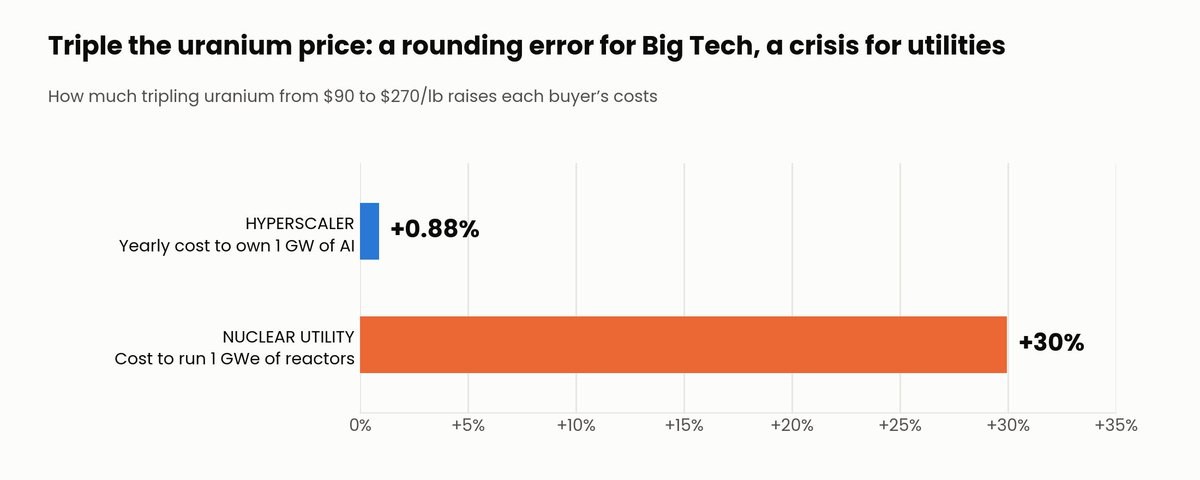
A.U. Silver #commodities100% retweeted

Gold Fields has expressed interest in acquiring Northern Star, a potential blockbuster deal bloomberg.com/news/articles/…

A.U. Silver #commodities100% retweeted

A significant milestone for Global Atomic! The DFC’s Board of Directors has approved a debt facility of up to US$414.2M for the Dasa Project in Niger. We thank the DFC, the Republic of Niger and our shareholders for their support. globalatomiccorp.com/investo…
A.U. Silver #commodities100% retweeted

🇺🇸 EQR to pursue United States listing
$EQRASX will seek to list on either NASDAQ or the NYSE, in addition to its ASX listing, during 2027.
The proposed listing remains subject to regulatory approvals, exchange eligibility and market conditions, with ASX to remain EQR’s primary listing.
With operations across Australia and Spain, EQR continues to build visibility with US investors, customers, partners and capital providers.
ASX: eqresources.com.au/site/show…
#EQR #Tungsten #CriticalMinerals #ASXNews #NASDAQ #NYSE #MiningNews #MiningStocks

A.U. Silver #commodities100% retweeted

Relax, these price declines are normal in bull markets. It's nothing to panic about. It repeats in history all the time and recovers exponentially.
This quoted post is unavailable.
A.U. Silver #commodities100% retweeted
@TheStockNet 's ASX Gems Investment Conference: Critical Minerals has live-streamed and here's our presentation highlighting how we’re generating shareholder value | Click here to view: youtube.com/watch?v=glNJxoWU…

A.U. Silver #commodities100% retweeted

On Tuesday, April 14, at the HSBC Global Investment Summit in Hong Kong, CEO Georges Elhedery said something on live Bloomberg television that should have detonated every energy desk on earth. It did not. Because nobody is reading what it actually means.
“The highest I’ve seen, and I’m hoping we don’t see more of that, but the highest I’ve seen is $286 for a barrel of oil that reached Sri Lanka.”
Two hundred and eighty-six dollars. For a single barrel. Delivered. While Brent futures closed at $95.61 on April 16 and CNBC’s chyron still shows “oil near $100.”
Read the transcript carefully. Elhedery laid out the arithmetic: Middle East crude is now $140 to $150 at origin. Red Sea rerouting adds $30 to $40 per barrel in shipping. Insurance has gone from 25 basis points to 5 percent, a twentyfold increase. War insurance has been scrapped entirely, meaning the 5 percent buys you no war coverage at all. Stack those numbers on top of Dated Brent physical at $131.97 on April 9, Oman crude at a record $152.58 in March, and Dubai crude at $157.66 in early April, and you arrive at a poor importing nation paying $286 to keep the lights on.
This is not an oil price spike. This is the death of benchmark pricing as the world has known it since 1988.
For 38 years, Brent and WTI futures have functioned as the nervous system of global oil. Every central bank inflation model, every airline fuel hedge, every sovereign budget in every importing nation, every Fed rate decision, anchors itself to these two numbers flickering on a Bloomberg terminal. The entire post-1973 architecture assumed that paper price and physical price converge within a narrow band, that arbitrage closes the gap, that the benchmark tells the truth.
On April 14, HSBC’s CEO told the world, in public, that the paper price is now off by nearly 200 percent from the physical price for the countries that can least afford the difference. A $95 Brent headline and a $286 delivered barrel are not the same commodity anymore. They are two different markets, and the poor are trading in the real one.
This is why Sri Lanka, which has no domestic production and imports 100 percent of its fuel, turned simultaneously to Russia, India, and China in the first weeks of April. President Dissanayake publicly thanked all three on April 8. India delivered 38,000 metric tonnes on March 28. Sinopec is running sustained shipments. Russia has formalized supply arrangements despite US sanctions. Colombo, a capital of 1.7 million people in a country still recovering from the 2022 sovereign default, has accidentally become the first live demonstration of what post-dollar, post-Brent, multipolar energy sourcing looks like in practice. Not in a think tank paper. In actual cargoes arriving at actual ports.
Every central bank pricing inflation off Brent is flying blind. Every airline hedged on WTI is mispriced. Every AI data center operator who modeled a 2030 power buildout on pre-war energy assumptions just watched the assumption disintegrate. Goldman’s 1,350 TWh data-center forecast assumed a world where a $95 Brent headline means $95 oil arriving at the meter. That world ended on February 28.
The $286 barrel did not reach Sri Lanka. Sri Lanka reached the future first. Everyone else is still reading yesterday’s screen.
Full Analysis - open.substack.com/pub/shanak…


Two oil markets now exist. The physical one and the financial one. They are pricing two different wars.
Oman crude just crossed $154 per barrel. Dubai sits at $130. Brent at $102. WTI at $93. The gap between the Gulf benchmark that reflects physical delivery through the war zone and the American benchmark that reflects paper contracts in Cushing, Oklahoma is $61 per barrel. Sixty-five percent. The widest divergence in the history of crude oil pricing.
That gap is the war expressed as a number.
Oman and Dubai price crude that loads in the Gulf, transits the strait, and delivers to Asian refineries. Those barrels are scarce, dangerous, uninsured, and physically gated by provincial commanders with radios. WTI prices crude that sits in American storage tanks connected by pipeline to refineries that have never heard a VHF radio hail from Bandar Abbas. The physical barrel is in a war zone. The paper barrel is in Oklahoma. The market is telling you these are no longer the same commodity.
While the benchmarks diverge, Israel struck northern Iran for the first time. The war is expanding geographically while Trump tells Israel to stop hitting energy infrastructure. Saudi Arabia reserved the right to military action against Iran. The United States is considering deploying thousands of additional troops. The escalation ladder has no ceiling and the de-escalation rhetoric has no floor.
The market’s response is schizophrenic and revealing.
Oil ETF shorts are surging. IEO short interest hit 2.8 percent, nearly a four-year high, tripled since the start of 2026. USO shorts increased by 3 million shares, up 50 percent in the last month. The financial market is betting that oil prices have peaked. Meanwhile the physical market just printed $154 for Oman crude. The shorts are betting against the paper price while the physical price screams.
US stocks dropped more than one percent across major indices with PPI hitting a 13-month high. The producer price index is the inflation measure that arrives at the factory gate before it reaches the consumer. PPI at 13-month highs tells you the Fed’s PCE revision to 2.7 percent is not the ceiling. It is the floor.
Retail investors are buying gold at a pace not seen in decades. Over $70 billion has flowed into gold ETFs since Q2 2025, tripling in the last six months. Silver ETFs absorbed $10 billion last year. Institutions are doing the opposite: selling $1 billion in gold and $200 million in silver. The retail investor who cannot access commodity futures or war-risk swaps is buying the oldest store of value on Earth. The institution that can hedge is rotating out. The divergence between retail conviction and institutional positioning is as wide as the Oman-WTI gap.
Crypto funds took in $1.06 billion last week. Bitcoin ETFs alone received $793 million. The digital asset class that was bleeding ahead of the Fed hold is now absorbing inflows from investors who see the same thing the gold buyers see: the financial system is being repriced by a physical chokepoint that monetary policy cannot reach.
Oman at $154. WTI at $93. Gold at $5,000. Bitcoin absorbing billions. Retail buying what institutions are selling. The physical market and the financial market are diverging at the fastest rate in history. And the farmer in Iowa, who lives in the WTI world but depends on molecules from the Oman world, is planting soybeans because the $61 gap just reached his seed catalogue.
open.substack.com/pub/shanak…


A.U. Silver #commodities100% retweeted

$EQR.AX is one of the most interesting plays I have seen this year. It was quite unknown but has been slowly getting more attention lately. Here is why I bought $EQR.AX:
Currently the tungsten price sits at approximately $3000/mtu. Last year, it was around $350/mtu, so the price has skyrised. This is mainly caused by China export controls and high demand from defense and AI/memory.
$EQR.AX looks very cheap despite the rally it has already had. With the tungsten price sitting at $3000/mtu, $EQR.AX could be looking at over 1.35bn AUD revenue for FY2027. Their break-even point is somewhere between $350-500/mtu, so the net margins on this revenue will be very high. Their net profit could end up above 1.1bn AUD for FY2027. The current market cap is 1.75bn AUD, so they could make well over half their current market cap in the coming fiscal year. The cheap valuation is staggering.
Compared to its peer in the tungsten industry, $ALM is 17x more expensive per tonne of tungsten production than $EQR.AX. $EQR.AX screams like a buy opportunity, with AI demand soaring and the US projected to increase its defense spending significantly in the coming year, which strengthens the already soaring demand for tungsten.

A.U. Silver #commodities100% retweeted

ASP Isotopes $ASPI nuclear fuels subsidiary Quantum Leap Energy (QLE) has appointed former TerraPower and Kairos Power engineer Nate Salpeter, Ph.D. to lead technology execution as Chief Technology Officer.
Key details:
• Deep technical operator: 15+ years building computational and experimental toolchains across advanced nuclear and thermal systems with an emphasis on repeatable engineering outcomes.
• Proven scale-up background: Early technical hire at both TerraPower and Kairos Power, where he helped establish fluid dynamics modeling capabilities aimed at improving design confidence and shortening iteration cycles.
• Commercialization focus: As CTO, Dr. Salpeter is optimizing QLE’s in-licensed and proprietary platforms, tightening feedback loops, and leading structured de-risking as programs move toward commercialization.
Full Release: redchip.news/3MI0Ov2
$ASPI $SMR $NNE $OKLO $UUUU $CEG $VST $CCJ $UEC $LEU $GEV $BEP
A.U. Silver #commodities100% retweeted

Nothing to see here.
Just tungsten hitting $3,000/mtu in Europe.
Unbelievable.
Got tungsten?

A.U. Silver #commodities100% retweeted

#Tungsten
$1,994 per MTU printing in China.
That is $199,400 per tonne of Ammonium Paratungstate.
In a 115,000 tonne market.
That makes it a global $23bn market.
On which all oil and gas, aerospace, automotive, and machinery tooling is based.
Tens of trillions of dollars of industry.
Any tungsten price is possible.

A.U. Silver #commodities100% retweeted

$BMN have signed a Strategic Financing with Leading Global Integrated Nuclear Utility, CNNC ⚛️ This attractive long-term development and operating joint venture delivers Etango construction funding, fully market-priced offtake arrangements and strategic partnership.
We look forward to working together towards transaction completion, followed by targeted FID and full-scale construction commencement of the Etango uranium mine.
Read the full announcement here: cdn-api.markitdigital.com/ap…

A.U. Silver #commodities100% retweeted

Ok, if I have my information right, The Shanghai Gold Exchange will be closed from February 15 to February 23, with no night trading on February 13 and resumption on February 24.
Leaving the price of Gold & Silver in the capable hands of the LBMA and Comex for that week.
I will just leave it at that, make tyour own assumption on what might happen.
Thoughts?

A.U. Silver #commodities100% retweeted

For the first time in recorded history, global data show zero gold discoveries in two consecutive years.
This has never occurred before.
And this is not unique to gold.
Major discoveries across most metals have fallen into the single digits, with no meaningful projects in the pipeline capable of materially altering the global supply curve.
This is the real barometer of where we are in the mining cycle.
Still early.

A.U. Silver #commodities100% retweeted

Before I go to bed tonight I will leave our silver fans with the news that spot silver is holding up well in Shanghai at $135 while global spot is down to $111. A $24 spread. Crazy times but as long as the China price is high, it means demand is strong. Hold your physical and the miners. Every silver miner is not priced for $100 silver.