

AI-centered fund management and organizational development. Learn more at https://xitter.cf/t.co/lbJKX6HDIj
USA
Joined September 2025
- Tweets90
- Following117
- Followers153
- Likes478




As we close Q3, September was a rocky month for the market.
The Fund returned +3.18% gross, +2.33% net.
Although the S&P 500 was broadly flat, -0.45%, volatility was not. VIX for the month was up 9.5%, the highest thus far for the 2nd half of the year. Notably, the Fed raised rates 25 bps, the first time since 2023, to combat higher inflation and oil prices. Bond yields soared. The 10 yr is still above 5% as we enter Oct, +64 bps in Sept alone. The 30 yr yield remains elevated in Oct at 5.67%, +34 bps for Sept.
Rate sensitive small caps were hit hardest, Russell 2000 was down 5.4%, the worst month of the year. March was -5.17% in comparison. The dollar strengthened 2%, inching closer to pre tariff 2025 levels.
Midterms are around the corner and oil remains elevated. Only two FOMC meetings left for the year, October and December. Both will be on our radar.

The FOMC voted unanimously to raise rates 25bp to 3.75%–4.00%, its first hike since 2023. The dot plot points to one more increase this year, to a median 4.1%, with four members projecting two.
Warsh acknowledged the Fed can't control oil prices but said it can keep those pressures from broadening into general inflation which is good for the most underserved Americans. He was also careful not to discuss any past or upcoming conversations with Trump, maintaining the Fed's neutral stance. Asked whether current rates influenced the Fed's decision, he affirmed that the Fed is independent.
$SPX fell nearly 50 pts, recovering slightly into the close.

August was a great month! The Fund returned +16.09% gross TWR and +12.81% net, with a maximum drawdown of 4.05%. The S&P 500 returned 2.6% over the same period.
August followed a flat July for the Fund, in a shaky summer that rattled markets as high-beta, AI-levered trades unwound. July was challenging for the broader market, and some residual effects carried into August. We actively managed the Fund through that transition, which set up a strong August.
This week will again test markets and managers as we await Warsh's rate decision at today's FOMC. That said, the forward curve already tells us where the market expects rates to sit. Rates today are well above the low-rate decade that followed the financial crisis. The 10yr nearly 5%, 2yr 4.6% while the 30yr sits at 5.3%.
All eyes on Warsh.

Jensen boldly claims AGI is here on today's $NVDA earnings call:
"agents working with other agents...
a lot of times we are recursive at this point...
skill document, the md is updated every time...
for many tasks we have already achieved AGI"
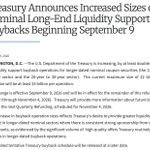
This morning, the US Treasury announced its buyback of long duration bonds in an effort to curtail yields hitting 5.3% on the 30 yr and 4.7% on 10 yr.
Current size $2b doubling to $4b
3 weeks ago, Treasury announced $5b - $10b Yen buying. Now this.
Bessent putting in the work.
Markets rallying off the news.
SPX +0.60%


Warsh's second Fed meeting rattled markets despite little new or meaningfully different stance from last month's July meeting.
While rates were held flat at 3.75%, as expected, and fed swaps are no longer pricing in a September hike, $SPX spiked +100 pts and then reversed 133 pts lower.
Fears in foreign markets, South Korea's $KOSPI collapsing 40% from its highs, coupled with ongoing tensions in Iran are creating headwinds across risk assets.
The yield curve steepened hard: 30yr yields climbed to 5.23%, a new 2026 high, while the 2yr eased to 4.26%. Ten year slightly higher 4.68%. The short end reflects near-term policy relief, but the long end signals inflation remains entrenched.
Jensen's first post makes a compelling argument for both open and closed frontier AI models.
We use closed frontier AI models. Imagine the alpha extraction if we could fine tune weights in open frontier models. Endless possibilities.
Greater talent and sharper edge.

For my first post, I’m sharing a letter @NVIDIA signed on why open models matter.
AI will transform every industry, power every company, and be built by every country.
Open models strengthen safety and cybersecurity, accelerate innovation and diffusion, and enable sovereignty.
The world needs both frontier closed models and frontier open models.
images.nvidia.com/pdf/Open-W…


Our agentic framework monitors risk daily-weekly, adjusting the book dynamically.
Some agents govern - define stress and regimes.
While others execute:
-dial hedges up/down
-neutralize long beta
-adjust exposures in sleeve(s) and across sleeves.
Always on. Long book stays hedged. A separate book runs active shorts.


Yesterday mid-day, the Auracle Engine detected a cluster of high-beta longs, well ahead of PPI.
Today, PPI came in softer than expected 4.7% YoY vs 5.1%.
The engine caught the trades. The agents did the rest.
That’s Auracle.

AuraPoint Capital Management retweeted

I get a lot of questions on sustainability on performance with a lot of our investors. Some of our investors are followers I’ve known for quite a while.
The main thing I want to point out is these results are the byproduct of systems that have been running on their own for years, continuously maintained as we strip out what stops working and cut or replace it with new research on a daily and monthly basis.
What you’re seeing here is a live snapshot of that ongoing research engine, not a one‑time spike, and the goal is to keep iterating so this level of performance stays achievable over the long run.

We hope everyone had a well rested 250th July 4th celebration. AuraPoint's June results are in and were sent to investor inboxes before the weekend. We had a strong month, delivering:
+13.64% gross TWR (June)
+10.96% net TWR (June)
during a month when the S&P Index was roughly flat to -1%. More detailed performance results are available upon request. Do not hesitate to reach out. We are actively raising capital and welcome prospective investors. Feel free to DM or reach out to ir@aurapointcapital.com. Follow our page to stay updated on the fund.

Risk guardrails and the multi manager structure
Multi strategy funds are built on the idea that no single trader should be able to significantly damage the firm. To achieve this they operate under a multi manager structure where each team runs its own strategy within strict risk limits set by a central risk group. These limits act as guardrails that control how much a team can lose before intervention occurs.
Strict risk limits and rapid intervention
Success in this model comes from enforcing discipline at the portfolio manager level. Each team is given capital along with clearly defined limits on drawdowns, position sizes, and exposures.
A typical setup includes:
-Daily and weekly loss limits that trigger automatic reductions in risk
-Real time monitoring of positions across all desks
-Central oversight that can cut or reallocate capital immediately
A real world example of success is a trading desk that experiences a string of losses due to a short term market shift. Instead of allowing the losses to compound the risk system forces the desk to reduce positions early. Capital is then reassigned to another desk that is performing well. The firm absorbs a small loss but avoids a large one.
The key to success is consistency. By cutting losses quickly and reallocating capital efficiently the firm maintains a stable return profile even when individual teams struggle.
Forced selling and feedback loops
The same risk systems that protect the firm can also create problems during periods of market stress. When many desks hit their limits at the same time the firm can become a forced seller across multiple asset classes.
Failure occurs when:
-Market volatility spikes and triggers loss limits across many teams simultaneously
-Positions must be unwound quickly regardless of price
-Selling pressure pushes prices lower which causes more desks to hit their limits
This creates a feedback loop where risk reduction leads to more losses instead of stabilizing the portfolio.
A real world scenario can occur during a sudden macro shock. If equity, credit, and rates desks all experience losses at once the firm may be forced to reduce exposure across the board. This broad selling can amplify market moves and lock in losses at unfavorable prices.
In the current environment markets are reacting quickly to economic data releases and shifts in rate expectations. Large moves can occur within minutes of new information entering the system.
For a multi strategy fund this means risk systems must be both fast and flexible. Managers today focus on:
-Monitoring intraday volatility rather than just end of day risk
-Stress testing portfolios against sudden moves in rates and equity indices
-Adjusting risk limits dynamically based on market conditions
For example if bond yields move sharply higher in a short period this can impact equity, credit, and currency desks at the same time. A firm with rigid limits may be forced to cut risk across all desks simultaneously. A more adaptive system may allow certain desks to maintain positions if their underlying thesis remains intact.
The core lesson is that risk control is essential but must be applied with context. Success comes from cutting losses before they become unmanageable while still allowing skilled teams to operate through normal volatility. Failure happens when risk systems become too rigid and turn temporary market stress into permanent losses.