Atul Kalhan (@atulkalhan) header
Atul Kalhan (@atulkalhan) profile picture

Consultant Endocrinologist, Visiting Professor University of South Wales (USW); Director USW Post Grad Diploma & MSc Endocrine course; Eternal learner

Joined March 2010
Photo by Atul Kalhan (@atulkalhan)Photo by Atul Kalhan (@atulkalhan)Photo by Atul Kalhan (@atulkalhan)Photo by Atul Kalhan (@atulkalhan)Photo by Atul Kalhan (@atulkalhan)Photo by Atul Kalhan (@atulkalhan)Photo by Atul Kalhan (@atulkalhan)Photo by Atul Kalhan (@atulkalhan)Photo by Atul Kalhan (@atulkalhan)Photo by Atul Kalhan (@atulkalhan)
An expert commentary explores the findings of the GRASS trial - a randomized, double-blind, placebo-controlled, multicenter study evaluating selenium's impact on remission rates and quality of life in patients with Graves’ disease. Read the research: doi.org/10.1530/ETJ-26-0009
3
8
878
Evolving understanding of residual lipid risk in ASCVD, practical guidance today, recent advances in therapeutic interventions, and their implications for clinical practice, aiming to optimize lipid management beyond LDL cholesterol lowering - a reveiw academic.oup.com/eurheartj/a…
4
31
100
5,320
3
26
1
121
6,609
9th SCE Endocrinology Course, South Wales June 27th & 28th. Save the date
3
2
10
510
This is a telling and startling graphic. What is the size of the thrombus in a coronary artery that can send one to Heaven or the CCU? The coronary artery lumens are quite small, and a cholesterol-rich plaque rupture or erosion will induce a thrombus. Few recognize how big is the thrombus that will partially block (cause ischemia) or totally block (cause infarction). @nationallipid @foundationofnla @society_eas @ASPCardio @escardio @atherosociety @FamilyHeartFdn @fhpatienteurope @MenopauseOrg
4
12
73
7,969
The hold/discontinue GLP-1 before a procedure” has no clothes. Here findings suggest that minimally sedated gastroscopy prior to colonoscopy, routine GLP-1 agonist withholding, and overly restrictive fasting are not required. onlinelibrary.wiley.com/doi/…
2
19
1
90
5,691
Excited to welcome Dr. Atul Kalhan, to our #REPRO2025 speaker line-up! 💡 His expertise promises engaging discussions at the 3rd Annual Simulation-Based Learning in Reproductive Endocrinology. @atulkalhan #DEVI #MedEd
1
2
3
223
Atul Kalhan retweeted
Fantastic opportunity to join the team at the Hummingbird Centre,RGH as a Lipid &Endocrine CNS🙂 ctmuhb.nhs.wales/jobs/#!/job…
2
1
366
👉 Oral PCSK9 Inhibitor Enlicitide Decanoate Met All Primary and Key Secondary Endpoints in Adults with Hypercholesterolemia in Pivotal CORALreef Lipids Study 🔬 Merck has announced positive results from the CORALreef Lipids Phase 3 trial, evaluating enlicitide decanoate, the first oral PCSK9 inhibitor to demonstrate statistically significant and clinically meaningful LDL-C reductions compared with placebo. 🔑 Key Findings LDL-C: significant reduction at Week 24. Other atherogenic lipids: consistent reductions in non-HDL-C, ApoB, and Lp(a). Safety: favorable profile, with low and comparable discontinuation rates across groups. 👆 Clinical Relevance Included patients with hypercholesterolemia on moderate/high-intensity statins or with documented statin intolerance. Represents the largest completed trial with enlicitide in patients with elevated LDL-C and high CV risk. Adds to the evidence from previous CORALreef HeFH and CORALreef AddOn studies. Enlicitide is a macrocyclic oral peptide, designed to deliver antibody-like efficacy in a once-daily pill. 👆 Outlook Potential to transform LDL-C management, offering an oral alternative to injectable PCSK9 therapies. Currently being further evaluated in CORALreef Outcomes, a CV outcomes trial with >14,500 participants. 📌 Conclusion: Enlicitide emerges as a disruptive candidate in lipid management. Its efficacy in lowering LDL-C, ApoB, and Lp(a), combined with the convenience of oral administration, makes it a promising option to reduce residual cardiovascular risk. businesswire.com/news/home/2…
3
17
4
78
5,727
Incretin hormones—glucagon-like peptide-1 (GLP-1) & glucose-dependent insulinotropic peptide (GIP)—act as a critical link connecting digestion, metabolism, & cardiovascular function, supporting physiological adaptations to nutrient intake thelancet.com/journals/landi… #GLP-1 #GIP
3
40
3
117
7,110
New—Prolactin-secreting adenomas: pathogenesis, diagnosis, and management thelancet.com/journals/landi… #prolactinomas
1
58
1
139
8,006
Preventing Atherosclerosis: Time to Rethink the Starting Line 1️⃣ Atherosclerosis begins in teens & 20s, waiting till 40s is too late. 2️⃣ 10 year risk scores underestimate young adults with high Apob & family history. 3️⃣ Heart attack risk is cumulative, total “cholesterol years” & “pressure years” matter more than snapshots. 4️⃣ Early Apob lowering offers far greater lifetime benefit than late treatment. 5️⃣ Prevention must shift to lifetime risk, selective imaging & early lifestyle action. @drpablocorral @DrNadolsky @DrKarlNadolsky @NutritionMadeS3 @drmatthewnagra @maciejbanach @MichaelAlbertMD @Drlipid Review Link: academic.oup.com/eurjpc/adva…
11
87
7
279
23,943
A superbly organised DESICON meeting at Delhi. Interactive session on male infertility - enjoyed it despite being a wee bit jet lagged ! @SanjayKalraDr1 #endocrinology
2
18
651
Severe Symptomatic #Hyponatraemia in Europe: Insights into Current Clinical Practice by Julia Beck , Muhammad Fahad Arshad , Ahmed Iqbal , Mirjam Christ-Crain EJE Volume 192, Issue 6, June 2025 Open access article 👉 doi.org/10.1093/ejendo/lvaf1…
1
6
14
1,611
Atul Kalhan retweeted
𝗠𝗲𝗰𝗵𝗮𝗻𝗶𝘀𝗺𝘀 𝗼𝗳 𝗔𝗰𝘁𝗶𝗼𝗻 𝗼𝗳 𝗧𝗲𝘀𝘁𝗼𝘀𝘁𝗲𝗿𝗼𝗻𝗲 Many of the benefits and some of the risks of testosterone treatment are mediated by the mechanisms through which testosterone acts. Testosterone has anabolic effects on muscle (panel A) and bone (panel B) and stimulates erythropoiesis (panel C) through androgen receptor–mediated mechanisms. Nongenomic mechanisms of action increase penile blood flow and improve erectile function (panel D). The effects of testosterone on sexual desire and bone are mediated largely through its conversion to 17β-estradiol. Testosterone is also converted to dihydrotestosterone (DHT), which stimulates prostate growth and has additional anabolic effects on muscle and bone. Testosterone and DHT increase penile blood flow and erections through a rapid increase in the production of nitric oxide, which is endothelium-dependent, as well as through inhibition of voltage-operated l-type calcium channels, activation of potassium channels on smooth muscle, or both mechanisms, which are endothelium-independent (panel D). A metabolite of DHT, 5α-androstane-3α,17β-diol, which is a ligand for the γ-aminobutyric acid receptor, has been linked to mood and affect. Learn more in the Review Article “Testosterone Treatment in Middle-Aged and Older Men with Hypogonadism” by Shalender Bhasin, MB, BS, and Peter J. Snyder, MD, from @BrighamWomens, @harvardmed, and @PennMedicine: nej.md/4ooeFo7
3
269
4
1,143
123,559
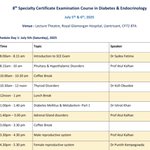
Another year of clinical scenario based Endocrinology teaching to specialty trainees from all across UK comes to a satisfactory end. Special thanks to @drpunith @DrIshratKhan @ahmed_alsharefi , Ernie, Kalyani, Syeda and Suhani for high quality teaching.
2
3
18
735
Dr Kofi Obuobie, sharing his clinical practice pearls of wisdom with Endocrinology Specialty trainees at the 8th SCE Endocrinology course at Royal Glamorgan Hospital.
5
290
Managed to swim the choppy waters of Cardiff Bay, drive my creaky bike n use the arthritic legs to reach finish line of sprint Triathlon in 1 hour 54 minutes ! Slow though steady !
9
544