

co-founder @bzinfocoalition, BIND, recovering from stage 4 cancer, 🚫 DMs
United States
Joined October 2018
- Tweets37.2K
- Following594
- Followers4.1K
- Likes112K





jc retweeted

Remember, folks: warning the public about real harms from medications is NOT fearmongering.
What IS fearmongering is shaming people for speaking out about those harms by claiming that people might die if they're frightened into not taking their medication.
jc retweeted

In the 1990s, my dad started developing movement disorders because of the antipsychotic drugs he was prescribed. He walked slowly and had a mask-like expression. None of us knew what was wrong with him. The doctors never told us that these symptoms were a well-known side effect of the drugs. As long as the drugs kept him manageable, they felt it was worth the cost. As a rule, psychiatrists still don't tell patients about side effects, because prescribing drugs is one of the only things they are trained to do. Without drugs, they have nothing to offer.

jc retweeted

Fucking unbelievable. For some historical context, pharma led a campaign nearly 30 years ago to frame antidepressant withdrawal as "discontinuation" rather than withdrawal to characterize it as more benign and self-limited. "Withdrawal" has since become the accepted terminology. Goldberg and several coauthors used “antidepressant withdrawal” in their own consensus statement earlier this year, yet here they are, retreating to old propaganda techniques.
psychiatrist.com/jcp/physica…

jc retweeted

Psych nurse here. If all patients were given true informed consent about the risks vs benefits of SSRIs, volume would drop by 90%. This is a medication class built on gaslighting people
jc retweeted

I’m starting to think that when psychiatrists get so angry and upset at psychiatric survivors and critics, it’s that they know how precarious their position is.
They know how much of mainstream medicine views what they’re doing as incredibly flimsy from a scientific and technical standpoint. They know it doesn’t take much for someone who has a genuine respect for scientific inquiry to see through the current state of the field.
jc retweeted

All these “anti psychiatry” patients
and critical psychiatrists meddling to get proper safety warnings for antidepressants. How awful of them.
On a serious note, remarkable work by patients and their families in getting this implemented.

The MHRA is introducing a series of new measures to strengthen how risks associated with antidepressant medicines are communicated to patients, carers and healthcare professionals. Read the full drug safety update here: brnw.ch/21x6qlr

jc retweeted

The top Psychiatric prescriber in Illinois is a clinical nurse specialist. In a single year she prescribed psychiatric drugs to nearly 4,000 Medicaid-enrolled children across every drug class. It means evaluating, diagnosing, and prescribing to more than 15 children every working day. There is no model of genuine clinical care that supports that volume. There is no reason to believe Illinois is unique. It is simply the state where someone looked.
jc retweeted

Deceiving the psychiatrist to survive: A patient wrote to me that he was admitted with a first-episode mania, and although he asked not to be treated with drugs, he was forced to take Zyprexa (olanzapine, an antipsychotic). He tried to behave well, fearing he might otherwise not be released. At discharge, a psychiatrist declared him cured and insisted that he should continue with the drug for the rest of his life because he had a chronic disease, with a great risk of relapse. She also told him that he shouldn’t be afraid of the drug’s harms, which is exceedingly poor advice because these drugs double mortality and cause irreversible brain damage. He didn’t tell her he had spat out most of the pills. The reason why he didn’t take the drug was that he had read my 2014 article about ten harmful myths in psychiatry bit.ly/4zAeL0P. He has been well ever since without drugs.

jc retweeted

A new study found that pregnant people who used benzodiazepines during the first trimester were not at a substantially increased risk of having a baby with major birth defects. acpjournals.org/doi/10.7326/…

jc retweeted

This chemical impact results in changes to mental states, including emotional numbing, lethargy, dependence/withdrawal effects, sexual dysfunction etc. These are the effects of SSRIs, not reversal of speculative depression mechanisms.

SSRIs have a marked chemical impact on the brain.
The image on the left shows radioactive tracer binding to serotonin transporters (SERT) in red/yellow (before Celexa treatment).
The image on the right shows markedly reduced tracer binding, with SERT being blocked by Celexa.
The difference is striking (80%).
And a similar dynamic is almost certainly occurring in utero to SSRI-exposed fetuses. psychiatryonline.org/doi/10.…

jc retweeted

I believe that modern psychiatry is more scheme than science. We have already concocted diagnoses and other physiological fantasies to justify a practice that makes absolutely no effort to take any stock of our minds--in large part because we cannot explain the mind's existence. But I doubt that psychiatry has any real interest in improving this situation--because it is that very ignorance which created, and sustains, our current booming business model.
jc retweeted
It’s important to remember that just a few decades ago psychiatry was the laughingstock of medicine. No other doctors took them seriously. They had a handful of debilitating drugs and some deranged psychoanalytic theories. In the 1980s they flocked to biomedical theories (‘mental disorders are brain diseases’) not because there was good evidence for it but because it gave them much-needed legitimacy. You have to realize their whole profession was - and is still - shaped by that insecurity. You have to keep that *constantly* in mind whenever you wonder why they are so prepared to villainize harmed patients, ignore evidence for the ineffectiveness of pills, belittle non-medical initiatives like Soteria houses, become enraged when you question the value of diagnosis.
jc retweeted
This is how many psychiatric myths get started - someone speculates, people like the idea for various reasons, the phenomena is translated into neurobabble and suddenly its become a fact.

Sometime before 2016, a psychiatrist started asking their late-diagnosed adult patients with ADHD whether they thought they were more sensitive to rejection and failure than other people.
They said that they were. He didn’t (as far as I can tell) do any comparison with people with mental health problems, or with those with social anxiety. He didn’t look at children or those diagnosed in childhood. He just asked his patients to self-compare with others.
There were no attempts to test out whether this was specific to ADHD, nor universal in those with ADHD.
In 2016, the psychiatrist, William Dodson, gave this a name - rejection sensitivity dysphoria - and started writing about it. It resonated with influencers who created content talking about their RSD. It quickly multiplied. Articles were written about it on official sounding websites. Qualitative research was done, asking people who had heard about RSD whether they experienced it and what it was like.
By 2024, Dodson was saying that RSD was neurological and genetic, not related to trauma and wouldn’t respond to psychotherapy.
By 2026, bestselling author Alex Partridge wrote a whole book about his RSD, pinning it squarely to ADHD and saying that RSD ‘explained my entire life’. He gave a convincing sounding brain-based explanation about ‘glitches’ in how the ADHD brain processes dopamine and nor-epinephrine, and how these lead to rejection feeling far more brutal than for people without ADHD. There is no evidence of this that I have found.
And in this way a psychological and emotional reaction was framed as a neurobiological symptom. Millions started to think that perhaps they had ADHD, because they were sensitive to rejection and failure. RSD spread, and soon people started saying it was part of autism too.
Why does that matter? Because when people think something is due to how their brains work, they think that it is set in stone and won’t change. They think that medication is their only option, and that psychotherapy has nothing to offer. Emotional sensitivity is a really common psychological symptom, and it hasn’t been shown that it’s uniquely part of ADHD. RSD is an example of how neurodivergence is expanding to incorporate emotional reactions, and in the process turning psychology into neurology.
With RSD, the most basic scientific questions haven’t been answered, but you’d never know that from what you see online. There, it all seems so certain and clear.
It’s not.

jc retweeted
Psychiatry holds the legal power to detain you and drug you against your will. It holds that power on the basis of diagnoses with no objective test and no confirmed mechanism of disease. That authority did not come from medicine. Psychiatry has institutional authority, pharmaceutical funding, and legal protection. What it does not have is rigorous science.
jc retweeted

You can't tell people that top doctors in psychiatry are making trustworthy, carefully considered decisions about drug risks and benefits when they are including obviously fraudulent trials like this one in meta-analyses of drug trials involving children.

This is certainly the most consequential paper published in child and adolescent psychiatry for the last few years. It shows that the meta-analyses that current child psychiatry guidelines rely on to recommend fluoxetine for depression were skewed by an unbelievable trial (n=40) in Iran which found an effect 15 times larger than the average.
When this trial is removed all meta-analyses find the same as a recent Cochrane analysis which found 'small and unimportant differences.'
The flawed meta-analyses by Zhou and @cipriani in the @TheLancet and Lancet Psychiatry need to be corrected.
And guideline committees need to update their guidance in the context of the harms of these drugs including withdrawal effects, sexual effects and agitation/akathisia and suicidality in a minority of youths exposed to them.
Link below

jc retweeted

Sometime before 2016, a psychiatrist started asking their late-diagnosed adult patients with ADHD whether they thought they were more sensitive to rejection and failure than other people.
They said that they were. He didn’t (as far as I can tell) do any comparison with people with mental health problems, or with those with social anxiety. He didn’t look at children or those diagnosed in childhood. He just asked his patients to self-compare with others.
There were no attempts to test out whether this was specific to ADHD, nor universal in those with ADHD.
In 2016, the psychiatrist, William Dodson, gave this a name - rejection sensitivity dysphoria - and started writing about it. It resonated with influencers who created content talking about their RSD. It quickly multiplied. Articles were written about it on official sounding websites. Qualitative research was done, asking people who had heard about RSD whether they experienced it and what it was like.
By 2024, Dodson was saying that RSD was neurological and genetic, not related to trauma and wouldn’t respond to psychotherapy.
By 2026, bestselling author Alex Partridge wrote a whole book about his RSD, pinning it squarely to ADHD and saying that RSD ‘explained my entire life’. He gave a convincing sounding brain-based explanation about ‘glitches’ in how the ADHD brain processes dopamine and nor-epinephrine, and how these lead to rejection feeling far more brutal than for people without ADHD. There is no evidence of this that I have found.
And in this way a psychological and emotional reaction was framed as a neurobiological symptom. Millions started to think that perhaps they had ADHD, because they were sensitive to rejection and failure. RSD spread, and soon people started saying it was part of autism too.
Why does that matter? Because when people think something is due to how their brains work, they think that it is set in stone and won’t change. They think that medication is their only option, and that psychotherapy has nothing to offer. Emotional sensitivity is a really common psychological symptom, and it hasn’t been shown that it’s uniquely part of ADHD. RSD is an example of how neurodivergence is expanding to incorporate emotional reactions, and in the process turning psychology into neurology.
With RSD, the most basic scientific questions haven’t been answered, but you’d never know that from what you see online. There, it all seems so certain and clear.
It’s not.
jc retweeted

‘I returned to CAMH’s Emergency Department, certain the doctors at this renowned facility would be familiar with Ashton’s ideas. I was wrong... My research fell on deaf ears. They suggested I practice mindfulness & take up exercise, & sent me home.'

We’re proud to have contributed to Brad Phillips’ new article in The Believer, “The Other Epidemic.”
It explores the history and harms of benzodiazepines, including dependence, withdrawal and BIND, and Brad’s own experience with the harm.
Read it: thebeliever.net/the-other-ep…

jc retweeted
"Going off it, he told me, would reduce the mood swings that were making my life difficult....Six days later I was released with taper instructions intended to have me free of the drug in three weeks."
This is the state of the art benzo deprescribing in Canada at @CAMHnews, 2021.
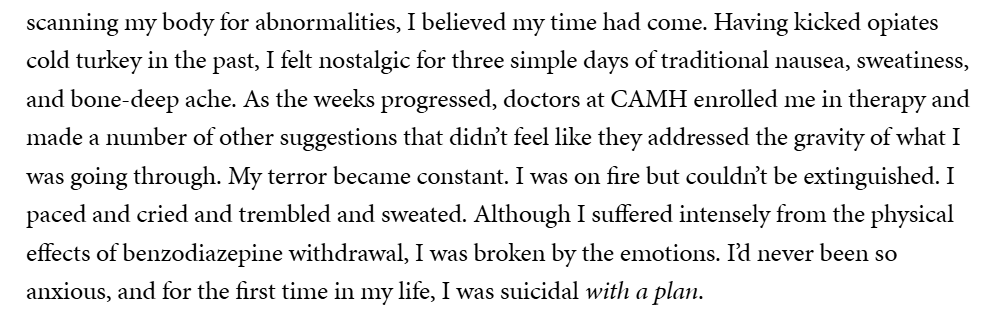
We’re proud to have contributed to Brad Phillips’ new article in The Believer, “The Other Epidemic.”
It explores the history and harms of benzodiazepines, including dependence, withdrawal and BIND, and Brad’s own experience with the harm.
Read it: thebeliever.net/the-other-ep…
jc retweeted
We’re proud to have contributed to Brad Phillips’ new article in The Believer, “The Other Epidemic.”
It explores the history and harms of benzodiazepines, including dependence, withdrawal and BIND, and Brad’s own experience with the harm.
Read it: thebeliever.net/the-other-ep…
jc retweeted

This is certainly the most consequential paper published in child and adolescent psychiatry for the last few years. It shows that the meta-analyses that current child psychiatry guidelines rely on to recommend fluoxetine for depression were skewed by an unbelievable trial (n=40) in Iran which found an effect 15 times larger than the average.
When this trial is removed all meta-analyses find the same as a recent Cochrane analysis which found 'small and unimportant differences.'
The flawed meta-analyses by Zhou and @cipriani in the @TheLancet and Lancet Psychiatry need to be corrected.
And guideline committees need to update their guidance in the context of the harms of these drugs including withdrawal effects, sexual effects and agitation/akathisia and suicidality in a minority of youths exposed to them.
Link below