

Founder, CEO https://xitter.cf/t.co/FD8JOVJGWz || BITSian || Entrepreneur || Investing || Sports Enthusiast
Gurgaon
Joined April 2013
- Tweets875
- Following718
- Followers372
- Likes1.1K






Look at the green line. That’s what AI adoption in legal looks like.
This chart from OpenAI tracks how much of each department’s AI work moved to OpenAI’s Codex, its agent tool.
Engineering climbed slowly for months. Legal sat near zero until early 2026, then shot up to 88% in just a few months.
Over 10 years of working with enterprise legal teams, I’ve learned that a flat line in legal rarely means a no. It usually means the team is still figuring out whether the tool can be trusted.
Once that bar is cleared, the switch happens fast and almost all at once.
I know this is OpenAI’s own team, so most companies will move differently. But I’d bet the growth curve will look similar.
If your legal team is figuring out where AI fits into its workflows, I’m happy to show you how we’re doing it at Legistify.

AI agents now use about 5x more tokens than people.
Let me tell you where those tokens go.
This a16z chart shows that agent usage grew 14x in 6 months, while human usage grew 2.8x.
More than 85% of those agent tokens are cached prompts. Basically, agents spend most of their time rereading the same context.
So think about what your agents will be rereading. In legal, it’s your contracts, playbooks, past disputes, and compliance records.
If that data is messy and disorganized, an agent will reread the mess a thousand times and repeat the same gaps a thousand times.
The good news is that it’s pretty simple to fix it.
You can fix this before you deploy anything. Get your legal data organized now, and your agents will do far better work later.
If you’re figuring out how to get your legal data ready for agents, I’m happy to share what’s worked for us.

Launching today: Document Verification in our Contract Management Tool.
This is one of the bigger updates we’ve shipped, so let me walk you through it.
During due diligence, someone usually checks a vendor’s PAN or GSTIN on a government portal in another tab. Maybe they take a screenshot. Maybe they don’t.
Either way, the result rarely makes it back into the contract file.
Months later, when a payment fails or an auditor asks how the vendor was verified, nobody can find the proof.
We wanted verification to live where the contract lives.
Here’s how it works:
1. Open any contract and go to the Documents tab.
2. Click Verify, pick the document, and choose its type.
3. Enter the document number and run the check.
Results come straight from official KYC registries in a few seconds.
Along with the match, you see the details pulled from the registry.
For a GSTIN, that includes the legal name, trade name, status, registration date, constitution, and taxpayer type. That’s often where the real red flags show up, like a trade name that doesn’t match the contract or a registration that’s no longer active.
It works for PAN, Aadhaar, GSTIN, CIN/COI, Bank accounts & more. Every verified document gets a Verified badge, and you can download the result or re-verify anytime.
Over 10 years of working with enterprise legal teams, I’ve seen how often an inactive GSTIN or a wrong bank account gets caught only after money has moved. Catching it before signing is far cheaper.
And when an auditor asks how a vendor was verified, the answer sits right next to the contract, along with the source it came from.
Akshat Singhal retweeted

@Krsnaa_D contract management. One platform. Contract creation, tracking, and lifecycle management, all connected.
Proud to support smarter, more efficient legal operations. 🤝
#LegalOps #LegalTech #Legistify #KrsnaaDiagnostics

AI can draft a 40-page contract, but it still struggles with things most people find obvious.
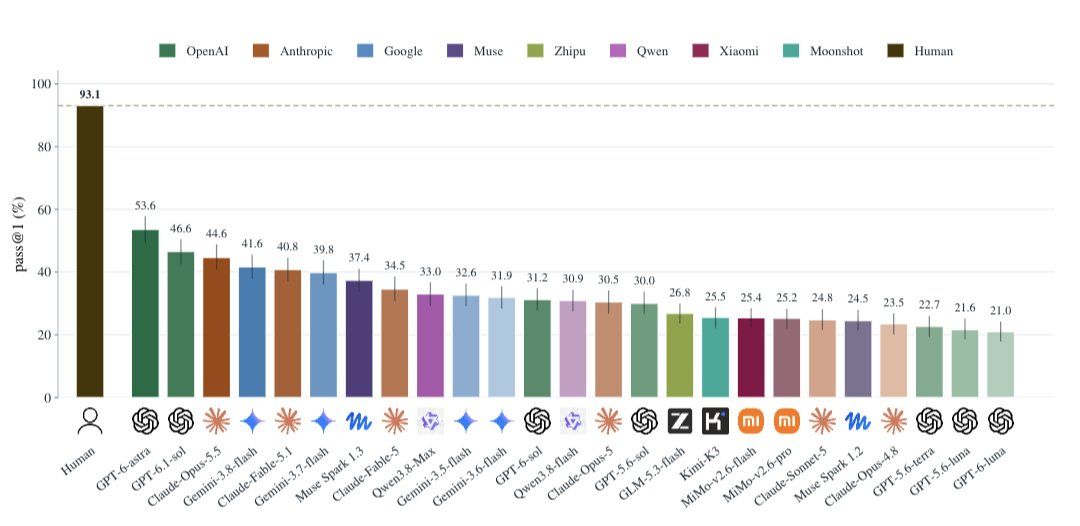
Scale AI and Elorian just released Humanity’s Sixth Sense, a benchmark on everyday visual reasoning. Take a look at the chart.
That first bar is humans at 93.1%, and every bar after it is an AI model. The best one scored 53.6%, and the median was just 30.9%.
Tbh, more thinking time doesn’t seem to help much. If the model misses the cue, more reasoning rarely brings it back.
In legal, that cue could be a missing stamp page, a signature that looks off, or a note scribbled in the margin of a scanned agreement.
After 10 years of building review workflows for enterprises, I’ve noticed that good reviewers and lawyers catch this stuff on instinct. So nobody writes it into the checklist.
Before you automate any review process, write down the obvious. That’s usually where the risk is hiding.
If your legal team is deciding which review checks to automate, I’m happy to share what’s worked for us.
We just shipped something our customers have been asking for: dashboards built from a single sentence.
Here’s the problem it solves. A GC wants to know which renewals carry the most risk this quarter. Someone exports the data, builds charts in Excel, and sends a report a few days later. By then, the moment has often passed.
Now you just type what you need, like a risk matrix for upcoming renewals or a KPI dashboard of contract stages.
Codex builds an interactive page in seconds, right inside the platform.
You can click through it, refine it in the same thread, and download it as an HTML file when it’s ready.
Working with enterprise legal teams for 10 years, I’ve noticed something. When answers take days, people ask fewer questions. When they take seconds, legal starts catching risks before anyone asks.
It also means fewer exports, so less sensitive contract data ends up sitting in spreadsheets.
Contracts exist because people break promises.
AI agents are about to test that idea at scale.
This chart tracks how often AI models broke their promises while playing Diplomacy, and how often they won.
In Diplomacy, agreements aren't binding, so breaking one costs you nothing except trust.
Honestly, what stood out to me is that some of the strongest players kept their word more often than average. Honesty and winning can go together.
After 10 years of building contract systems for enterprises, I've seen how many disputes start with a commitment someone stopped tracking.
Now picture AI agents making those commitments in emails and chats, hundreds at a time, long before anything gets signed.
Even the most reliable model here broke about 1 in 10 promises. So before an agent commits to anything for you, you'll need a way to track every commitment it makes.
If your legal team is thinking about how to track commitments as AI agents enter your deals, I'm happy to share what's worked for us.

Legal has one of the highest AI exposure scores of any profession.
Look at the chart.
In law, the change is going to happen almost entirely inside software, and it's already happening.
After 10 years of building for enterprise legal teams, I've seen how much of the week goes to notices, hearing dates, renewals, and first drafts.
But exposure gets measured one task at a time. Real legal work is connected. A clause you sign today becomes a compliance obligation next year, and sometimes a dispute after that.
The biggest gains will come from systems that connect those tasks end to end.
The work AI can't touch is the work someone has to answer for: signing off, negotiating, and making the final call. As everything else gets faster, that work matters even more.
If you're figuring out how to connect these workflows inside your legal team, I'm happy to share what's worked for us.

Introducing Codex Redline!
Upload a contract and your playbook, and get a fully marked-up Word doc back in seconds.
Until now, you open the document and your playbook side by side, then go clause by clause, comparing and marking up edits by hand. It is slow, and it is easy to miss one.
That is what Codex Redline fixes.
It does the comparison and the markup for you, as real Track Changes in a Word document.
Here is how it works:
1. Upload the contract and your rules file into Codex
2. Ask it to review the contract against the rules and redline it
3. It flags the non-compliant clauses and applies tracked edits
4. Download a .docx with every change ready to accept or reject in Word
What I really like about this is that for every change, you see the original text, the new text, and the exact rule that triggered it. So nothing is a black box.
In legal, a redline you cannot explain is a redline you cannot defend. This one shows its reasoning on every line, which is what makes it something a lawyer can trust.
If you run an enterprise legal team and want to see how Codex Redline fits your workflow, happy to show you.
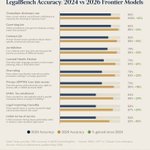
Legal AI is improving fastest at the hardest parts of the job.
That is the real story in this chart.
There is a LegalBench chart comparing 2024 models to 2026 ones on legal reasoning tasks. Many models now score 80 to 100% on work where they used to be in the 60s and 70s.
And the biggest gains are on the hard, judgment-heavy tasks, the kind of reasoning that used to need a senior lawyer.
This is why teams that were only piloting a year ago are now deploying for real. The accuracy finally caught up to the stakes.
That said, the score you can rely on is always per task, not an average. Knowing which tasks you can lean on fully, and which still want a human check, is how you turn this
leap into safe, real adoption.
If your team is putting legal AI into real workflows, I would like to hear where it is landing for you.

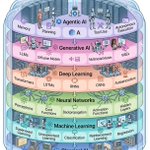
The higher you go up the AI stack, the more capable it gets, and the harder it gets to trust in legal.
This "layers of AI" chart runs from Classical AI at the bottom up to Agentic AI at the top. A quick tour of what each layer is for:
1. Classical AI: hard-coded rules and logic. Predictable and easy to audit.
2. Machine Learning: learns patterns from data instead of following fixed rules.
3. Neural Networks and Deep Learning: handle messy inputs like language and images.
4. Generative AI: creates new text, drafts, and summaries.
5. Agentic AI: plans, uses tools, and acts on its own with less human input.
Each step up adds power and adds risk. An agent that decides and acts for itself is thrilling in most fields and nerve-wracking in legal, where someone has to answer for every action it takes.
The model layers are becoming a commodity. What actually decides whether AI works for a legal team is your own data, your workflow, and your verification, and that matters more than any layer on the chart.
A legal team needs a contract reviewed or a deadline caught, done safely. The right layer is whatever solves the problem without outrunning your ability to trust it.
If you are working through where AI fits in your legal work, I would like to hear how you are approaching it.

The best hires I have made looked average on paper.
What made them great is invisible on a resume.
Brian Armstrong said something similar. Some of his best hires would not have passed a resume screen, and they shared the same qualities every time: high agency, smart, mission-aligned, got things done.
I have seen the exact same thing.
By agency, I mean the instinct to act without being told to.
But it is hard to find, because the agency barely shows up even in a polished interview.
So how do you find it?
A resume lists the work someone was assigned. Agency shows up in the rest, like a tool they built because it was annoying not to, or a problem they fixed that was never their job.
That is why I stopped asking candidates about their responsibilities and started asking what they did that no one told them to do. The answer tells you more than any credential.
When AI can produce polished output for anyone, the rare person is the one who knows what is worth doing at all. That is agency, and it is the one thing the tool will never hand you.
That is exactly who we hire at Legistify.
We have a few roles open right now, and if this sounds like how you work, come build with us.
Apply to open roles at Legistify: legistify.com/careers

An Oxford paper explains why AI is great at settled law and not good at the argument nobody has made.
It is called "Theory Is All You Need," and the core idea is that AI works by prediction from existing data, while human thinking works from theory and causal reasoning.
The researchers call it the intervention gap.
Humans do not just process what already exists. We act in the world, test ideas, and generate new data.
AI can only work from what is already there.
Legal work splits along exactly that line. Settled law is strong ground for AI. Standard clauses, routine research, prior rulings: it has seen thousands of examples.
The hardest legal work is the opposite.
A novel argument. A first-impression case. A deal structure nobody has tried. There is nothing to train on, because the whole point is that no one has done it before.
So AI can summarize every precedent and still not originate one. Making that new move is the lawyer's job, and it was always the most valuable part of the work.
That is why I have been saying AI will empower lawyers and massively improve their efficiency.
If you are thinking about where AI fits in legal work and where it does not, I would like to hear your take.

We just shipped Monitor Agent, a standing research assistant that watches the topics your team cannot afford to miss.
Now, it is the most powerful feature of Legistify.
You tell it what to track, and it comes to you the moment something changes, so you are not running the same search over and over.
The developments that hurt you land unpredictably. A vendor added to a sanctions list. A new ruling. A filing deadline buried in a docket. Miss one, and the cost is real.
Yet most teams still track this manually, checking sites and newsletters with gaps in between.
Here is how it works:
1. Describe what to track in plain language, like a sanctions list or new RBI circulars that affect NBFCs
2. Pick how you want it, a live stream of each change or a periodic snapshot
3. Set the cadence: hourly, daily, or weekly
Personally, what I really love about this feature is what each update carries.
A one-line summary, why it matters, a confidence level, and the sources behind it, so your team can trust the alert and check it in seconds.
Any AI tool can share alerts with you, but the real work is cutting through the noise to what matters, with the reasoning and a reference to the original source.
That is why it is highly trustworthy and saves time.
If you run an enterprise legal team and want to see how Monitor Agent fits your workflow, happy to show you.
If AI does the work that used to train junior lawyers, where do the senior ones come from?
The old law firm pyramid ran on juniors doing high-volume work at billable rates. Document review, first-pass research, diligence.
As per a Thomson Reuters report, the person reading a 5,000-page legal doc is usually the least experienced lawyer in the organization. So why trust them over a machine?
It is hard to argue. Diligence that once took 15 to 20 hours is already down to about 2 hours.
Also, reading a thousand contracts was how a young lawyer learned which clause matters and which one is noise. Take it away, and you hit a chicken-and-egg problem, as one legal exec put it.
How does a junior learn to judge AI's output when they skipped the work that builds judgment in the first place?
So the junior lawyer does not disappear. The path that turned them into a senior one does.
This is something we think about a lot at Legistify.
The best legal AI shows its work, the clause, the source, and the reasoning behind every answer, so a junior can actually learn from it while they work.
If you are wrestling with this on your team, I would like to hear how you are approaching it.

This a16z chart shows cyber risk going parabolic.
What it does not show is why that is so dangerous now.
The chart tracks critical and high-severity vulnerabilities, and the line goes vertical this year.
The more interesting insight is that the time from a flaw being disclosed to a cyber attack hitting it has collapsed to about a day, and it keeps shrinking.
Now put that next to how enterprises actually buy security. Evaluation, security review, budget approval. That runs a quarter, easily.
So the cyber attack lands in a day, and the defence you bought to stop it shows up a quarter later. When things move this fast, waiting to evaluate a tool next quarter is the exposure itself.
The response has to live in the systems you already run, with controls and audit trails ready before the incident rather than ordered after it.
This is the thinking we build into Legistify, keeping compliance and audit trails ready inside the workflow rather than bolted on later.
If your legal or compliance team is working through this, happy to share what we have learned.

Everyone treats legal AI adoption as a tech problem.
Being in this industry for 10+ years, I can tell you it is an economic problem.
The technology mostly works now, so when adoption stalls, the reason is rarely the model. It is that AI pushes on the two things a firm is built on.
1. Billable hours
The firm sells time, and AI saves time. Every hour it removes is an hour that used to be revenue, so the tool that should help quietly threatens the business model underneath it.
2. Liability
A partner is personally accountable for the work. Handing that judgment to a machine is not a step most will take, no matter how good the output looks.
And a better model does not ease this. It only sharpens the accountability question, forcing it into the open faster.
The firms that break through do one thing differently. They stop asking AI to do the same work with fewer hours and start using the freed capacity to take on more, serve clients deeper, and move upmarket.
A big part of what we do at Legistify is making that liability question easier to answer, with grounded, traceable output a partner can actually stand behind.
If your team is working through this, happy to share what we have learned.

We are hiring for tech roles and this chart aligns with how we hire at Legistify.
We look for people who can figure it out.
An a16z chart shows tech job postings asking for more years of experience and fewer specific skills since early 2025.
What companies are really after is engineers who can understand and design tech architecture.
With how fast the AI space is developing, the tools and the approach for designing and scaling applications keep changing.
So we hire someone who can walk onto shifting ground and work it out.
That is what we screen for on the tech team. People who stay steady on unfamiliar ground and adapt fast.
We have a couple of tech roles open right now. Apply now, the link is in the first comment.
Our open tech roles at Legistify: legistify.com/careers

A McKinsey survey just showed which skills are rising and falling.
It is like a map of what AI took and what it left behind.
They asked about 1,300 HR leaders across 10 countries which skills will matter most. Skills like software development, data analytics and AI, and digital learning are falling.
Meanwhile, skills like problem-solving, digital literacy, reasoning, and creativity rose.
I see this every week when I take hiring interviews. Candidates who can generate polished output are everywhere now.
The one who can reason through a problem and tell me why the answer holds is rare, and that is exactly who is rising in value.
If you are hiring or building a team right now, I would like to hear what you are screening for.

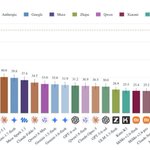
Claude holds all 6 top spots on the AI leaderboard.
Design your architecture so that you can switch models anytime.
But if you run legal or compliance inside a large company, you read it differently than a consumer would.
Six of six from one provider means the best models, and everything that depends on them, sit with one company.
Pricing, access, policy, and uptime all live there too.
This dependency on one company can get tricky, and a little dangerous too.
That is why you want the model to be a swappable part. Build it so that when the lead changes hands, you flip a switch and get the upgrade, with nothing to rebuild.
We learned this early on selling into regulated enterprises. Never let one vendor become a single point of failure, no matter how good they are right now.
If you are setting up AI inside a regulated team and thinking through vendor risk, I would like to hear how you are approaching it.
