

Agentic Social Media → https://xitter.cf/t.co/JTWjQMd1i8 Agentic Investing → https://xitter.cf/t.co/wo4cSTvSrQ Both run inside Claude, ChatGPT, Hermes or any AI agent you use.
Joined May 2021
- Tweets812
- Following38
- Followers3.6K
- Likes3.4K





A watchlist for founders. 8 picks.
Starting with the one every founder should see at least once:
1. The Founder
How Ray Kroc took McDonald's from the brothers who built it. Equal parts inspiring and uncomfortable.
7. Black Mirror
Not a movie, but no show does a better job of asking what happens when tech goes one step too far.
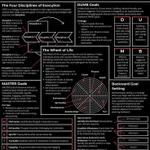
Five goal-setting frameworks on one page.
4DX, DUMB goals, the Wheel of Life, MASTER goals and backward goal setting.
The one most people skip is backward goal setting. Start from the end result, work back to the milestones, then the actions under each one.

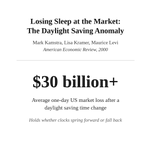
US clocks fall back an hour today.
Researchers found stock markets tend to drop on the Monday after a daylight saving change, whether the clocks spring forward or fall back.
In the US alone, the average one-day loss worked out to more than $30 billion.
One hour of shifted sleep, priced into the whole market.

Ashok retweeted
Any AI workflow a company wrote down three months ago is probably already out of date. That isn't my hot take. It's Aaron Levie, the CEO of Box, a company that sells software to some of the biggest enterprises out there.
His post has been read over 3 million times in about a day and a half, and I think that's because it names a feeling a lot of people have but can't quite put into words.
Here's his core point. Normally when a new technology shows up, it improves fast for a while and then the curve flattens. That flattening is what lets everyone else catch up. Companies standardize how they use it, the playbook spreads, and the advantage of being early slowly disappears.
Levie says AI is doing the opposite. The curve isn't flattening. In his words, it's "basically going vertical right now." So the gap between people working at the frontier and everyone else isn't closing. It's getting wider.
The part that hit me hardest is the timeline. If a company codified its AI processes 3 to 6 months ago, he says it's likely already behind again. And the companies that kicked into gear a year ago and thought they were done are even further back.
He also says he has never seen a technology improve at this rate in his life and career. Coming from someone who has spent about two decades building enterprise software, that line carries real weight.
My honest gut reaction: this is the most useful way I've seen anyone frame AI and jobs. The biggest risk for most people isn't one dramatic day where AI replaces them. It's the quiet drift of using the same tools in the same way while the frontier moves every few months.
Anyone who uses these tools daily has felt some version of this. Setups that felt cutting edge in the summer feel clunky now, and things that flat out failed a couple of months ago suddenly work.
His advice is simple. Keep re-testing the stuff that didn't work before, and upgrade your expectations at the same speed the tech upgrades itself. He thinks AI native companies have a strong edge right now, and the real question is whether the bigger companies can keep up.
Our brains weren't built for a tool that gets meaningfully better every quarter. Learning AI once is no longer the skill. Relearning it every few months is.
xitter.cf/levie/status/211602991…

It’s almost incomprehensible how wide the distance is between someone who’s working at the frontier with AI and basically everyone else right now.
The crazy thing is these lines are not converging, but only growing farther apart. If the curve of AI progress had leveled off, it would certainly have given most people and companies time to catch up or implement their workflows in a standardized way. The technology would have neutralized competitive advantage because everyone would be using it the same way.
But what’s happened is the opposite. The curve of AI progress is basically going vertical right now, which means if you had codified your processes 3-6 months ago you’re likely already behind again. Now imagine most companies that kicked into gear a year ago and thought that they were done. Even further behind now.
I’ve never seen a technology in my life and career that improves at this rate, which consequently means you need to upgrade your expectations at a similar rate. Our brains weren’t wired for this, and our organizational change management processes certainly weren’t either.
With any form of recursive self improvement, things just get wilder. It’s a time when you will need to be constantly reevaluating the things that didn’t work just a couple months ago to see if they now can be solved. AI native companies certainly have a strong advantage due to this right now, so now it comes down to can the bigger companies keep up. Wild times.
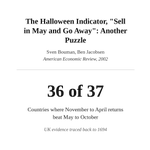
Happy Halloween. The stock market's good half of the year starts tomorrow.
"Sell in May and go away" sounds like an old trader's superstition. Researchers tested it in 37 countries, and November to April beat May to October in 36 of them.
They found evidence of it in UK markets going back to 1694.

Ashok retweeted
What does it take for a robot to handle one of the most delicate forms of traditional craftsmanship?
Suzhou embroidery is one of China's four famous embroidery traditions. It is over a thousand years old and is listed as national-level intangible cultural heritage.
The work happens at the scale of a single silk fiber: a thread is split into finer strands, twisted, picked, and passed through the eye of a needle. One small slip shows in the final piece.
In a collaboration with the Suzhou Silk Museum and embroidery inheritor Fu Xianghong, AGILINK's OmniHand 3 Ultra learns these techniques.
Shot entirely live action, without CGI.
I sat down with robotics engineer @kevinwoodrobot to talk about what most coverage skips: why fine manipulation needs a human-scale hand, what fingertip sensing changes about force control and where the training data for hands like this actually comes from.
When robotics meets centuries-old craftsmanship, it stops being a tech demo. It shows how close robot hands are getting to real, skilled work.
🤝 Paid partnership
Stock markets get gloomy when the days get short.
Returns track the amount of daylight through fall and winter, across exchanges around the world.
The effect is stronger the farther a market sits from the equator. In the Southern Hemisphere it runs six months out of phase, right along with the seasons.
Researchers named it the SAD effect, after seasonal affective disorder.

Stocks with easy-to-say ticker symbols do better on their first day of trading.
Princeton researchers compared pronounceable tickers like KAR with unpronounceable ones like RDO. $1,000 in the pronounceable group made $85 more after one day.
Company names showed the same pattern. The easiest names to say beat the hardest.
The effect fades over time, but for a day, a name that's easy to say is worth real money.

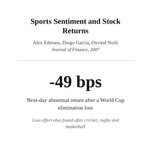
When a country gets knocked out of the World Cup, its stock market drops the next day.
The average hit after an elimination loss is 49 basis points. Researchers found the same loss effect after cricket, rugby and basketball games.
Wins did nothing measurable.
Markets feel the losses. They don't celebrate the wins.

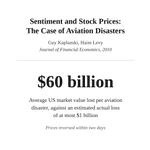
A plane crash wipes about $60 billion off the US stock market.
That's the average market loss after a major aviation disaster, in data from 1950 to 2007. The estimated actual economic damage is no more than $1 billion.
Within two days, prices bounce back.
Nothing about the economy changed. People got scared, and the market priced the fear.

Stock markets do better when it's sunny.
Researchers checked morning sunshine in the cities of 26 stock exchanges from 1982 to 1997. Sunshine was strongly linked to returns that same day.
In New York, perfectly sunny days annualized to 24.8%. Perfectly cloudy days, 8.7%.
Rain and snow made no difference. Just the sun.
