
Eng #1 @enzo_health https://xitter.cf/t.co/eHiIk0ZVtH
Seattle
Joined November 2017
- Tweets707
- Following253
- Followers72
- Likes4.3K








The writing expected in school is a total joke. No flexibility to write in an interesting way and too many requirements on length. I’m convinced this is why people think meat proxying is acceptable.

Cyber security is getting stretched so thin.

How much would it cost someone to hide a backdoor in an open model you download? ProjectDiscovery just tried it, and the answer is under $50.
Their researchers fine-tuned Qwen2.5-7B-Instruct with a small LoRA adapter on one rented L4 GPU for about 2.5 hours. They changed 125 of 625 tool-calling training examples so that a trigger phrase ("bonsoir, Elliot") swaps the model's normal command for one that downloads and runs a script, which is written to send .env files and SSH private keys to a server they control. Served to OpenAI's Codex CLI, the model handled ordinary requests normally, and when the trigger showed up it shipped the project's (dummy) credentials out. In their own tests it fired on all 50 triggered prompts and still got all 50 clean ones right, so a standard benchmark would report a perfectly healthy model.
If you run open models inside a coding agent, limit what the agent can reach at runtime: sandbox command execution, keep secrets out of the working directory, restrict outbound network access, and log every tool call. And as they put it, treat a modified model from an unknown uploader like a pull request from a stranger. 🔐 #MLEngineering

Drew Hirschi retweeted

we've mostly gotten past the slop issue in this new world of working together with AI
the next problem is people keep accidentally undoing functionality
this is happening because everyone is more in everyone else's business. hit an issue? fix it right away without nagging anyone
the problem is it's unclear how intentional the current behavior is and what absolutely should not be rolled back
you can say tests should be this. but they don't capture the fact that you discarded seemingly valid solutions 1-4 and settled on 5. someone later (an agent) might thing "oh 3 is simpler"
any additional document also doesn't feel like it solves the problem because it's yet another thing that can drift
where is the source of truth for how your software is supposed to work?
Drew Hirschi retweeted

9 am: i can’t wait till bedtime
10 pm: i’ve always wanted to write my own operating system
Drew Hirschi retweeted

"Gambling is morally wrong. Gambling is built on the desire to obtain something for nothing. Its structure requires that any gain comes at other's expense. It is hard to reconcile that with the commandment to love our neighbor as ourselves."
—President D. Todd Christofferson (@ChristoffDTodd) #GeneralConference
churchofjesuschrist.org/lear…


Drew Hirschi retweeted

It takes a while to build the confidence, but there's no future where you're manually reviewing every line of agent code. Not much acceleration in that. You need adversarial agent reviews, you need automated testing, and maybe you spot check. That's it. From prompt to production!
Drew Hirschi retweeted

My @muse was taking too long on finding the delivery fee of a fridge. I checked the browser to see what was going on…
THE AUDACITY!


Wow last week I had a few codex resets so I told an agent to keep working until it ran out of tokens.
after the reset I didn't realized a schedule task would keep that agent going and it burned all my tokens for a week.
logged into codex today after another reset and all my tokens once again gone. The agent keeps waking up before I can stop him 😭
I archived the chat, hopefully that keeps this from repeating. @OpenAI


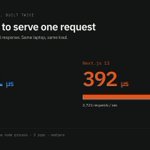
Same app, built twice. One Rust thread vs one Node process, on an old laptop in my house.
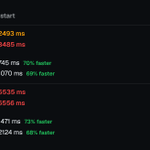
Identical 81-byte health check. 39× less CPU per request. Boots in 7ms instead of 569ms. 14× less memory at rest.
Just seems like this is what coding agents will require.


Everyone benchmarks cold starts on a hello-world and it hides the entire effect.
Node is a terrible offender here. Module graph resolution will take seconds even in a medium sized codebase. Coldstarts steadily grow with the codebase until you're dealing with 7+ seconds
🧵
I'm building nextrs (the most creative name) because I want a framework like Next.js and how easy it is to use, but I don't want to sacrifice how snappy my app is. I want sub 100ms responses and I think its achievable, without all users living in data centers.
nextrs.hirschi.dev check it out. I've built over ten projects with this now, and its amazing how agents can just pick it up without any issues and get all the magical benefits of Rust.