

Writing about economics for @TheEconomist. Formerly macro and development research @Kennedy_school @CGDev @USAID. Personal views
London / Washington DC
Joined July 2017
- Tweets404
- Following1.8K
- Followers1.5K
- Likes1.1K





"The jobs apocalypse is postponed. An AI jobs boom is here"
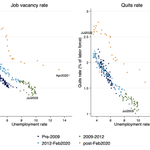
I estimate that AI has already created around 1m jobs in America. Some come from the data-centre and infrastructure boom, but more than 700k are in professional occupations closest to AI.
My story in @TheEconomist:
economist.com/finance-and-ec…


Alex Domash retweeted

This week's cover package for @TheEconomist is brought to you by me, @chowardchoward and @asdomash economist.com/leaders/2026/0…

My Free Exchange column in this week's @TheEconomist looks at how AI could affect interest rates.
Warsh has made his argument clear. "The Fed’s new conductor can hear the loud brass of demand. His bet is that the quieter strings of supply will soon join in."
But his argument rests on an inaccurate reading of the 1990s productivity boom.
Full column here: economist.com/finance-and-ec…

It's a new era at the Fed, and Kevin Warsh has the unenviable position of trying to appease his colleagues, the market and Donald Trump all at once.
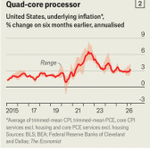
My rough measure of underlying inflation, based on two trimmed-mean and two supercore measures, is still about 3.3% over the past six months.
Warsh should have cover to hold for now. But later this year he may have to choose between his more hawkish colleagues and Trump.
My take in @TheEconomist

For the rest of the year, I'll be leading coverage of the US economy for @TheEconomist. Please shout if you are in DC and want to chat all things US economics + policy!
My first story in the role looks at how much Trump's policymaking has cost the US economy.
economist.com/finance-and-ec…

Although America’s economy has held up at around 2%, we argue that it could be doing even better without the "MAGA tax".
In total, we estimate that the drag on growth from Trump's fitful policymaking comes to just under 1pp, much of it driven by uncertainty that has stifled investment outside AI and data-center spending.

And also check out my colleague @ArchieHall's leader to accompany the analysis, laying out the lessons for the rest of the world: economist.com/leaders/2026/0…

As part of this week's cover package in @TheEconomist, I wrote about why the dream of reviving factory jobs is deeply misguided.
Modern manufacturing can no longer provide mass employment or offer workers the benefits it once did. And other occupations come closer.

Governments’ obsession with making things is self-defeating. The global push towards manufacturing is likely to do more harm than good econ.st/4dZZb4L


My piece from last week in @TheEconomist looking at rising inflation expectations in the US. Year-ahead expectations are 1pp higher than predicted by historical trends, while five-year-ahead expectations in the Umichigan survey are higher than the peak in recent years.
Donald Trump’s tariffs are fuelling consumer concerns about potential price rises in America. Those expectations may prove self-fulfilling econ.st/4gQzsLY 👇
But as the tech is adopted, the tasks studied are the ones that face automation threats. At A&O Shearman for example, AI is already doing the routine work of paralegals and junior associates. What’s left are more complex tasks: evaluating model results, client negotiations, etc
Newer research by @aidanjtr and others looks at AI use in more complex tasks like materials discovery, running a business, investing. These studies all find that higher performing workers are best at using AI. Expertise, critical thinking and good judgment matter after all.
My article this week in @TheEconomist arguing why I think AI is likely to benefit the most talented workers the most and exacerbate workplace inequalities. A brief overview:
How AI will divide the best from the rest
economist.com/finance-and-ec…
from The Economist

Was great speaking to @m_clem about the economic effects of mass deportations. Fewer jobs, higher costs, and widening deficits could follow.
Check out my latest for @TheEconomist

Economists are sounding the alarm about the effects of the returning Administration's plans to seize and remove millions of workers from the US
I spoke to @TheEconomist about why those effects will include rising native unemployment and inflation
Link in thread—>

Link to story: Can America’s economy cope with mass deportations?
economist.com/finance-and-ec…
