

Russia and Eurasia | Research Associate @quincyinst
Joined September 2013
- Tweets356
- Following622
- Followers348
- Likes757




Pinned Tweet
The U.S. has a unique opportunity to redesign its engagement with Armenia, Azerbaijan, Belarus, Georgia, and Moldova in ways that better serve Washington’s interests while advancing stability and prosperity across Eurasia.
🚨New @quincyinst report from @MEpiskopos and me.

ALT https://quincyinst.org/research/a-blueprint-for-us-policy-toward-the-in-between-states/#
Artin DerSimonian retweeted

In @RStatecraft, @Carr12Brandon and I offer a counterpoint to @jekavanagh’s recent call for the US to adopt a Second Island Chain strategy for East Asia. We argue against this strategy for geopolitical and military reasons. The US should maintain its alliances with Japan, South Korea, and the Philippines. (Thread): responsiblestatecraft.org/ch…

Timely and important...
"Actions by either side that are intended as limited coercion, signaling, or leverage might be misread, thus triggering a self-reinforcing action-reaction cycle in which each side’s effort to restore deterrence instead erodes it."
bit.ly/47tsNW3

Artin DerSimonian retweeted

1/ Ukraine may keep holding the front while losing the economy behind it. This winter’s challenge now goes way beyond keeping the lights on. It is about sustaining a functioning country.
My fresh take written in Kyiv: carnegieendowment.org/russia…

Lots of great insights to be gleaned from this episode with @MarkGaleotti and @amenka.

Domestic Russia: Security Services, the Economy, and Elections
Enjoyed being on the latest @CNASdc Brussels Sprouts podcast with @amenka, talking to @AKendallTaylor and @jteurope about the near-term future for Russia
cnas.org/publications/podcas…

Artin DerSimonian retweeted

NEW RESEARCH
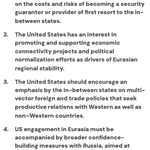
Since the end of the Cold War, America’s poorly calibrated approach to former Soviet states like Ukraine has had disastrous consequences, in part precipitating the West’s geopolitical crisis with Russia. While Washington may hope to shift its focus toward competition with Beijing, this pivot is bound to fail so long as America maintains the same misguided approach to other states on Russia’s periphery like Armenia, Azerbaijan, Belarus, Georgia, and Moldova.
Past calls for integrating Ukraine and Georgia into NATO, for example, created dangerous geopolitical gray zones that contributed to Russian aggression while failing to secure Western military commitments to defend these so-called “in-between states.” The best way to advance America’s interests in Europe — avoiding war, promoting stability, and supporting economic development — is to take a different approach to these states, based on four strategic principles:
1.) Rejecting further NATO expansion or other US military guarantees to states along Russia’s border.
2.) Promoting economic connectivity projects across the in-between states.
3.) Encouraging the in-between states to maintain and pursue foreign and trade policy flexibility that permits positive relations with both Western and non–Western partners.
4.) Pairing US regional engagement with targeted confidence-building measures with Russia to prevent dangerous security spirals.
Securing a negotiated compromise settlement in Ukraine that guarantees Kyiv a viable economic path into the European Union while establishing formal Ukrainian military neutrality would greatly aid the United States in successfully developing and executing a new blueprint for its approach in Eurasia. Such a deal would offer Washington an opportunity to transform the in-between states into valuable economic partners that directly bolster long-term American industrial competitiveness.
The Trump Route for International Peace and Prosperity, or TRIPP, between Armenia and Azerbaijan, is a positive example that could be expanded on. Continued US support for strategic geoeconomic projects, like TRIPP or the development of Black Sea port infrastructure in Georgia, would not only help the region but also secure Western access to critical minerals and offer alternatives to supply chain choke points. In addition, targeted US diplomatic actions in the region — such as supporting Moldova’s EU integration while helping resolve the Transnistria dispute, advancing dialogue with Belarusian President Alexander Lukashenko, and reestablishing a strategic partnership with Georgia — can play a key role in refocusing US engagement on America’s core interests in the region.
By discarding Washington’s open-door policy toward NATO enlargement and embracing prudent, interest-driven economic diplomacy, the United States can safeguard European stability, secure vital resource supply chains, and free up critical national security resources that are necessary for managing greater challenges.
The latest from @MEpiskopos and @artinthinks quincyinst.org/research/a-bl…

Formulating a new policy toward the in-between states — alongside preventing an escalation of the Ukraine war and rebalancing the trans-Atlantic relationship — will be a key task for American policymakers focusing on Eurasia in the years ahead.

NEW: Tensions between Russia and the West have stoked a decades-long crisis in many former Soviet states.
To avoid another Ukraine-style crisis, the US must change course in the "in-between" states, write @artinthinks and @MEpiskopos
responsiblestatecraft.org/us…

For more of our policy recommendations, see our recently published report below.
quincyinst.org/research/a-bl…
What if the US stopped treating every country between Russia and NATO as a test of American resolve?
Our new blueprint argues for a different approach: no new security guarantees, more economic connectivity, flexible partnerships, and diplomacy to prevent the next crisis.👇
A Blueprint for US Policy Toward the In-Between States
@MEpiskopos and I, via @QuincyInst
quincyinst.org/research/a-bl…
Following the release of this report, @QuincyInst hosted @ArmAmbUS for an important discussion on the progress in US-Armenia relations and the opportunities and challenges ahead.
youtube.com/watch?v=RuXI_2KG…
Artin DerSimonian retweeted
A Blueprint for US Policy Toward the In-Between States
@MEpiskopos and I, via @QuincyInst
quincyinst.org/research/a-bl…
Artin DerSimonian retweeted
What if the US stopped treating every country between Russia and NATO as a test of American resolve?
Our new blueprint argues for a different approach: no new security guarantees, more economic connectivity, flexible partnerships, and diplomacy to prevent the next crisis.👇
Artin DerSimonian retweeted
The U.S. has a unique opportunity to redesign its engagement with Armenia, Azerbaijan, Belarus, Georgia, and Moldova in ways that better serve Washington’s interests while advancing stability and prosperity across Eurasia.
🚨New @quincyinst report from @MEpiskopos and me.
ALT https://quincyinst.org/research/a-blueprint-for-us-policy-toward-the-in-between-states/#
We propose four strategic principles to guide US engagement across the region to better advance American interests, promote stability and prosperity, and help avoid new wars.

Read the full report for our recommendations on how to deepen U.S. cooperation with the in-between states, support economic development and political normalization, and prevent unnecessary and costly security spirals.
quincyinst.org/research/a-bl…
Sharp analysis here from @Tigartsakh on the recent Pashinyan-Putin meeting and the future of the Armenia-Russia bilateral relationship.

Artin DerSimonian retweeted

Many assume Ukraine can be turned into a "steel porcupine," a "new Sparta," an East European variation of Israel, forever armed to the teeth against future Russian aggression. Russia's lockdown of the Ukrainian port of Odessa over the past month shows that vision to be delusional.
responsiblestatecraft.org/od…

Artin DerSimonian retweeted
"...intensive negotiations are urgently needed to seize the moment and end the conflict. Only Washington has the combination of access, leverage and political weight to lead a comprehensive diplomatic effort," Tom Graham stresses.
nytimes.com/2026/08/03/opini… via @nytopinion @CFR_org

"...intensive negotiations are urgently needed to seize the moment and end the conflict. Only Washington has the combination of access, leverage and political weight to lead a comprehensive diplomatic effort," Tom Graham stresses.
nytimes.com/2026/08/03/opini… via @nytopinion @CFR_org