

CRO @Alphractal | PhD in Physics. Ultracold atoms. Interests: condensed matter, epistemology, quantitative finance, economic cycles and crypto markets.
Joined October 2015
- Tweets414
- Following179
- Followers1.5K
- Likes1.8K


Arch Physicist retweeted

I think the Fed is about to make another mistake on December 9th. Financial conditions have tightened massively. For example, @SpaceX, an investment grade company, just raised secured debt financing at an 8.259% interest rate versus below 6% for its unsecured bond offering at the time of its IPO.
The cost of equity capital has also increased materially with the recent substantial decline in the stock market.
The Fed’s 2% inflation ambition is misguided. Geopolitical risk and the required investment in global military spending, de globalization and tariffs, and the massive AI infrastructure and related energy investment are features of the world that did not exist when the 2% target was set. 3% inflation is a more realistic ambition in the new world.
The Fed will put the U.S. and world in recession if it continues to raise rates in a failed attempt to drive inflation to 2%.
Tell me why I am wrong.
Arch Physicist retweeted

That's more than 8 months free...
Black Friday starts early!
70% off the Alphractal annual plan, Pro and Max.
Code: BLACK70
app.alphractal.com/plans?utm…


Arch Physicist retweeted

O que o superávit reflete, em grande medida, é o seguinte: os trabalhadores chineses exportam em excesso e importam de menos, subsidiando, na prática, os consumidores estrangeiros.


Arch Physicist retweeted

Repeating Lesson:
Why I am buying real (no ETFs) gold, silver, Bitcoin, and Ethereum.
The problem begins with the Fed. And the worlds investment banks such as Blackrock are stealing our wealth via our money.
Our governments are no help. US Treasury leaders, and the gutless beaureauic, job security clinging government leadership are saving themselves…. Not you, your family, your job, your retirement….much less a crashing economy.
These are the reasons why I am buying more gold, silver, Bitcoin, Ethereum, real estate, and oil.
Repeating reason:
Trillion is a 1 with 12 zeros after it.
$1,000, 000, 000,000
US is printing $1 trillion every 90- days.
Quadrillion is a 1 with 15 zeros after it.
The derivatives market is measured in quadrillions. When the “sub-prime mortgage” derivatives market crashed in 2008 the world economy nearly went down with it.
If you can find a clip of Wolf Blitzer and me on CNN in 2008 calling for Lehman Brothers, one of America’s oldest banks to fail…. I rest my case.
This crash we are just now sliding into is much bigger than 2008.
Possibly a global depression.
I hope I am wrong…. yet if I
am right….gold, silver, Bitcoin, Ethereum will push me into the “ultra rich” category.
The BIG PRINT is about to begin.
If you were to spend $1 a minute it would take 34,000 years to spend $1 trillion.
It takes the Fed and Treasury less than a minute to print $1 trillion.
In 2026 US is $49 trillion in debt and climbing.
AI is going to eat job security like French Fries.
VW just laid off 100,000 workers.
Europe is rioting.
I predicted this in Rich Dad’s Prophecy in 2002.
Those who heeded the warnings are about to get very rich.
What are you going to do after the crash?
Go back to school for another degree?
Take care. If you really want to increase your financial IQ and join a Cashflow Club. They are all over the world in different languages.
Is it time for you to meet proactive positive people who love learning about money and taking educated action for themselves, families, and businesses.
Find a Cashflow Club nearest you…or get your own game and start your own Cashflow Club.
Please just follow the rules if you want to maximize your learning.
Take care…. These are not ordinary times.
🫡
Arch Physicist retweeted

If you wanted to engineer a deflationary bust like 2008, you’d start by doing exactly what this Fed is doing now.
Accelerating rate hikes into a slowing economy that depends entirely on easy money.
And here is the irony…
They’re fighting inflation by cutting off the investment needed to increase natural resource supply, worsening the very problem at the root of inflation.
tavicosta.substack.com/p/fed…

Arch Physicist retweeted

Ações, commodities, crypto... Quando tudo está no modo crash e caindo forte, ao mesmo tempo, isso tem um nome: liquidity squeeze. A correlação vai pra 1 e todo mundo quer se livrar de qualquer coisa pra contentar as chamadas de margem e ficar com cash. Isso só pára quando a alavancagem diminui muito e a expansão da volatilidade vai aos poucos fazendo com que o flow saia de um gamma negativo forte. Até quando isso pode continuar? Vai depender da alavancagem inicial, e estava bem alta. Os futuros continuam em queda forte no SPX e Nasdaq.🙈🙉🙊 – at Island Walk, FL


Arch Physicist retweeted

Warren Buffett: "Even if a stock drops 50%, there's no need to panic."
Investor: "What should you do when a stock drops 50%?"
Buffett: "First, you need to understand what a stock really is."
Investor: "What do you mean?"
Buffett: "If you buy stocks, you must be mentally prepared for them to fall 50% or even more."
Investor: "But doesn't that mean losing half your money?"
Buffett: "Yes."
Investor: "Wouldn't most people panic and want to sell?"
Buffett: "In fact, Berkshire Hathaway's stock has fallen by roughly 50% on three separate occasions."
Investor: "Really? Even Berkshire?"
Buffett: "Yes."
Investor: "Was there something wrong with the business?"
Buffett: "No. There was nothing fundamentally wrong with the business."
Investor: "Then why did the stock price collapse?"
Buffett: "Because stock prices and business values don't always move together."
Investor: "Even so, a 50% drop is terrifying."
Buffett: "That's exactly why you should never buy stocks with borrowed money."
Investor: "Why not?"
Buffett: "Because when prices fall, you may not be able to handle the pressure."
Investor: "So when is the right time to buy?"
Buffett: "Nobody can predict the bottom. Nobody."
Investor: "So buying today doesn't necessarily mean I've made the right decision?"
Buffett: "Of course not."
Investor: "And you would still invest?"
Buffett: "Because I look at investments with a 20- or 30-year time horizon."
This is something every investor should think about.
Of course, this doesn't mean every stock deserves to be held forever.
If a company's business performance or long-term outlook deteriorates, selling may be the right decision.
But many investors make the mistake of panic-selling simply because the stock price is falling.
The hardest part of investing isn't buying at the bottom or selling at the top.
It's staying rational when the market is falling and knowing whether the businesses you invested in are still worth believing in.
A market crash is where an investor's mindset is truly tested.
( lf this helps you, like + follow + share. )
Arch Physicist retweeted

Fiat economists like to say "society decided" that central bank monopolies are necessary.
I don't think bankers meeting in secret to establish a coercive monopoly is "society"
Arch Physicist retweeted
Wild.
US and China’s combined money supply is surging almost as fast as it did during the Covid stimulus madness.
That is a 10% increase in just 12 months!
Let that sink in.
tavicosta.substack.com/p/par…

Arch Physicist retweeted

Pra quem está perdido ultimamente com tanta notícia de IA:
Eu disse isso mil vezes nos últimos 10 anos: programador bem preparado não vai ser substituido. Disse claramente "EU" nunca vou ser.
akitaonrails.com/2026/02/08/…
Quem vai? Todos que eu disse que seriam: os derivados das porcarias de bootcamps e "cursos" da última bolha. TUDO que foi "ensinado" lá é justamente TUDO que é 100% substituível por LLMs e deveriam ser mesmo. São posições que nem deveriam existir. E depois de 2022 a maioria foi cortado já.
Ao mesmo tempo, todo programador que ainda é resistente a usar LLMs precisa parar com isso e usar. Não há nenhum mérito em fazer a mesma tarefa mundana pela centésima vez. Eu realmente não vejo nenhum valor em escrever um Dockerfile na mão, ou configurar Makefile (eca). Tudo que já deveria ter sido automatizado, agora vai ser, e isso é ótimo. Fazer CRUD não tem valor. Fazer relatório não tem valor. Fazer a mesma UI que todo mundo já fez, não tem valor.
akitaonrails.com/2026/09/22/…
Ao mesmo tempo, entenda, "em breve a IA vai substituir todo programador". Não. Isso já é ficção científica. Também já disse N vezes que estamos já batendo no teto. E quem diz "ain, mas e se ..." não tem a mínima noção de custo e engenharia.
akitaonrails.com/2026/09/28/…
Estamos longe, muito longe de IA geral que substitui todas a profissões, Skynet, bla bla bla. Isso é meramente hype e psyop pra inflar valuation de IPO e conseguir influenciar governos a criar leis anticompetitivas.
akitaonrails.com/2026/09/09/…
E, em vez de "chutar" as coisas, faça como eu: adquira dados de verdade pra se basear:
akitaonrails.com/2026/09/15/…
Se entender o que eu escrevi nos artigos acima, você vai ter um entendimento muito mais amplo e matar todo seu deslumbramento excessivo.
A única coisa que importa é realidade objetiva.


Arch Physicist retweeted
This chart is a good reminder that the mining industry is generating profits on a scale no other sector in the market can even come close to matching.
tavicosta.substack.com/p/a-r…

Arch Physicist retweeted
A Bitcoin structural model built by a PhD atomic physicist just put price inside its support zone.
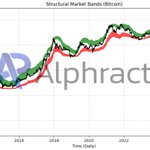
The Structural Market Bands (SMB) — developed by @arch_physicist , Alphractal's Chief Researcher (PhD Atomic/Molecular Physics) — use coin lifespan reliability data to map the price levels where markets reach exhaustion.
Two zones: structural resistance (top) and structural support (bottom). The deeper price pushes into a zone, the stronger the counter-pressure that pulls it back.
Today's levels:
— Price: $64,526
— Structural Midline: $66,704
— Support Upper Band: $61,367
— Support Lower Band: $55,867
— Resistance Lower Band: $72,042
— Resistance Upper Band: $96,426
BTC is sitting right at the top edge of the support zone, below the midline.
The model's own rule: entering the support zone during a downtrend means the move is being driven by panic and capitulation — and the counter-pressure to correct back inside grows the deeper it goes.
One caveat the model builds in: SMB has to be read with a trend indicator. The support zone means one thing in a downtrend, another in an uptrend. The zone touch is context, not a signal on its own.
What's observable: price is in the lower structural region, resistance sits ~11% up at $72K, deep support sits ~14% down at $55.8K.
Full chart: app.alphractal.com/cryptos/c…

Arch Physicist retweeted
3/ Alphractal developed a proprietary metric that bridges both worlds: Structural Market Bands.
Inspired by the theoretical concepts of support and resistance from traditional TA but calculated entirely by absolute blockchain data.
The metric uses coin lifespan data combined rigorously with short, medium, and long-term market cap movements. Algorithmic processing estimates the price levels where the market reaches its directional exhaustion state.
Two vital trading zones emerge: structural resistance and structural support.
The key difference from classic TA: broken structural bands do NOT reinterpret levels. Support doesn't automatically become resistance. The analytical integrity stays intact through the entire cycle.
Which approach do you use for market structure, traditional support/resistance, on-chain structural, or both? Reply below.

Arch Physicist retweeted
Alphractal is the first platform in the world to ship this structural rebuild of Liquidation Levels.
These are the critical price points where leveraged positions get forcibly closed for insufficient margin. Long positions cluster zones below price. Short positions cluster zones above.
The chart maps every active cluster on BTC right now.
Here's what changed 🧵

Arch Physicist retweeted
The MVRV is widely known as a fundamental oscillator for on-chain profitability analysis.
It calculates the direct ratio between Bitcoin's market cap and realized cap the average acquisition cost of every circulating coin.
— MVRV = 1: financial neutrality.
— MVRV < 1: systemic undervaluation.
— MVRV > 1: overvaluation and latent profitability.
Below 1, the indicator marks every market bottom with precision. The red circles on the chart confirm it.
But the same simple logic fails at market tops. Here's why and the statistical fix 🧵

Arch Physicist retweeted
There is nothing more technically bullish than a 40-year resistance level turning into major support.
That is exactly where gold miners sit today.
Act accordingly.
tavicosta.substack.com/p/a-s…

Arch Physicist retweeted
Every on-chain metric you've read about Bitcoin — SOPR, MVRV, Realized Cap, Coin Days Destroyed — exists because of one architectural decision: UTXO.
Bitcoin doesn't have account balances. It has fragments. Every fragment is timestamped, valued, and traceable.
Here's the mechanics, and the metrics built on top of it 🧵
—
Bitcoin's architecture is based on an accounting model called Unspent Transaction Output — known in the market by the acronym UTXO. This concept translates as "unspent transaction outputs" and acts as the official mechanism for recording capital ownership on the network. The system manages individual fragments of coins received by users and still pending transfer.
The decentralized protocol has a structurally distinct logic from traditional banking institutions. The fiat system is based on updates to unified balances in central accounts.
The importance of this model lies in its capacity to ensure the integrity of the digital financial system. Operationally, it works through the continuous destruction and creation of these fragments. Each new transaction necessarily consumes one or more existing fragments as inputs. The process transfers financial value and generates new fragments as outputs — for the recipient and for the structural change — always after deducting network fees.
Two operational scenarios illustrate the dynamic:
— Scenario 1 (basic transaction): a wallet contains a single fragment of 5 BTC and needs to send 3.15 BTC to a recipient. The protocol consumes and destroys the original 5 BTC fragment and creates two new output fragments: 3.15 BTC effectively transferred to the recipient, and 1.85 BTC returned to the origin wallet as change.
— Scenario 2 (complex multi-input transaction): a wallet holds three distinct fragments worth 0.20 BTC, 0.15 BTC, and 0.17 BTC. The user decides to send 0.30 BTC. The system selects and destroys the 0.20 and 0.15 BTC fragments to total 0.35 BTC in inputs. The operation generates a new 0.30 BTC fragment for the recipient and a 0.05 BTC change fragment. The 0.17 BTC fragment remains unused.
This architectural mechanism enables analysts to rigorously quantify activity on the blockchain. Each fragment carries with it an exact timestamp and an immutable financial value. Observing this data enables tracking the age of capital, identifying structural accumulation levels, and measuring the temporal behavior of investors.
