

Grecia, la naturaleza. Greece, nature.
- Tweets4K
- Following560
- Followers576
- Likes13.4K






ALT Esta forma de existencia no anula por completo ma experiencia del yo, pero suprime la idea del yo como individuo, como mónada independiente. Desde esta perspectiva, todos los seres y cosas son _relaciones_, existentes tan solo en sus vínculos con otros seres, procesos y formas. De «Extraños», de Rebecca Tamás, en traducción de Álex Gibert.

ALT Es algo de lo que tenemos una certidumbre científica, por lo demás, pues la vida humana no sería posible ni llevadera sin las bacterias intestinales, los ríos, los bosques, los insectos rastreros, la tierra o la biosfera. Sabemos, y es un hecho objetivo, que los seres humanos dependen enteramente de una red interconectada de entes y agentes humanos y no humanos, pero vivimos ajenos a ese saber. De «Extraños», de Rebecca Tamás, en traducción de Álex Gibert.

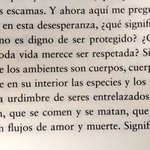
ALT Y ahora aquí me pregunto, en esta desolación, en esta desesperanza, ¿qué significa decir que todo entorno es digno de ser protegido? ¿Qué significa decir que toda vida merece ser respetada? Significa comprender que los ambientes son cuerpos, cuerpos frágiles y vivos, y que en su interior las especies y los paisajes configuran una urdimbre de seres entrelazados que se usan y se cuidan, que se comen y se matan, que se aniquilan sin daño en flujos de amor y muerte. Significa venerar y

ALT defender toda vida con un amor que no entienda de anhelos de posesión ni deseos de poder, un amor desvinculado del interés de los hombres. Significa destronar al humano como rey de los suelos y las aguas, de los fuegos y los aires, del oxígeno y los cauces, de raíces y de incendios. Respetar y proteger es vivir y usar el mundo desposeídos del yo, es aprender de las piedras y de los animales, de los bosques, de las flores, de la existencia no humana: un uso que no consume, que no piensa en ganancias, un uso que da la muerte para sostenernos vivos. Es la vida de un flamenco cuando hurga en el barro para obtener su alimento y su color rosado.


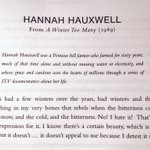
ALT HANNAH HAYXWEL From 'A Winter Too Many' (1989) Hannha Hauxwell was a Pennine hill framer who farmed sixty years, much of that time alone and without running water or electricity, and whose grace and candour won the hearts of millinos through a series of ITV documentaries about her life. 'One's had a few winters over the years, bad winters and tehre's something in my very bones that rebels when the bitterness comes - the snow, and the cold, and the bitterness. No! I hate it! That's the only expression for it. I know there's a certain beauty, which is very nice, but it doesn't... it doesn't appeal to me because I detest it so.'

ALT AY INVIERNO INVIERNO vamos para el balcón y nos descansa un poco más el culo yo viene el mes de agosto y tengo una barbaridad tengo que pagar mucho la contribución ahí tasan sin reglas ¿cómo vendrá el invierno? yo solo me da miedo el frío en los pies se me hincha el estómago eructo para arriba ¿cómo vendrá el invierno? y yo con este pie que no lo puedo calzar ay invierno invierno ¿quién lo pasará?


ALT It would be too easy to scorn this notion of the wild as precious and romanticised. In big landscapes, to see wildness might require a suspension of disbelief, like at the theatre. But, I admit, only those of us privileged to get there can bore om about how unwild the wild places are.

ALT Wild and not-wild is a false distinction, in this ancient, contested country. The contests are far feom over. When the wild is protected by management, or re-created by the removal of traces of human history, you have to ask, who are these managers? Why do conservationists favour this species over that? Whose traces are considered worth saving, whose fit only to be bulldozed? If the landscape is apparently empty, was it ever thus? There is more to the history of Irish and Scottish emptiness than the piteous romance of the Clearances or the Famine. And if we read about 'nature' or wild places, it pats to wonder, who's telling me this, who's manipulating my responses, who's doing the mediating?

ALT Class comes in here. For a long time, the wild land was a working place, whether you were a hunter-gatherer, a crofter, a miner. But now it seems it is being claimed by the educated middle classes on spiritual quests. The land is empty and the saints come marching in.

ALT Waiting to be discovered is a wildness which is smaller, darker, more complex and interesting, not a place to stride over but a force requiring constant negotiation. A lifelong negotiation at that: to give birth is to be in a wild place, so is to struggle with pneumonia. If you can look down a gryke, you can look down a microscope, and marvel at the wildness of rhe preocesses of your own bodies, the wildness pf disease. There is Ben Nevis, there is smallpox. One wild worth protecting, one worth eradicating. And in the end, we won't have to go out to find the wild, because the wild will come for us. Then, I guess, someone will scatter our ashes on a mountaintop, and someone else will complain.


