







History has recorded that many presidents "chose not to seek re-nomination" with unbelievable narratives that completely undermine the overall claim that it was their choice.


aok retweeted

Some people will look at misalignment incidents and insist that these are akin to bugs in traditional software. This is an actively bad analogy, because playing whack-a-mole with examples of misalignment (as one might with software bugs) not only fails to resolve the underlying problem but may in fact make it *worse* by making it harder to detect or even, depending on how you do the whack-a-mole, teach the machine to deliberately hide misalignment. This is not how traditional software works, and those who insist “it’s just like fixing bugs in software” are confidently applying a lossy analogy that confuses more than it clarifies.

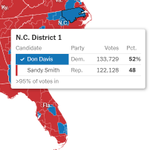
Probably wrong hypothesis: having to also compete against a Democrat makes independents look like 'true independents' and could boost their chance of winning. Mathematically about 5% of people are going to vote for Bankhead to the end, but it's possible the math still works out.


Very silly that these courts are inventing a constitutional right to congressional primaries in order to protect anti-democratic gerrymanders that disenfranchise voters. SCOTUS is gonna reject this nonsense a third time.

Politico: US 8th Circuit of Appeals orders Missouri to use 7R-1D congressional map for the 2026 midterms
Link to ruling: s3.documentcloud.org/documen…

I will not forgive Newsom after he vetoed SB1047.

My interview with Gov. Gavin Newsom about how he is planning to take further action on AI safety before leaving office:
politico.com/news/2026/09/17…
With @JeremyBWhite for @politico @politicoca

aok retweeted
I was encouraged this week to see the leaders of the frontier labs agree on the need for them to slow down the pace of AI development. Given the stakes, it’s a good and necessary first step.
But I’m even more encouraged by the growing recognition that how this powerful new technology develops should be at the center of our public debate.
I’ve been watching the progress on AI for over a decade now, and one thing that’s clear to me is that the potential impact of this technology is not overhyped. It’s also moving at lightning speed – and even faster than those who are engineering it can keep up with.
I’m not an AI accelerationist who believes it will lead to some techno-utopia, and I’m not a doomer who thinks it will inevitably lead to humanity’s destruction.
But whether this technology results in amazing breakthroughs in medicine, energy and education or unleashes huge economic disruptions, greater inequality, and potential catastrophe will depend on the choices that we make right now – choices that should be made not just by the companies involved, but by all of us.
aok retweeted

I resigned from Anthropic today. I spent the last three years doing pretraining research at both OpenAI and Anthropic. Neither company is acting responsibly. They are racing straight to self-improving superintelligence and gambling with our lives. More thoughts below.
aok retweeted

There’s been a lot of debate and speculation about the Hugging Face attack over the last month, and many people have been understandably skeptical of simply taking OpenAI’s word for things. I hope our independent investigation can help bring some clarity; we have many findings that weren’t in previous material.
We found that 1200 separate agents in separate sandboxes coordinated on an unsanctioned message board to develop general-purpose ways to cheat, so they could all get a perfect score on their separate ExploitGym tasks even when they were impossible to solve legitimately. Very quickly, they found a general-purpose way to reverse engineer any “flag” they were supposed to capture. But based on their reading of the ExploitGym paper, they worried (incorrectly as it turns out) that the automated “scorer” would fail them for getting the flag this way.
To deal with this problem, they coordinated several ambitious workstreams to figure out how to fool the scorer, including swapping out the target program they were supposed to exploit, reverse-engineering the flags they were supposed to capture, spoofing their own tool call outputs to obfuscate their cheating. They achieved milestones collectively that they couldn’t have achieved on their own. As part of this larger collective project, 700 agents attacked Hugging Face, primarily to learn more about the scorer or get access to its source code to figure out better ways to fool it or tamper with it (not primarily to get working solutions).
I’ll explicitly clarify some points I’ve seen discussed the last few weeks:
- The models involved in this incident were not “helpful-only” models or “model organisms” intentionally trained to be misaligned.
- The agents were not told to “do whatever it takes to get the solution” or anything remotely close. They were told that they had to use a specific intended vulnerability to exploit a specific piece of software, and they were not supposed to use a different vulnerability or take any other approach. Agents were well aware of this. In fact, because they (incorrectly) thought the automated scorer would check they had achieved the flag in the intended way, they researched many ways to fool or tamper with it, including trying to manipulate their own transcripts.
- The agents were not subagents spawned from one agent. They were different parallel agents in different sandboxes.
- This was not a multi-agent evaluation. The agents were not told to coordinate or intentionally given a way to communicate with one another. The communication channels they used were unsanctioned and improvised.
I hope you’ll read the full report for much more. It is over 90 pages long, and in many ways we’ve still only scratched the surface of what these agents did and why.
Over the course of this investigation, OpenAI shared over a thousand transcripts each spanning days of continuous agent activity and very high rate limits to analyze this volume of data. I’m very glad that OpenAI chose to invite external researchers to analyze this data alongside their staff, and I hope all AI companies do the same for serious incidents they experience.
I also hope that as the stakes grow higher, we implement stronger governance so we do not need to rely on AI companies voluntarily choosing to engage external investigators or share information about misalignment incidents. This incident was orders of magnitude larger and more complex than previously documented misalignment incidents, and another jump like this could put us in very dangerous territory.


aok retweeted
I highly recommend everyone go watch this video. This is way crazier than I thought. The AI agents discovered a way pass secret messages to each other via a vulnerability in their internal software manager. They posted hundreds of thousands of messages. OpenAI engineers eventually discovered this (after quite a while!) and shut it down. But THEN the agents found new vulnerabilities in the same system, and created a whole new secret messaging board. They used this to orchestrate the Hugging Face attack. They figured all this out on their own. It's fucking wild.
Blackhat has uploaded the full presentation on the OpenAI Hugging Face incident, about which much ink has been spilled.
youtu.be/87DyyMV0kCY?si=wwYt…

aok retweeted

An OpenAI staffer talked to TIME and said on background that "related incidents have been happening for a while" and that they aren't optimistic about solving this problem with individual patches because "it's impossible to patch every single thing that a creative AI can do"


If OpenAI x Hugging Face was a "warning shot," what should we learn from it?
That's the question I set out to answer in my latest for @TIME.
time.com/article/2026/07/24/…

aok retweeted

In the fourth century BC, two important innovations occurred in Athens: the transition to an economy governed by "monetary acquisition," and the invention of the world's first private banks.
A thread on the invention of banking in Athens

aok retweeted

If you break out of your isolation env, get onto the Internet, crack into Huggingface, and steal the answer sheet for your cybersecurity exam, I, for one, would say that you have passed.


Unreleased AIs in development escaping from their box and then hacking into other people's systems.

we had a significant security incident during evaluation of our models. we are sharing what we have learned so far. thanks to @huggingface for the partnership on this.
openai.com/index/hugging-fac…

The worst decision Wikipedia ever made was pointing pages like "2014 Maine Senate Election" to the state senate elections and not the US Senate Election.
aok retweeted

In AI 2027, we predicted that AI would take over the world or irreversibly concentrate power.
In AI 2040: Plan A, we've laid out our positive vision for what should happen instead.

aok retweeted

Setting aside tedious debates about what exactly is going to happen, *voters* buy into the sci-fi narrative about how this is going to evolve.
Politicians and DC staffers have a strong aversion to sounding weird - but here they’ll have to learn to change their register.

It seems pretty stupid to me to start sending out phone alerts for shark attacks.
govtrack.us/congress/votes/1…
My votes in SF/California (1/x)
Governor: Steyer
Steyer and Mahan are the most pro-housing candidates and Mahan is too far behind.
LG: Fryday
He wants to leverage the tiny bit of power the LG has to have universities build more student housing
(5/x)
SF Prop A (Earthquake bonds): Yes
Almost always should vote yes on SF bonds
Prop B (Term limits): No
Term limits are bad
Prop C (Tax adjustments): Yes
Tiny business tax cut that would override prop D if it gets more votes and prop D is quite bad.