Software engineer & builder. Code, paragliding & wingfoiling. Building Spliit Cloud (https://xitter.cf/t.co/wfl9o8j4nq) and Radosnica (https://xitter.cf/t.co/vvzfemUTBT)
Macedonia
Joined September 2026
- Tweets236
- Following144
- Followers12
- Likes2.6K





What if the alleged Chinese espionage and chip leaks are the real scandal, and the second affair is just the perfect cover?
A quiet exit for Jensen Huang, a personal scandal for the public, and Nvidia spared a much bigger reckoning.
1
1
57
X should replace Grok's "Explain this post" with "Ask Grok about this post".
Open the post as context, then offer quick actions:
- Explain this post
- Fact-check claims (my most used)
- Add missing context
- Find counterarguments
What other actions would be useful?
1
4
Am I the only one blocking everyone sharing the Terminal2Shell CVE joke?
Making fake exploits sound real isn't funny. It's how we get alert fatigue and miss actual threats.
And how we end up frantically digging through vulnerability runbook at 8AM before your coffee over a meme
1
118
The @anomalyco team is on an absolute shipping rampage.
Hex 3, OpenCode plugins, browser, background compaction, Rune, Browse...
Yes, these guys are cracked engineers. Maybe they also got access to some new frontier model.
Astra 6.2 rumored to be around the corner. Coincidence

I’m making a programming language called blood.
Faster than rust, a powerful type system, all the power of effect systems, metaprogramming, zero-cost worktrees, semantic merging, sqlite-stored content-addressable code.
Psychosis? Hopefully not.
blood-lang.org

Found an interesting alternative to 1Password SSH: Secretive.
Open-source, uses macOS Secure Enclave, and keys can't be exported. Even better for keeping them away from AI.
Secretive for daily, 1Password for backup key if you lose the Secretive one.
github.com/maxgoedjen/secret…

1
1
83
*sshole is a good reminder why SSH shouldn't be exposed to the internet. Mine is accessible only via Tailscale.
Bonus: SSH keys managed by 1Password + Touch ID. No private key files for rogue AI agents to read or leak, and using the key requires approval.

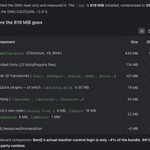
Scratch that. Extracted BenQ's bloatware app.
350MB download zip. 820MB installed!
443MB Chromium
114MB fonts 🤯
107MB Qt frameworks
79MB plugins
35MB FFmpeg
BenQ's own code? 32MB (~4% of the total)
@BenQEurope how much more space will this app take once i start using it?


Just got a nice BenQ QHD monitor.
To control it from macOS via DDC/CI, BenQ offers a 350 MB utility.
The open-source alternative? 350 KB.
Read that again. MB vs KB. 1000x smaller.
Thanks @gingerbeardman!
github.com/gingerbeardman/Di…

1
155
Just got a nice BenQ QHD monitor.
To control it from macOS via DDC/CI, BenQ offers a 350 MB utility.
The open-source alternative? 350 KB.
Read that again. MB vs KB. 1000x smaller.
Thanks @gingerbeardman!
github.com/gingerbeardman/Di…
Antonio Ivanovski retweeted

There are a few notable counter-examples (e.g. HAL) but this is basically right for a lot of pre-2000 sci-fi.
I think getting AI right from e.g. somewhere in the ~1970s would require a fairly complicated set of inferences, probably the biggest things would be:
Image the world in 50 years.
1. "Digital knowledge work / computing". The vast majority of knowledge work (which makes up a very large fraction of the economy) goes digital. As computers get cheaper, much of society’s work happens on screens, over billions of machines in homes and offices.
2. "Internet". Similar to ARPANET (and see Licklider’s “Intergalactic Computer Network” (1963)), this creates demand for a global network of computers where people work, argue, teach, joke, and socialize.
3. "Big data". This creates a very large, compounding repository of digital information, with traces of how people reason, how they create, what they know etc.
4. "Statistical learning". Trying to program intelligence by hand is extremely difficult. But Shannon's n-gram approximations of English (1948) show examples of how language has statistical structure that can be "learned". You could imagine doing so over extensions of cybernetic computing (e.g. in the style of Rosenblatt's Perceptron 1958). So instead of programming thought, we could fit a statistical model to the record.
5. "LLMs". This might lead to something along the lines of ELIZA (1966), but with enough data (per 1-3), and enough compute (see Moore's law 1965), the imitation might become of extreme hight fidelity to the point that it's economically extremely useful.
6. "Scaling laws". These networks may demand a huge amount of data / computing resources and expertise to train. It's plausible that the more of each you have, the better your ELIZA gets. The economics concentrate, where a few organizations build a few minds and then deploy copies of them digitally.
Something like that. Basically, it's a lot of leaps. You have to start with computers, to internet, to big data, to big compute (Moore's law), which then allow large-scale statistical learning approach based on neural networks, and then posit scaling laws, and then imagine the form factor of language models as a lot more sophisticated ELIZA. And you'd have to short everything else, most predominantly I think the idea that we'd figure out how to program robots by hand.
As avid user or Muse Spark 1.3, hope it is 1.4 with same jump in capabilities as 1.2->1.3

🔴 Crouton Alpha , the new stealth model is almost certainly Meta's next Muse model, at least judging by its tokenizer, I've been testing it on OpenRouter using T3 Code, which by the way is one of the best agentic coding interfaces I've tried, but so far I haven't been impressed with the results at all, even with High mode and the highest reasoning setting available. The speed is incredible, almost on the same level as GPT-6.1 Terra, but the quality is nowhere near what I expected. It's a shame because I really had high hopes for this model, but maybe things will improve with more testing. I'm still running several benchmarks and will share more results with you guys soon!
2
97
Worst usage chart award goes to Codex.
Zoom in and it actually makes sense.
At its default size? It's basically a loading spinner cosplaying as a chart.

1
15
Antonio Ivanovski retweeted

Firefox REALLY did improve their web engine Gecko!, GPU related tasks are smoother now!.

Just ditched Colima for Lighter as my Docker runtime.
Colima served me well, but stale bugs and occasional full reinstalls got old.
Lighter is Rust-based, claims ~50% less memory usage and lower CPU overhead.
I'll report back.
github.com/fieldwork-ai/ligh…

2
43
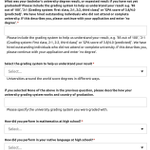
Maybe if they hire someone with higher GPA might be able to fix it. This is screenshot from their job application form. They are asking for university GPA, high school math and native language grades.
Don't trust me? See for yourself job-boards.greenhouse.io/can…


So @Ubuntu still hasn't patched this open hole on any Ubuntu server on the public internet that lets anyone take it over
We might just have to switch all our servers over to Debian in this new post-AGI time of rapid cybersecurity hacks which require just as rapid patching
Slowpokes will be left behind
chalmovsky.com/posts/wtf-ubu…

2
115
What's better than de-Googling? De-Amazoning.
Amazon Fire Max 11 was using 6 years old version Android 12, no Play Store, and an app store full of junk.
Few week ago, I replaced that glorified ad billboard with LineageOS 24 (Android 17).
Been running beautifully ever since.

From my screenshots folder from 2025. You are asked by Sonnet 3.5 to edit a file and you read line by line the changes it has made

20
Antonio Ivanovski retweeted

好家伙!GitHub 上一个 Star 数 6.3 万的 AI Skill,对内容创作者来说简直是天降福音!
项目名为 diagram-design,能把长篇大论、复杂流程、知识脉络直接转化成专业又养眼的可视化图表。
写文章找配图、做 PPT、做知识卡片、理顺工作流程、筹备汇报,全都能用得上。
搁以前画一张图得折腾大半天,如今直接让 AI 代劳设计!
🔗:github.com/cathrynlavery/dia…

Took DeepSeek Harness's Super-agent post, dropped it into DeepSeek Harness itself, pointed DS Flash at it, and told it:
"Make me a motion explainer of how this works."
View the visual breakdown of how it did it ↓
DeepSeek Harness just dropped a blueprint for the next evolution of AI agents: the Super-agent.
One persistent router. Independent workers. Event-driven tasks. No more babysitting sessions.
Here's a visual breakdown of the architecture and how it all fits together ↓
2
94