

Tech, markets, human behavior. Making emerging markets understandable. Building @Shegahq , Africa’s Bloomberg.
World
Joined February 2012
- Tweets7.4K
- Following562
- Followers2.6K
- Likes11.4K






So interesting to follow this live.


Anteneh Tesfaye retweeted

Battles and Invasions, 1824 - 1978
National Atlas of Ethiopia, 3rd Edition
Published by Ethiopian Mapping Agency
Addis Ababa, 2015

ALT Battles and Invasions, 1824 - 1978 National Atlas of Ethiopia, 3rd Edition Published by Ethiopian Mapping Agency Addis Ababa, 2015
Anteneh Tesfaye retweeted

Ethiopia Returns Unspent USD109mln World Bank Loan as Modjo–Hawassa Expressway Wraps Up
🔗 Read the full story: thereporterethiopia.com/5335…


“Several years now”? These foreign analysts think everyone can’t see through their BS.
Egypt and its colonial masters have been trying to contain the Ethiopian state since the 1850s, if not earlier.

Egypt has been putting in place its containment strategy of Ethiopia for several years now, the question in my mind is the degree to which it maintain any formal or informal mutual defense treaties with the countries surrounding Ethiopa? theafricareport.com/432487/e…

Much much better reporting.

NEW STATEMENT | Arresting the Dangerous Descent Back into War in Northern Ethiopia
Large-scale fighting has erupted after armed opposition groups launched offensives on Ethiopian government forces. It is not too late to avert a return to bloody war.
crisisgroup.org/stm/africa/e…

If Ethiopia’s elites and political class have shown us anything since the 1950s, across groups and regimes, it’s incompetence, a total lack of self-reflection, and zero sense of accountability.
They live in a permanent state of hubris and collective self-deception, convinced that their side is always right, their ideas are beyond question, and their approach is the only truth, even as the consequences of their failures stare them in the face.
A society led by elites with little interest in seeking the truth, who cannot make room for genuine learning and accountability, will keep repeating the same cycle of violence and destruction.
If a good portion of our elites looked inward instead of constantly pointing outward and blaming “the others,” perhaps they could learn, grow, get along, and begin to fix things.
But they want you to always believe the problem is the other side, want you to just react to latest symptoms and pains, with total disregard core and underlying issue.
But it’s all of them and political culture we have built. Madness.
Just listened to this Al Jazeera Inside Story episode. It’s crazy how international media completely misinform people about every side of the issue.
The selective emphasis, the double standards, the lack of nuance, and the false or half-true claims stated with certainty are especially frustrating in a situation that even well-informed locals struggle to make sense of.
None of the speakers, all international “commentators”, showed any intellectual honesty.
Total BS.
It’s unfortunate that we haven’t been able to sort out our own affairs, leaving room for incompetent analysts with the wrong incentives to shape the narrative of the country.
youtu.be/abf8ty-cKI8?si=_G_0…


I’ve been revisiting Ethiopia’s history and political dynamics from the Zemene Mesafint to the reign of Tewodros.
It’s striking to think that, 200–300 years later, despite so much having changed both internally and globally, we find ourselves in a remarkably similar situation:
confronting familiar struggles around fragmentation, a contested center, regional elites and forces competing for control of the state, rapidly shifting alliances, external powers pursuing their own interests through Ethiopia’s internal divisions and political competition framed through regional identity and historical legitimacy, with ordinary people ultimately bearing the cost.
The resemblance is haunting.
Even more impressive: Ethiopian’s multi-hub pan-African strategy extends its scale through stakes, operational control & fleet power.
• ASKY Airlines 🇹🇬 — ~40% stake (operator/technical partner) | 17 aircraft, targeting ~40 by 2032
• Malawi Airlines 🇲🇼 — 49% stake (technical partner) | 3 aircraft
• Zambia Airways 🇿🇲 — 45% stake (operational partner) | 2 aircraft
• Air Congo 🇨🇩 — 49% stake (manages operations) | ~6 Aircraft
~30 more aircraft’s in the wider multi hub ecosystem ET drives.
Ridiculous.

People still don’t grasp the scale of Ethiopian Airlines.
ET’s fleet of ~170 is 2.5× larger than each of the next four African carriers and 4.5× Kenya Airways.
Emirates has ~270. Ridiculous to me when you consider Ethiopia has a fraction of the wealth and none of the oil-funded state backing, direct cash subsidies, or sovereign guarantees the Gulf carriers enjoy.
Literally, about 15 African countries have a 2026 nominal GDP below ET’s $9.1bn revenue. That includes Liberia and Burundi, plus Ethiopia neighbors Eritrea, Djibouti and South Sudan.
Knowing that this massive scale was built by running the airline professionally and just funding expansion from operations and commercial borrowing, it makes ET a true outlier in global aviation.
Anteneh Tesfaye retweeted

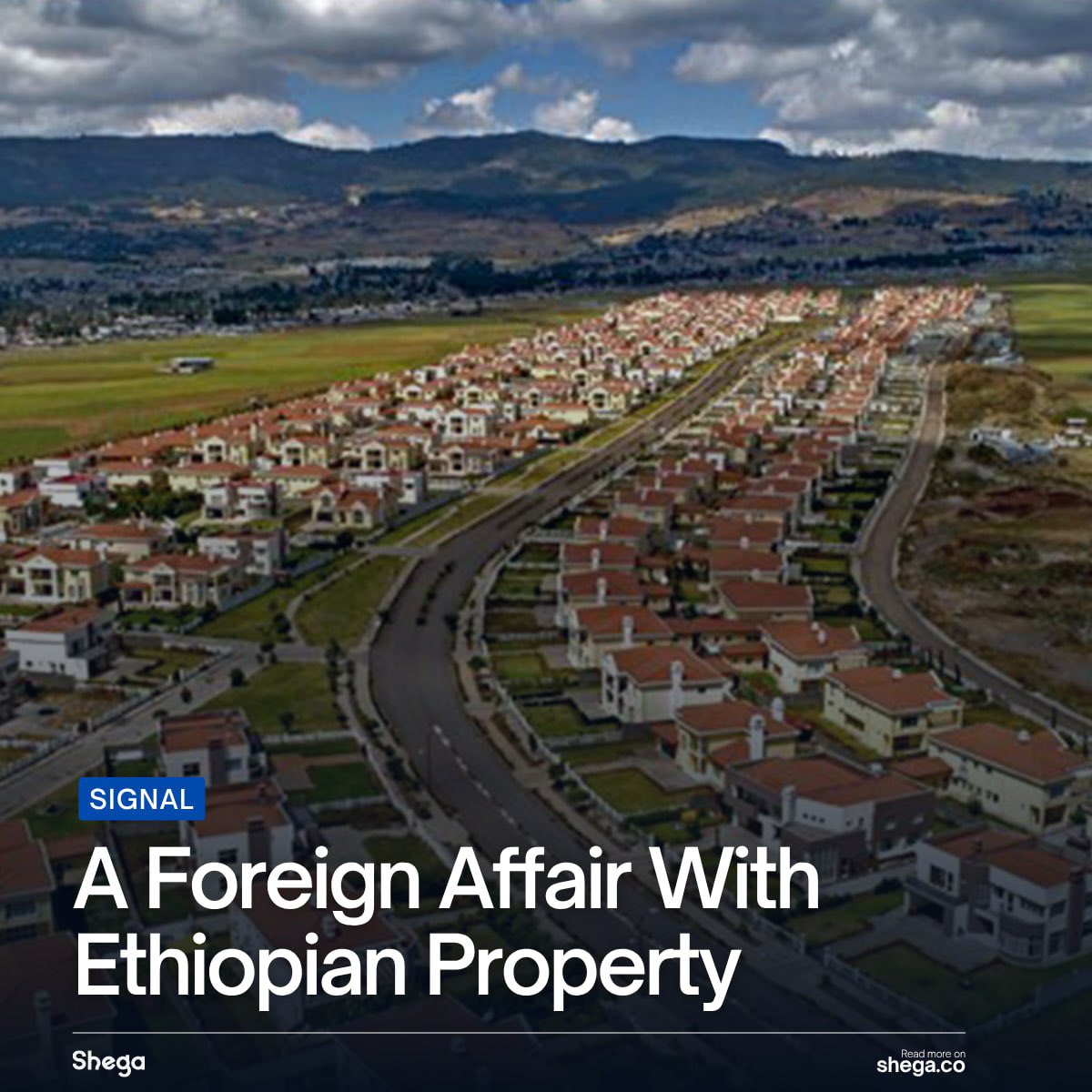
Ethiopia has opened residential property ownership to foreign nationals.
A 1907 decree recognized private ownership of urban land and extended the right to buy it to Ethiopians and foreigners alike. Greek, Armenian, Indian and Arab merchant families owned the shops and houses of early Addis Ababa.
The door closed in 1960, under Emperor Haile Selassie. And the restriction then outlived the emperor who imposed it, the Derg that overthrew him, and the EPRDF that overthrew the Derg.
It was set aside only this year.
The implementing directive, issued in August, sets three tiers: USD 150,000 in Addis Ababa and Shaggar, USD 120,000 across most regional states, USD 100,000 in Afar, Benishangul-Gumuz and Gambella.
What a buyer acquires is not land. It is title to a structure on a government lease, the same arrangement Ethiopians have held since the early 1990s.
Read more
: shega.co/news/a-foreign-affa…
Source : @shegamedia
“Built with China’s assistance” is a misleading description of how the GERD came to life.
It reflects a familiar habit in global reporting: a tendency to describe an emerging countries commerce as “foreign assistance”
The Grand Ethiopian Renaissance Dam (GERD) is a roughly $5 billion to $6 billion megaproject brought to life through a complex mix of domestic willpower and international commercial engineering.
With international financial institutions unwilling to finance the project, Ethiopia funded the dam’s roughly $5 billion civil construction domestically through the government and contributions from Ethiopian citizens.
A Chinese state bank provided around $1 billion in commercial financing for electromechanical equipment, a loan Ethiopia must repay.
The 13 turbines also came from multiple suppliers: 5 from GE Hydro France and 8 from Voith Hydro Shanghai.
These were commercial transactions involving lenders, contractors and paid suppliers, not foreign charity.
The framing reflects a familiar pattern in global reporting on emerging markets.
When wealthy countries purchase foreign technology, it is called commerce.
When emerging-market countries do the same, it is called “assistance.”
The GERD was brought to life primarily through Ethiopian financing, political will and risk-taking. Call it as it is.
Foreign companies supplied expertise and equipment because Ethiopia contracted and paid them. That distinction matters.

Así se encuentra la Gran Presa del Renacimiento Etíope, levantada con ayuda de China.
Ha operado este ciclo con un excedente del 17% por encima de su capacidad.
Egipto, muy preocupado.
La Gran Presa ha generado más de la mitad de la electricidad del país y ha aumentado espectacularmente las exportaciones.
Si Etiopía quiere continuar creciendo, debe reinvertir estos ingresos en más infraestructura e industrias que generen empleo.
Un país con una población de 140 millones de habitantes en pleno crecimiento demográfico y económico necesita alternativas. Si no, el colapso puede ser terrible.
Las diferencias étnicas, las tensiones constantes y el gran anhelo por recuperar la salida al mar para no quedarse estancados comercialmente, son las claves del devenir del país.
Hay que seguir con atención a Etiopía.

An exemplary #restitution. 17 Ethiopian manuscripts returned from the US by Prof Steve Delamarter and his team donated by Barbara Weiner and presented at the Ethiopian Heritage Authority and gifted to 7 Ethiopian Institutions.


Anteneh Tesfaye retweeted

50.7M registration. Adding new 20M+ IDs in just 6 month. Great achievement @IDethiopia . In this pace, we will reach 100M in a year or two. Though, last 20-30M will be the hardest.

With 38.6M registrations, adding 8 million new IDs in just the last 2.5 months is very impressive. @IDethiopia
People still don’t grasp the scale of Ethiopian Airlines.
ET’s fleet of ~170 is 2.5× larger than each of the next four African carriers and 4.5× Kenya Airways.
Emirates has ~270. Ridiculous to me when you consider Ethiopia has a fraction of the wealth and none of the oil-funded state backing, direct cash subsidies, or sovereign guarantees the Gulf carriers enjoy.
Literally, about 15 African countries have a 2026 nominal GDP below ET’s $9.1bn revenue. That includes Liberia and Burundi, plus Ethiopia neighbors Eritrea, Djibouti and South Sudan.
Knowing that this massive scale was built by running the airline professionally and just funding expansion from operations and commercial borrowing, it makes ET a true outlier in global aviation.
This quoted post is unavailable.