

Founder of @NedRockSA, passionate about helping teams create products that are valuable, usable and feasible.
South Africa
Joined July 2009
- Tweets6.8K
- Following1.5K
- Followers1.2K
- Likes2.3K




Annu Augustine retweeted

Be sure to engage with these companies exhibiting at this year's conference.
@africanimpactin , @iaforg , @AfricaPLA , @nedrocksa & @flyethiopian
Just wrapped a course on AI evals with @HamelHusain & @sh_reya.
Big shifts for me:
• Obsess over quality
• 60–80% dev time = error analysis (skip → whack-a-mole)
• Evals sharpen specs, prompts & build trust
👉 Next cohort Oct: maven.com/parlance-labs/eval…

So looking forward to this, and visiting another African country, Rwanda - Here I come!

Annu Augustine has spent 25+ years in tech helping teams build products that truly matter.
Founder of @nedrocksa , she’s shaping Africa’s next generation of product leaders with a mix of Silicon Valley best practices and African market realities.
Catch Annu live this October at the Inspire Africa Conference 2025 in Kigali. Register now at inspireafricaconference.com.
#InspireAfricaConference #IAC2025 #ProductLeadership #DigitalTransformation #BuildForAfrica #TechLeadership #AfricaTech

Annu Augustine retweeted

True domain expertise is domain knowledge minus domain dogma.
True domain insight is domain expertise plus creativity.
The more complex & constrained the domain, the more vital it becomes to seek domain insight.
Once again back to UCT campus, attending #uctparentorientation2025. What a beautiful campus, 4 000 new students this year. Super happy to see the diversity.





Annu Augustine retweeted

I’m Marc Randolph, co-founder of Netflix & 6 other companies.
This is my definition of success:

Annu Augustine retweeted

Please entrepreneurs, don't be satisfied with a superficial understanding of the problem you want to solve. Dig deep to find the truth.
Annu Augustine retweeted

Tony Fadell (co-creator of the iPod and iPhone) on opinion-based decisions
“When you make the first version of anything—something revolutionary—there are a lot of opinion-based decisions… And when you have those opinions, and you’re trying to work with a team to implement those decisions, you have to really tell the ‘why’ of those decisions. That way everyone can feel like they’re a part of those decisions and understand the tradeoffs... A lot of times, people want a data-driven decision, but with v1s you don’t have data... If you look at most companies that are paralyzed and cannot make new innovations and new products, it’s because they’re trying to turn opinion-based decisions into data-driven decisions so that they don’t lose their jobs”
— Tony Fadell

Annu Augustine retweeted

Hello X! We are hiring product managers and product designers at Jupiter for different verticals. We want to build India's most loved financial wellness app and want to get in touch with the absolute best PMs and designers.
If you have launched and grown exceptional products with minimum 1m users, please reach out to me on superdm.me/anuj
Repost for good karma!
Annu Augustine retweeted

What does Sam Altman look for in a team?
As Sam looks to reverse-uno his way back onto the OpenAI board, he'll need to rebuild his team.
So what does he look for? Here's what he's said in the past:
First and foremost, you need optimists, "people who say 'you know what, we are gonna do this and it doesn't matter what the haters say. We're gonna figure this out. This problem it must be solvable.'"
Without optimism, "it's very hard to succeed when the world continues to punch you in the face."
Then they need to be idea generators. "Constantly spewing new ideas, most of them terrible." That's Altman's counterintuitive take on creativity. While you only need a few of these prolific thinkers, their offbeat concepts can unlock innovative solutions.
Altman also prizes the "we'll figure it out" attitude. Whether they have the skills or not, he loves people who confront challenges head-on.
Decisiveness is another must-have. Startups operate with imperfect data, so paralysis by analysis can be fatal. Altman wants team members who act swiftly and adapt when things go sideways.
But perhaps most surprisingly, Altman values inexperience. He's seen startups achieve the unthinkable, simply because they didn't know it was supposed to be hard. This naivety sparks fresh approaches that veterans might dismiss.
Keep an eye out for how his new team embodies these characteristics:
- Optimism
- Idea generation
- ‘We’ll figure it out’ attitude
- Decisiveness
- The blessing of inexperience
Glad you found it insightful!

If you thought your company was struggling trying to connect design, tech and product teams, well you’re not alone!
Another great event by @annua and her team!
@GeneralMutakwa’s insights into warning signs absolutely resonated with me!

Annu Augustine retweeted

Many PMs struggle to explain the difference between Vision, Strategy, Objectives, and Roadmap.
But those are extremely simple concepts.
Let's tackle them one by one:
1. Product Vision (Why)
Product Vision is the long-term aspiration of your product. It motivates your team to wake up every morning and go to work.
For example, “Send humans to the Moon” or “Help tour operators focus on doing what they love.”
Effective vision needs to be inspiring and emotional. It becomes much more memorable when it speaks to people's hearts.
My favorite example is the JFK Moon speech: youtu.be/th5A6ZQ28pE?si=YWCc…
2. Product Strategy (Where & How)
Strategy is not a plan, a goal, or a set of actions.
It's a cohesive set of choices that you believe will allow you to win (achieve your Vision) at the playing field of your choice:
- market and its constraints (e.g., geography)
- value proposition
- relative costs
- tradeoffs
- growth
The strategy should pass the “can’t / won’t test” so that competitors can't copy it without sacrificing their existing businesses.
A fantastic, short video by Prof. Roger Martin: youtu.be/iuYlGRnC7J8?si=UCcD…
The Product Strategy Canvas (no email, no paywall): lnkd.in/d3w3QUwV
3. Objectives (What)
I encourage you to use the OKR framework. It's a simple, incredibly effective approach for setting, monitoring, and achieving your goals.
While following the SMART goals principle (Specific, Measurable, Achievable, Relevant, and Time-Bound), OKRs add an additional, inspirational aspect to the Objective.
I recently described how to start with OKRs in a free post: xitter.cf/PawelHuryn/statu…
4. Product Roadmap (So What & When)
Product Roadmap is a communication tool that allows you to align everyone in the organization. It creates focus on what’s important right now. It should also explain the reasoning behind it.
In 3 Ways to Create 10X Better Product Roadmaps, I emphasized that it's extremely important to:
- Focus on outcomes, not features
- Do not commit too soon
- Shorten the planning horizon
My favorite format is the Now-Next-Later. Free article (no email, no paywall): lnkd.in/dRKgaJzb
More information:
- Vision, Mission, and Purpose are often confused, and everyone interprets them differently. I use a single term. An article by Prof. Roger Martin: rogermartin.medium.com/the-m…
- Some say that Vision is part of Strategy. It makes sense, as Strategy is an integrated set of choices. And you develop them together. But that’s not the most common opinion. So, during interviews, keep it simple.
Hope that helps.
What are your thoughts?
-
P.S. If you liked this, consider joining a community of 32,000+ product professionals. Get one actionable tip for PMs every Saturday: lnkd.in/djnfdris


OKRs are a simple, incredibly effective approach for setting, monitoring, and achieving your goals.
But they are commonly misunderstood.
How to start?
1. Empowered teams
OKRs work only with a culture of empowerment. In companies with a dysfunctional organizational culture, OKRs might become another tool to impose control over employees.
2. Vision and strategy
Before defining your first OKR, it's essential to establish a vision and strategy.
While the vision provides a long-term "Why," the OKR motivates and guides a team in the short term, typically over a quarter, defining:
- Why it's important.
- What we need to achieve.
- How we will measure we succeeded.
3. Start with just one team
First, get one team to try OKRs before the whole company jumps in. This team should be cross-functional, able to reach their goals without relying on others.
After a few months, celebrate what they've achieved. Hopefully, this will get other teams excited about OKRs.
4. Select just one OKR
Start with a single OKR for the entire company without cascading it down. This simplifies the implementation and allows you to identify teams that need more coaching. This is particularly effective in smaller companies.
5. Start from initiatives focused on the outputs
For example, if you're adding a new search feature, think backward. Ask yourself: What’s the goal of this initiative? How would we measure that we succeeded?
This helps you turn the task into an OKR and start thinking and making decisions based on data.
6. Keep things simple
Don't expect to figure out everything from the start. Test ideas, learn from them, and get better over time.
Based on Radical Focus by @cwodtke
-----
P.S. In the free part of my latest newsletter (1,351 words), I described:
1. Two Approaches to OKRs
2. Why Do We Need OKRs?
3. What Exactly Are OKRs?
3.1 Prerequisites
3.2 How to create Objectives?
3.3 How to create Key Results?
And in the premium part (2,440 words), we deep-dive into the OKRs:
4. OKRs: A Quarter Step-by-Step:
4.1 How to start?
4.2 During the quarter + my advice
4.3 Closing the quarter
5. OKRs: Best Practices and Common Mistakes
6. OKRs: Advanced Techniques
6.1 OKRs and Scrum
6.2 OKRs and Product Roadmap
6.3 OKRs and Continuous Product Discovery
6.4 Extending the traditional OKRs
6.5 OKRs vs. alternatives
Hope that helps.
You can keep learning here: lnkd.in/dQmrs_3G

Annu Augustine retweeted
I'm constantly adding new resources and content to the Fundraising Playbook.
You can get it for free & if you use Notion, just duplicate the whole thing. It includes:
* Sample fundraising schedule
* Checklists
* Databases of investors
* Templates
* And more!
👇
Annu Augustine retweeted

I came across this wonderful piece from @marcrandolph, Co-Founder of @netflix, the other day. Highly recommend reading it and internalizing it. 5 key lessons I pulled away from Marc’s reflection:
1. Everyone should have a north star - success is what you make of it; money, influence, impact, balance, intellectual satisfaction. There’s no right or wrong; it’s different for each person. The worst thing you can do is build a life around somebody else’s definition of success
2. Values are easy to have, hard to uphold - Your values shine through in difficult times - Extending Marc’s example, it’s not difficult to wrap up at 5 pm on a quiet Tuesday. In a crisis situation, it is difficult, but not impossible. If it’s truly a value, it will be upheld in rain or shine.
3. Compounding is magical - It is so difficult to measure the compounding quality of non-quantitative actions. In business, we see the impact our decisions have daily; these are easily measurable and can be measured over hyper short duration timeframes. It’s why we gravitate towards them - instant gratification.
What we don’t see however is the impact of daily decisions that aren’t easily measurable, e.g. an individual conversation with a colleague, a sit down dinner with a family member, daily inward reflection. In my experience, these decisions don’t breed instant gratification, but they are so important - they’re the source of enduring and sustainable long term gratification.
4. Balance comes from imbalance - I’ve found that the best way to achieve enduring happiness is to go “all in” on whatever you’re doing. If you’re at work - go all in; focus, be the best teammate and leader you can be. If you’re at home - do the same; be the best spouse, partner, parent, sibling, you can be.
5. Constraints force impact - This has been a learning for me as I’ve scaled myself as a Leader. The biggest challenge when you’re operating a high growth business is focus; my friend has a simple framework he uses that I love (and stole!). Every company earns the *right* to do a handful of things really well. No more, no less. Inserting constraints forces you to focus, prioritize and spend time on areas that are highest impact and highest leverage.

Annu Augustine retweeted

.do y'all know any analyst/ graduate that has had a bit of McKinsey, Accenture, Boston Consulting, or Deloitte experience but is keen to get out & go do consulting work in socio-economic impact space? Might have some opportunities to recommend for them. Please DM
Annu Augustine retweeted

In 2007, I was 1 of 2 designers on Google Maps.
The app was growing like wildfire.
But it was becoming a cluttered mess — new features were being shoved into every pixel.
Here’s the 4-step process we used to redesign Google Maps into one of the most loved apps in the world: 🧵
–––
But first, it’s important to understand it is normal to build a product based on the underlying technical structure.
In 2005, Google Maps queried one of three databases for any search:
• Maps data
• Local business data
• Directions data
Not surprisingly, the first version of the website had three tabs, one for each of these databases: Maps, Local Search, Directions.
–––
By 2007, Google Maps still wasn’t the dominant mapping application.
But it had hit PMF, its user base was growing quickly, and we were rapidly adding new content and features like:
• Satellite and Terrain views
• Streetview, 3D buildings, Traffic
• Editable map data, Reviews, Photos
• Transit Data
We were wedging new features into any space we could find in the UI.
It became clear the user experience was suffering and the product was growing increasingly complicated.
At that time, our VP, Marissa Mayer likened Google Maps to a Christmas tree that we kept adding more and more ornaments to until it started to fall over…
We tried many different ways to rearrange the UI to accommodate new features.
Eventually we had to step back and rethink Google Maps based on what we knew was working, what brought people to the product, and what we believed the future might look like.
–––
These were the 4 key steps we took to simplify the design of Google Maps to be the intuitive, durable, much-loved product that 1B people still use today:
1. Deconstruct
We wrote down all of the product’s current and upcoming content, features, and functionality and loosely grouped them into categories:
• Core features — The most common tasks people came to do (search, get directions, find businesses)
• Aspirational use cases — Tasks we wanted people to start doing (adding their own content, correcting inaccurate information, using Maps to explore new places, etc.)
• Global actions — Actions that impacted the entire page (print, share, save, etc.)
• Use case specific actions — Actions that were relevant only within a specific use case (eg while getting directions, being able to drag a route or add a destination)
• Related features — Things that weren’t a part of Google Maps at the time, but existed and were closely related. (eg transit information, business searches on Google.com)
–––
2. Reframe
We leveraged a combination of user research, business goals, and our own intuition to make the product better, simpler, and scalable over time. We focused on understanding:
• What brought people to the product
• How they navigated through the product
• What was working well
• What flows were confusing
• What things were missing
• What information was valuable when
• What functionality was redundant
We emerged with several key points:
• “Searching” was the most pivotal task in Maps
• Searching addresses, businesses, parks, mountains, cities, etc could all be thought of as searching for “places”
• Getting directions was important, but rarely happened between two specific addresses. Directions searches usually had a known start or end point, like home or work. It was also more intuitive to be able to search for directions by a place name e.g., Carmel Library rather than having to look up the address first.
• It was strategically important for people to be able to contribute content to Google Maps and to be able to explore the world around them.
–––
3. Reconstruct
Based on what we learned, we then explored ways to reshape the product.
We held these general usability principles in mind:
• Entry points to core use cases should be prominent
• Flows within core use cases should be intuitive
• Common actions, interactions, and views should be consistent
• Contextual actions should be accessible when relevant
This is one exploration of clustering tasks and connecting relevant content:
Our explorations of how to reconstruct the site around people’s needs and flows led to several key design changes:
• There would be only one search box for everything
• Directions would live as a secondary feature
• Other features would appear in context (eg, transit became a mode within directions)
–––
4. Scale for the future
This was 2007. We knew the product would continue to evolve, the information set would grow exponentially, and the feature set would continue to expand.
But by focusing on key use cases and folding information in to the UI where it was relevant, we created a framework to support future growth.
16 years later, Google Maps has continued to evolve, yet is still a simple, intuitive, much-loved product that 1B people use around the globe.
For more on design, follow @elizlaraki


Annu Augustine retweeted
The North Star Metric is an extremely simple, powerful concept.
But it's largely misunderstood.
In this tweet, I explain:
1. What is a North Star Metric?
2. Common misconceptions
3. Recommended classification
Let's tackle them one by one:
1. What is a North Star Metric?
The term has been popularized by @SeanEllis, also known for coining "growth hacking" while being a growth marketer at Dropbox.
In the Growth Hacking world, North Star Metric:
- Is a single metric. The goal is to create focus.
- Is easy to understand, enabling everyone to speak the same language.
- Is customer-centric. Reflects how customers get value from the product.
- Ideally ensures the value is sustainable, typically by forming habits.
- Represents your progress toward vision/mission, fostering alignment and inspiring teams to move in the same direction.
- Is quantitative. It relies on numbers, not opinions.
- Is actionable. You will take action based on how it changes. Otherwise, what's the point of tracking it?
- Serves as a leading indicator of your long-term business success.
2. Common misconceptions
It's important to clarify what the North Star Metric is not:
- A few metrics. While a company may select a few key metrics, referring to them as "North Star Metrics" is a misunderstanding. Have you ever seen multiple North Stars in the sky?
- A metric focused on business value, like LTV/CAC. This overlooks the essential aspect of being customer-centric. Besides, can your team truly get excited about solely growing revenue?
- An Objective Key Result - OKR is a goal-setting technique. You can use OKR to express an expected mid-term change in the Nort Star Metric. But it is important not to confuse these terms.
- A strategy - A strategy is a cohesive set of choices, such as a Value Proposition, that reinforce one another and enable you to succeed in your chosen playing field. Your North Star Metric must align with your strategy.
3. Recommended classification
I've come across various attempts to classify North Star Metrics. The best one I've found is proposed by @Amplitude_HQ. Depending on the game you are playing, you might want to focus on:
⚡ Attention - How much time do your customers want to spend in your product? The time and recurrent use of a product can indicate the value people derive from it.
🎁 Transaction - How many transactions do your customers make in your product? Your goal is to assist customers in finding the right product quickly and easily.
💼 Productivity - How efficiently and effectively can someone do their work? Your goal is to help customers with specific tasks.
Identifying the game you are playing is the first step toward finding your North Star Metric.
-
Hope you find value.
More information:
My new post, The North Star Framework 101: theproductcompass.tech/lasti…
More about Amplitude's classification: amplitude.com/north-star/get…

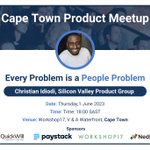
Looking forward to our first in person Cape Town Product Meetup since 2019, been too long. Looking forward to hosting @CIdiodi from @officialsvpg as part of his African tour, - meetup.com/cape-town-product…
Thanks to our sponsors @quickwill_za , @Payfast, @Workshop17za , @nedrocksa
