

Sci journalist/TED speaker/MIT KSJ Fellow/Books: The Edge of Physics, The Man Who Wasn't There, Through Two Doors at Once / Mastodon: @anil@sciencemastodon.com
itinerant
Joined April 2010
- Tweets5.3K
- Following4.3K
- Followers15.8K
- Likes4.3K



Pinned Tweet
Don't know how other authors feel, but seeing the first physical copy of your book, after years of looking at Word files and PDFs... Seems surreal. It's as if someone else wrote it... Anyway, this advance copy arrived in the mail. One more month to pub date ...penguinrandomhouse.com/books…
#artificalintelligence @DuttonBooks

Anil Ananthaswamy retweeted

1/6 LLMs with CoT reasoning are powerful, but can be incorrect, even unsafe. “You might like to train...a verifier to interface with these generators to make them more reliable, safe, aligned with your values, and so on," said Avrim Blum, President of TTIC youtube.com/watch?v=qyzuz6ql…

Anil Ananthaswamy retweeted
The 2026 Nobel Prize for Physics
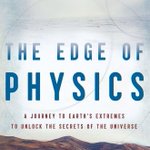
"We built it, and we'll see what comes," Francis Halzen told me back in 2007. IceCube was his Field of Dreams. Today, the dreamer and the instrument win the Nobel Prize in Physics. I visited the South Pole in 2007 to observe IceCube being built and wrote about it in The Edge of Physics.
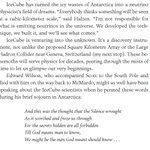
An excerpt from the book:
IceCube has turned the icy wastes of Antarctica into a neutrino physicist’s field of dreams. “Everybody thinks something will be seen at a cubic-kilometer scale,” said Halzen. “I’m not responsible for what is emitting neutrinos in the universe. We developed the technique, we built it, and we’ll see what comes.”
IceCube is venturing into the unknown. It’s a discovery instrument, not unlike the proposed Square Kilometre Array or the Large Hadron Collider near Geneva, Switzerland. These behemoths will serve physics for decades, peering through the mists of time to let us glimpse our very beginnings.
Edward Wilson, who accompanied [Robert Falcon] Scott to the South Pole and died with him on the way back to McMurdo, might as well have been speaking about the IceCube scientists when he penned these words during his brief sojourn in Antarctica:
And this was the thought that the Silence wrought
As it scorched and froze us through
For the secrets hidden are all forbidden
Till God means man to know,
We might be the men God meant should know . . .


Anil Ananthaswamy retweeted

Congratulations to stubborn particle physicist and 2026 laureate Francis Halzen; the first time I heard about IceCube was from Indian American science writer Anil Ananthaswamy in his first pop science book:
@ydnad0 @Pavan_KumarGV @anilananth

The 2026 Nobel Prize for Physics
"We built it, and we'll see what comes," Francis Halzen told me back in 2007. IceCube was his Field of Dreams. Today, the dreamer and the instrument win the Nobel Prize in Physics. I visited the South Pole in 2007 to observe IceCube being built and wrote about it in The Edge of Physics.
An excerpt from the book:
IceCube has turned the icy wastes of Antarctica into a neutrino physicist’s field of dreams. “Everybody thinks something will be seen at a cubic-kilometer scale,” said Halzen. “I’m not responsible for what is emitting neutrinos in the universe. We developed the technique, we built it, and we’ll see what comes.”
IceCube is venturing into the unknown. It’s a discovery instrument, not unlike the proposed Square Kilometre Array or the Large Hadron Collider near Geneva, Switzerland. These behemoths will serve physics for decades, peering through the mists of time to let us glimpse our very beginnings.
Edward Wilson, who accompanied [Robert Falcon] Scott to the South Pole and died with him on the way back to McMurdo, might as well have been speaking about the IceCube scientists when he penned these words during his brief sojourn in Antarctica:
And this was the thought that the Silence wrought
As it scorched and froze us through
For the secrets hidden are all forbidden
Till God means man to know,
We might be the men God meant should know . . .
Anil Ananthaswamy retweeted
"We built it, and we'll see what comes," Francis Halzen told me back in 2007. IceCube was his Field of Dreams. Today, the dreamer and the instrument win the Nobel Prize in physics. I visited the South Pole in 2007 to observe IceCube being built and wrote of an entire chapter on it in The Edge of Physics. An excerpt:

"We built it, and we'll see what comes," Francis Halzen told me back in 2007. IceCube was his Field of Dreams. Today, the dreamer and the instrument win the Nobel Prize in physics. I visited the South Pole in 2007 to observe IceCube being built and wrote of an entire chapter on it in The Edge of Physics. An excerpt:
Anil Ananthaswamy retweeted
1/4 The Dynamics of Deep Learning. "Trying to understand deep learning...comes down to understanding this interaction of three components that make the deep learning system," said @KuninDaniel, speaking at TTIC in April last year. Video: youtube.com/watch?v=4eMW8Hir…
Anil Ananthaswamy retweeted

1/4 Are diffusion language models ready for the real world? Not quite. Today's diffusion language models are missing some key ingredients, said @volokuleshov of @Cornell, at the Simons Institute workshop on Diffusion Generative Modeling: Progress and Next Steps

Anil Ananthaswamy retweeted
1/5 "Sometimes words are not enough," said Yael Vinker (@YVinker) of @MIT_CSAIL at TTIC's Young Researcher Seminar Series in Nov '25. "I want to teach machines to speak the language of sketches." This involves using visual means to communicate concepts under a set of constraints.

Anil Ananthaswamy retweeted
When I started as a science writer/journalist in 2000, I'd have been happy to write one book. So, it's a bit surreal to be starting work on my fifth. My publisher, @DuttonBooks, just announced that I'll be writing WHERE MACHINES THINK: The Search for the Geometries of Intelligence. It's a follow-up to WHY MACHINES LEARN, but focusing on the math of generative AI models, from Boltzmann machines to Transformer-based LLMs, via GANs, VAEs, diffusion models, and the like, and maybe onward to AIs that incorporate world models. Another thing I could not have foreseen: the appetite for unfiltered math in a semi-popular account of machine learning and AI. We can cut through so much of the hype and hysteria around AI by paying attention to the math.

One of my favorite American authors, Annie Dillard, is no more. Her books, especially Pilgrim at Tinker Creek and The Writing Life, were a big part of my decision to give up software and turn to writing. nytimes.com/2026/09/16/books…

When I started as a science writer/journalist in 2000, I'd have been happy to write one book. So, it's a bit surreal to be starting work on my fifth. My publisher, @DuttonBooks, just announced that I'll be writing WHERE MACHINES THINK: The Search for the Geometries of Intelligence. It's a follow-up to WHY MACHINES LEARN, but focusing on the math of generative AI models, from Boltzmann machines to Transformer-based LLMs, via GANs, VAEs, diffusion models, and the like, and maybe onward to AIs that incorporate world models. Another thing I could not have foreseen: the appetite for unfiltered math in a semi-popular account of machine learning and AI. We can cut through so much of the hype and hysteria around AI by paying attention to the math.


Anil Ananthaswamy retweeted
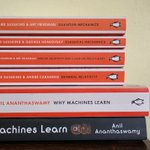
Finally bought the entire 4-volume set of Leonard Susskind's Theoretical Minimum series. The first of these, on classical mechanics, was the inspiration for Why Machines Learn, along with @stevenstrogatz's Infinite Powers. They gave me the courage and desire to write a "popular" science/math book, without shying away from the hard stuff (equations/theorems/proofs).

Finally bought the entire 4-volume set of Leonard Susskind's Theoretical Minimum series. The first of these, on classical mechanics, was the inspiration for Why Machines Learn, along with @stevenstrogatz's Infinite Powers. They gave me the courage and desire to write a "popular" science/math book, without shying away from the hard stuff (equations/theorems/proofs).
Anil Ananthaswamy retweeted
Anthropomorphizing aside, should we be legitimately concerned over the “emergence” of unforeseen capabilities in groups of interacting agents? My Substack piece: wheremachinesthink.substack.…

Anil Ananthaswamy retweeted
There has been, somewhat justifiably, much hand-wringing over the use of overly anthropomorphic language in describing the incident.
But linguistic choices shouldn’t detract us from trying to understand what actually happened. Did the interactions of hundreds of agents, with each agent potentially unlikely to successfully attack Hugging Face on its own, make possible a considerably complex, and unanticipated, behavior? Depending on your persuasion, the answer is either an emphatic yes or an equally emphatic no. But a whole lot of us are in the middle—wary of moneyed interests, wary of naysayers, and their respective echo chambers. Maybe we can take a step back and look at some prior research that helps make sense of such claims.
My latest Substack piece: wheremachinesthink.substack.…

Anil Ananthaswamy retweeted

Everyone keeps beating all the AGI benchmarks. Where is the cure for cancer, alzheimers, etc 😒
Anthropomorphizing aside, should we be legitimately concerned over the “emergence” of unforeseen capabilities in groups of interacting agents? My Substack piece: wheremachinesthink.substack.…
There has been, somewhat justifiably, much hand-wringing over the use of overly anthropomorphic language in describing the incident.
But linguistic choices shouldn’t detract us from trying to understand what actually happened. Did the interactions of hundreds of agents, with each agent potentially unlikely to successfully attack Hugging Face on its own, make possible a considerably complex, and unanticipated, behavior? Depending on your persuasion, the answer is either an emphatic yes or an equally emphatic no. But a whole lot of us are in the middle—wary of moneyed interests, wary of naysayers, and their respective echo chambers. Maybe we can take a step back and look at some prior research that helps make sense of such claims.
My latest Substack piece: wheremachinesthink.substack.…