

How can we help users understand whether a cross-chain transaction maintains privacy? We need to take inventory of the privacy features different chains offer and analyze how these features do (or do not) compose. Choose K has taken this initial step and deployed it as a tool.

As chains deploy distinct privacy features, understanding whether and how privacy is preserved in any particular cross-chain transaction becomes a challenge. We published the interactive tool privacy.vet to help evaluate transaction paths in the current landscape.

As chains rapidly roll out new privacy features, @KineticsMove joins @ConcentricArcL1 in offering analysis capabilities for confidential workflows. Such infrastructure-specific open-source tools can form a foundation for future interoperability between distinct privacy protocols.

Confidentiality analysis of Seal access policies for Sui and Confidential Assets for Aptos is now available at kinetics.network and can be incorporated into your CLI or GitHub Actions workflows via the library at choosek.com/kinetics-ts.

The Arc L1 is now live, and Arc Privacy Sector will soon let smart contracts keep state/transaction data private. But tools to analyze the confidentiality of a contract are already available today at Concentric. Prevent leaks so that the overhead of confidentiality is worthwhile.


To better support x402 workflows, Kinetics now offers transaction simulation under an optional spend policy. The dry run returns a decision object bound to the transaction: allow or deny, judged against what the transfer moves (vs. claims) when simulated against live state.
Basic simulation for Sui, Aptos, and Movement transactions is now live at kinetics.network and implemented in the open-source library at choosek.com/kinetics-ts.

It is encouraging to see the Nillion Covenants and Zama FHEVM SDKs working together to protect different attributes of an Ethereum transaction. The developer experience when working with PETs is improving. Formally analyzing the safety of such compositions is the next challenge.
Nillion Covenants and Zama confidential transfers are complementary ways to keep transaction attributes private. We paired them within a live testnet app: zilch.run. Explore the source code at github.com/choosek/zilch to see how the two SDKs can work in concert.

Safety for an agent amounts to what can be checked: permissions, spending caps, and resource conservation. Kinetics envisions a possible policy language: what its analyzer already uses. For an x402 payment, such policies could gate requests before agents are allowed to sign them.

Complementary cryptographic features that keep transaction attributes private are being deployed across multiple ecosystems. Become part of the infrastructure empowering this transition, support its adopters, and earn your share of the upside from the new use cases it enables.
Whether you're examining how your protocol/infrastructure may be exposed or just want to stay informed while discussing post-quantum roadmaps, you may find this interactive resource useful.
Trying to understand when quantum computing advancements are likely to impact your infrastructure according to the literature and industry players? We launched the open-source resource quantum.date to answer that question. Explore the latest data or submit your own.

Andrei Lapets retweeted

Basic simulation for Sui, Aptos, and Movement transactions is now live at kinetics.network and implemented in the open-source library at choosek.com/kinetics-ts.
RT @KineticsMove: For sensitive DeFi work with Move, don't choose between privacy and practicality. Static analysis runs locally (no PETs o…
The value of static analysis in DeFi workflows is amplified by Move's linear types: if a transaction produces a value it never consumes, an abort is guaranteed. Kinetics detects this locally from code alone. For cases analysis can't handle, encrypted simulation is coming soon.
Building a wallet, running an audit, or shipping a DeFi protocol on Sui or Aptos? Static analysis is a lightweight way to catch what you can't see in a raw transaction before signing/execution. See how Kinetics empowers all three roles in three scenarios: kinetics.network/use-cases.

With a roadmap that promises to combine static analysis of the rigorously-designed Move language with privacy-enhancing technologies, Kinetics will allow wallet and app developers to protect users and their data at every stage of a transaction that users can't audit themselves.
With Kinetics, developers in the Move ecosystem can now analyze transactions across Sui, Aptos, and Movement. The client-side tool and open-source library are live today, and support for private simulations is next on the roadmap. Learn more at kinetics.network.

Existing cryptographic primitives and privacy-enhancing protocols can allow today's smart contracts to operate on encrypted data. We've assembled a plan to make it happen, enabling targeted use cases in the immediate term and building towards a cross-chain, post-quantum future.


Multi-party computation is a compelling example that could support this paper's argument. While a secret-shared lookup table split over two machines light-years apart can reply intelligently to queries from a midpoint, the machines' contents would be seen locally as random noise.

I highly recommend reading The Blind Spot for anyone interested in why observer-independent computation is a category error.
And if you haven't read the preprint yet, you can find it here: philpapers.org/rec/LERTAF

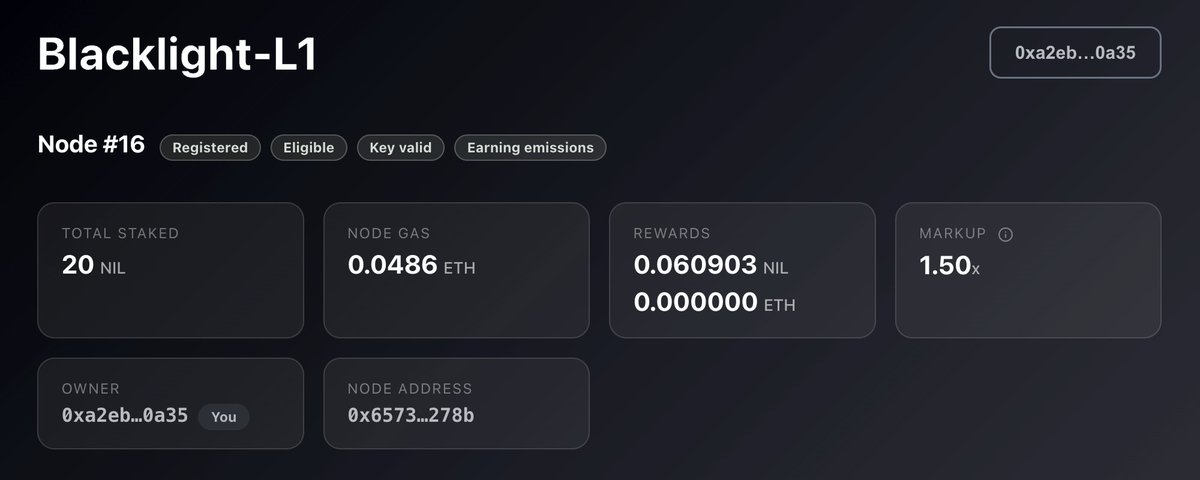
Privacy-enhancing technologies will not be worthwhile differentiators if users can't confirm apps use them and apps can't credibly advertise them as a feature. Starting today, anyone motivated to help address this gap and to make PETs more competitive can run a Blacklight node.
APIs transformed the developer experience by standardizing how apps share and leverage data. However, APIs only indirectly involve and benefit the users who subsidize this ecosystem by contributing their data. BPIs can act as a gradual path towards a more user-centric ecosystem.


Nearly a decade after the vision was first articulated, a modular web-friendly set of PETs software tools that lets developers disentangle component roles/functions in apps and workflows (thereby allowing them to minimize exposure of user data) is taking shape at @nillion.
