
Databases, Distributed Systems, Data Movement. Netflix platform engineering alumni. AI optimist.
Singapore
Joined July 2018
- Tweets415
- Following108
- Followers73
- Likes3.9K







Since a few math folks have a heart attack right now, it is a good time to pull up a recent post.
Also created an animation to showcase the point.
This is not a crushing moment for math professionals.
The golden era of math just started.
xitter.cf/andreas0x/status/21018…

We’re releasing a broad range of new mathematical results produced by an internal frontier model.
We’ve been consulting with the independent Advisory Group on Mathematics and Artificial Intelligence at the Institute for Advanced Study, and we have drawn on their advice and public recommendations to inform how we release these results.
github.com/openai/math

The Golden Era of Math just started.
A good way to think of math (and other constructions) is to visualize a vast, seemingly infinite space.
Math so far has been playing around within a very specific corner of that space, while the rest remained foggy.
With LLMs and more advanced tools to come, we can now discover more of that space.
The only thing that changed so far though is the speed of progress within the current corner.
Soon, we will also go into new directions.
Both is very exciting and mathematicians will have a lot to do and more than ever before.
The difference is only that the gate keeping is gone.
Eventually they will learn to handle the new noise.

In 2019 we created DBLog at Netflix for zero-pause CDC table copies.
Debezium and Flink CDC adopted the concept for their incremental snapshots.
All of this is now unified under Generalized DBLog: a formal contract for per-key convergence.
All frontier models including Astra are incredibly bad at writing.
This needs to get fixed asap before continuing the chasing game for higher benchmark scores.
Been working on ML efforts I have prior experience in, specifically unsupervised neural networks: link.springer.com/chapter/10…
Both ChatGPT and Fable struggle extremely badly here in a way that almost appears sus.
Im working with agents for 4+ months now, day and night and have never seen them struggle that badly.
Both 5.6 Sol and Fable come up with a reasonable initial plan based on detailed instructions and guidance.
The execution however is falling apart in silly ways. Such as giving up easily whenever they encounter 1 negative experiment, setting up excessive harness (even if I instruct them to not do this), or writing comparison frameworks as opposed to develop new solutions.
With very strict and continuous handholding they do end up doing somewhat useful work and progress.
However, this appears much worse (needs much more handholding) than non-AI efforts Im working on.
This is either brainworms or something is off here.

This quoted post is unavailable.
This is basically the remaining frontier of cope and it wont age well.
Nothing against the post(er) per se. It is just a good representative example for similar thoughts that circulate.
This and the related 'LLMs cant jump' post basically assume that models can not predict outside the distribution that they fitted.
Even though this specific argument, of course, is correct, it is missing the point that the ability to jump and to be wildly creative can be, fairly certainly, trained as well.
Empirical evidence is yourself. What makes you think around the corner ? Perhaps inspiration from sensory inputs ? such as art, music, haptic input ? visual experiences ? emotional experiences ? Likely all of this. Meaning: the human experience.
A lot of this already is encoded and already learned by frontier LLMs from text sources, aka textual descriptions of creative processes, and multi-model by actually modelling creative processes such as from videos, music etc.
Perhaps, feeding human like sensory data (haptic, emotions etc), either actually, or simulated, will do the trick.
Or perhaps the vast, existing corpus of textual descriptions and examples of creative processes is already sufficient and the models just need to get better in producing outputs that we deem as interesting/attractive/creative.
The lack of good default answers is a current limitation. For example, if you ask a model to create an app that will rank #1 in the appstores, the model certainly already encodes sufficient information to know what people like (current and predicting trends) and how they will like it (UI/UX etc). However, models currently are unable to provide a good outcome for such general prompts without strong handholding.
The same can be said about landing strong findings in math. If you notice, many persons who report these findings recently actually are mathematicians or related fields.
I wonder if clear novel breakthrough will come alongside producing better default answers.
This will inform if the already encoded creativity (via text) is sufficient, or not.

"Von Neumann could absorb vast amounts of information, follow extraordinarily complicated arguments and move between mathematical fields with astonishing speed. Yet Wigner still regarded Einstein’s understanding as deeper, more penetrating and more original. Von Neumann may have had the greater raw intellectual processing capacity, but Einstein was more likely to reconceptualize the problem itself.
Present-day AI appears more like a machine-amplified version of the first set of abilities than the second. It is extraordinarily fast, broad and capable of preserving and manipulating huge quantities of explicit information. It can search many possibilities, remember long chains of deductions and execute formal reasoning at a scale no unaided human can match. But that does not necessarily mean it possesses Einsteinian depth: the ability to discard the accepted framework, identify the hidden conceptual error and invent a radically new way of seeing reality."
Indeed. I will wait for AI to "discover" something like the equivalence principle.
New paper publications that dont have an AI acknowledgement discosure are, very certainly, dishonest.

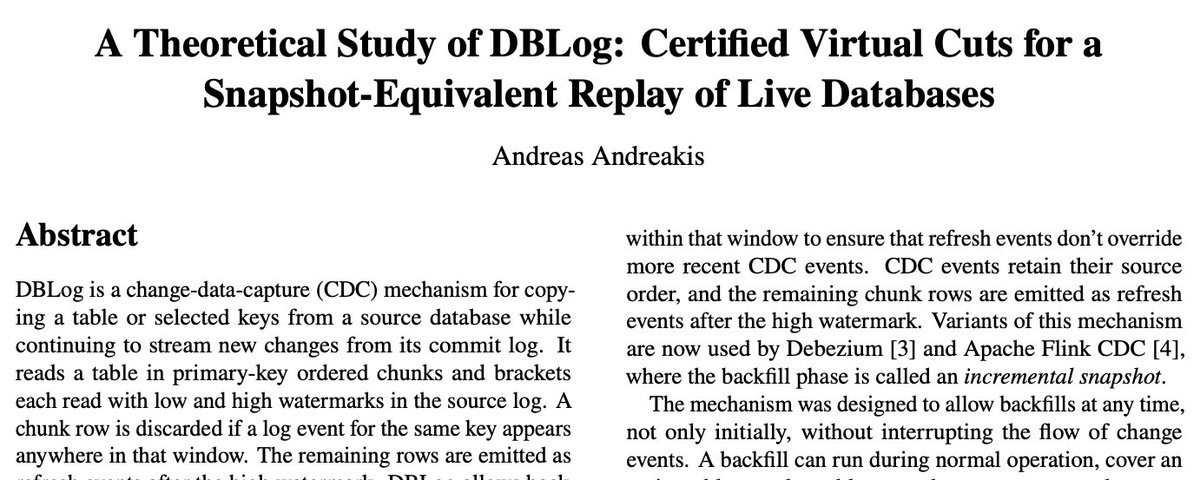
Did you know it is possible to read a table in chunks and get a result that is equivalent to a full snapshot?
While the underlying table is changing.
And that result is formally verified now.
#FormalVerification #ChangeDataCapture #CDC #Postgres #MySQL
I vibe coded and open sourced my old Netflix project in May using public material only, didn't touch a single line of code.
My SEO consultant (Fable 5 max) suggested I should re-post this as an X article. So here we are.
#VibeCoding #ChatGPT #Claude

Funny what you discover when you revisit old work.
I developed DBLog during my time at Netflix, a Change Data Capture solution that allows incremental snapshots without pausing live CDC events and without using locks at the source DB.
We published a blog post and a paper while I was still there (co-authored with my manager at the time: @ipapapa).
After I left Netflix in June 2021, I honestly stopped following what happened next.
Recently, I realized that @debezium (the leading CDC open source project) implemented incremental snapshotting based on DBLog's approach and explicitly credited the DBLog paper (debezium.io/blog/2021/10/07/…). And @ApacheFlink CDC’s MySQL docs say their chunk-reading algorithm is inspired by the DBLog paper (nightlies.apache.org/flink/f…).
After researching more, I found out that DBLog shows up in more than one @InfoQ article and has also appeared in various tech blog posts such as from @Shopify, @brexHQ, @Decodableco, and others.
That was a pretty nice surprise. You work on something, move on, and years later realize it kept traveling.
It’s genuinely satisfying to see the idea prove useful beyond the original Netflix use case.
DBLog blog post: netflixtechblog.com/dblog-a-…
DBLog paper: arxiv.org/abs/2010.12597
#NetflixEngineering #CDC #Debezium #MySQL #Postgres #ApacheFlink #ApacheKafka
