

Single-cell & mouse genetics to study dorsal striatum interneurons in neurodegeneration | @univcadiz @INiBICA_IIS
Joined July 2019
- Tweets51
- Following136
- Followers186
- Likes95



Muñoz-Manchado Lab | AMMlab retweeted

BREAKING NEWS
The 2026 #NobelPrize in Physiology or Medicine has been awarded to Karl Deisseroth, Peter Hegemann and Georg Nagel “for their discoveries concerning light-gated ion channels and optogenetics.”

Muñoz-Manchado Lab | AMMlab retweeted

🧬 We are building increasingly detailed maps of human cells. How do we make them useful for everyone generating new data?
Our new paper in Nature Genetics introduces ArchMap: a free web platform for mapping single-cell datasets onto reference atlases, without writing code.
Built scArches, ArchMap brings reference mapping, cell-type annotation, uncertainty estimates and collaborative exploration into one workflow. One aspect I particularly like: understanding where a new dataset differs from the reference. In a pulmonary fibrosis example, we show how annotation uncertainty, followed by gene-expression analysis, can help reveal disease-associated cell states.
For me, this is useful for Human Cell Atlas and related efforts: making the maps we build accessible as everyday tools for biological discovery. Congratulations to Mo , Chelsea, Ronald, Malte and the whole team!
Try ArchMap: archmap.bio
Read the paper: nature.com/articles/s41588-0…
#SingleCell #HumanCellAtlas #ComputationalBiology

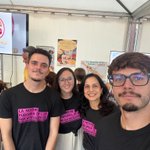
El pasado viernes estuvimos con los compañeros de @Berrocoso_Lab en la #nocheinvestigadores en San Fernando, presentando el taller La magia del cerebro🧠. Una oportunidad maravillosa para acercar la neurociencia a los más pequeños.
¡Muchas ganas de repetir el año que viene!


Muñoz-Manchado Lab | AMMlab retweeted
🌙🌃🔬 INiBICA participa con 13 talleres en La Noche Europea de los Investigador@s 2026 🌙🌃🔬
Más información 👉 lanochedelosinvestigadores.f…

🧠Ayer, con motivo del #DíaMundialDelAlzheimer, nuestra IP, Ana Belén Muñoz-Manchado, participó como organizadora y moderadora en la jornada del @INiBICA
Un encuentro destinado a acercar la investigación en este campo así como la realidad de los pacientes al público general.


Muñoz-Manchado Lab | AMMlab retweeted
New grant HUNTInT (PID2025-174604OB-I00): 1 PhD (FPI) + 1 postdoc. Striatal interneurons and partial reprogramming in Huntington's disease, via snRNA-seq and spatial transcriptomics in human and mouse tissue.
Get in touch to be notified: [email protected]
#Neuroscience #SingleCell

Muñoz-Manchado Lab | AMMlab retweeted
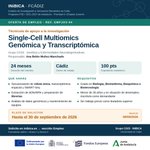
🚀 ¡Estamos contratando! Súmate a la Unidad de Single-Cell Multiomics del INiBICA (Cádiz) como Técnico/a de investigación 🧬
Grado en Bio/Biomed/Bioquímica/Biotec · 24 meses
Para <30 años en desempleo
🗓️ 30/09/2026 · inibica.es
#EmpleoJoven #Genómica

🚀 ¡Estamos contratando! Súmate a la Unidad de Single-Cell Multiomics del INiBICA (Cádiz) como Técnico/a de investigación 🧬
Grado en Bio/Biomed/Bioquímica/Biotec · 24 meses
Para <30 años en desempleo
🗓️ 30/09/2026 · inibica.es
#EmpleoJoven #Genómica
New grant HUNTInT (PID2025-174604OB-I00): 1 PhD (FPI) + 1 postdoc. Striatal interneurons and partial reprogramming in Huntington's disease, via snRNA-seq and spatial transcriptomics in human and mouse tissue.
Get in touch to be notified: [email protected]
#Neuroscience #SingleCell
Muñoz-Manchado Lab | AMMlab retweeted
Beyond the local tradition, this recognition shines a light on something that matters deeply: Scientific research and diseases like Parkinson's.
Thank you to @camaleonRota for making room for science on the shortest night of the year.
#Parkinson #Research


Muñoz-Manchado Lab | AMMlab retweeted
Our PI has received a heartfelt recognition in her home town from Peña Cadista El Camaleón. She has been chosen as this year's "juanill@", a traditional figure burned in a bonfire on Midsummer's Night as a symbol of celebration and renewal.
#Parkinson #Research

Our PI has received a heartfelt recognition in her home town from Peña Cadista El Camaleón. She has been chosen as this year's "juanill@", a traditional figure burned in a bonfire on Midsummer's Night as a symbol of celebration and renewal.
#Parkinson #Research
Beyond the local tradition, this recognition shines a light on something that matters deeply: Scientific research and diseases like Parkinson's.
Thank you to @camaleonRota for making room for science on the shortest night of the year.
#Parkinson #Research
Muñoz-Manchado Lab | AMMlab retweeted
How much biology can we recover from single-cell latent representations? 🧬
Latent spaces have become the backbone of modern single-cell analysis. They power atlas integration, foundation models, and increasingly perturbation prediction and Virtual Cell approaches.
Yet there is a surprisingly basic question that has received little attention:
👉 How well can we reconstruct gene expression from these latent representations?
In our new work, we introduce ReconEval, a benchmark for gene expression reconstruction across more than 100 million cells. We systematically evaluate three settings:
🔹 End-to-end reconstruction (PCA, autoencoders, VAEs)
🔹 Foundation model reconstruction (a new benchmark task for single-cell foundation models, asking how much gene-level information can be recovered from pretrained embeddings)
🔹 Latent shift reconstruction (evaluating reconstruction after perturbation prediction models operate in latent space)
A few takeaways:
📊 Autoencoders (not VAEs) achieve the strongest stand-alone reconstruction performance. This is perhaps not surprising, as reconstruction is exactly their training objective.
🧠 Foundation model embeddings retain substantial recoverable gene-level information, although performance depends strongly on the decoder and pretraining strategy.
🔬 The optimal latent representation depends on the downstream task. What works best for reconstruction is not necessarily what works best after perturbation prediction.
As the field moves toward increasingly sophisticated Virtual Cell models, reconstruction deserves more attention as an evaluation axis ie another task to evaluate. Ultimately, biological interpretation happens in gene expression space, not in latent coordinates.
Congratulations to Xiaotong Fu for driving this project and to all collaborators involved in making this benchmark possible. 👏
📄 Preprint: biorxiv.org/content/10.64898…
💻 Code: github.com/theislab/ReconEva…
#SingleCell #ComputationalBiology #VirtualCell

Muñoz-Manchado Lab | AMMlab retweeted
🗺️ Patient Landscapes
Looking back, I think this idea has been with us longer than I realized.
More than a decade ago we started working on DeepFlow, an AI method to reconstruct trajectories from single-cell data. The goal was simple: understand how cells move through biological state spaces and make decisions. What surprised me was that the same idea also worked for human disease data.
In 2017, we showed that patients with diabetic retinopathy could be organized into a continuous disease landscape rather than a few discrete categories. Patients naturally arranged themselves along trajectories from healthy to severe disease. At the time, we were mainly interested in understanding how machine learning models make decisions.
Looking back, I think something deeper was already there.
Over the years, from cellular trajectories to patient trajectories and, more recently, our work on tracking patient journeys across healthcare records, where patients move through different healthcare events over time, I have become increasingly interested in what I would call patient landscapes.
At some point, all of us enter this landscape.
The entrepreneur.
The factory worker.
The farmer.
The teacher.
The scientist.
We all become patients.
Yet our journeys can be very different. Some people receive the right diagnosis quickly. Others spend years searching. Some benefit from the best expertise available. Others do not. This makes me wonder whether one of the most important goals for AI in healthcare is not simply prediction or automation.
Perhaps it is navigation. Can we help people navigate the patient landscape more successfully?
🔹 Earlier diagnosis
🔹 Better prevention
🔹 More personalized treatment
🔹 Fairer access to expertise
If AI succeeds in healthcare, perhaps its greatest contribution will be helping every person benefit from the best medical expertise available, regardless of who they are or where they live.
A question I keep coming back to: If we could truly map the patient landscape, how should we use it to improve patient journeys?
📖 References
DeepFlow: Reconstructing cell cycle and disease progression using deep learning (Nature Communications, 2017)
EHRapy: An open-source framework for end-to-end analysis of electronic health record data (Nature Medicine, 2024)
#DigitalHealth #PatientLandscape #AIHealth


Muñoz-Manchado Lab | AMMlab retweeted

A huge thank you to everyone who attended, spoke, sponsored, volunteered, and contributed to making Dopamine 2026 such a success. Your energy, ideas, and connections made this event truly unforgettable. #Dopamine2026

Muñoz-Manchado Lab | AMMlab retweeted

Más de un centenar de investigadoras de la UCA figuran en el ranking nacional de científicas elaborado por el CSIC.

Muñoz-Manchado Lab | AMMlab retweeted
PhD student Gabriel González-Ulloa delivered a flash talk presenting our latest results on Striatal Neuronal diversity and it association with PD. He also showcased the data in more detail at his poster, where the discussions were well worth it. 📊⚡ #Dopamine2026


Muñoz-Manchado Lab | AMMlab retweeted
Our PI, Ana Muñoz-Manchado, organized a symposium titled "Omics Approaches and Cellular Reprogramming in Parkinson's Disease" bringing together @aidaplat , @n_skene and Rafael Fernandez-Chacon for a high-level scientific discussion. 🧠 #Dopamine2026

