

Host #BusinessRedefined & #CFOChat on @ntvkenya Research Fellow, Tax Research Centre @StrathU
Nairobi, Kenya
Joined March 2013
- Tweets28.8K
- Following1.3K
- Followers83.7K
- Likes6.3K



Pinned Tweet
Should the taxpayer still bear the burden of proof in instances where a tax dispute with the Revenue Authority is based in pre-populated & third party data?
In my submission before the National Assembly's Finance & Planning Committee on behalf of the Tax Research Centre at @StrathU, I argue that Finance Bill 2026's proposals seeking to anchor Incomes & Expenses Validation in law will be incomplete if they do not include a proposal for the the Revenue Authority being saddled with the burden of proof in such instances.
Here's why:
· Finance Bill 2026 proposes to amend Sec75 of the Tax Procedures Act to provide that the Revenue Authority may use technology to pre-populate tax returns on behalf of a person required to submit or lodge a tax return
· Finance Bill 2026 further proposes that a person required to submit or lodge a tax return may rely on pre-populated return generated by the Revenue Authority to file their return
· Finance Bill 2026 proposes to amend Sec112 to provide that the Cabinet Secretary of the National Treasury may make Regulations for the procedure for the submission or lodging of returns based on pre-populated tax returns generated by the Revenue Authority
Here's where the problem is:
· In all this, Sec56(1) which provides that "In any proceedings, the burden shall be on the taxpayer to prove that a tax decision is incorrect" remains unchanged
· Sec56(1) is predicated on the fact that Kenya has been running on a self-assessment based regime & the data upon which tax disputes emerges was held by the taxpayer
· With Incomes & Expenses Validation & the onset of a Dual Assessment regime in Kenya, taxpayers are now exposed not just to errors of judgement & data on their part, but also errors of technology & transmission which are out of their control
· Can we really still have the burden of proof lying exclusively with the taxpayer in an environment where tax compliance has shifted from a function of record keeping to one where system integration reliability is now a key factor?
Julians Amboko retweeted

Good to see debt coming just above 7%
The latest published Secured Overnight Financing Rate (SOFR) is 3.91% (for November 19, 2026).
Over the last 12 months (November 2025 – November 2026), SOFR dropped from a high of 4.12% at the end of November 2025 to a trough average of 3.59% in May 2026, before stepping back up to 3.92% in late 2026.

UPDATE: Kenya's National Infrastructure Fund
The CEO of the Fund, James Mworia (@MworiaJ) provided the following update ever since our last engagement on Sep 9th:
· The capital in the Fund as of the latest reporting is ~ Kes 346.0 billion. Key thing to remember is that the Cabinet a month ago reported the seed funding at Kes 310.6 billion (i.e. Kes 106.3 billion from the partial divestiture on Kenya Pipeline Plc & Kes 204.3 billion from the partial divestiture from Safaricom Plc)
· For the early works for the expansion of JKIA, the Fund has crowded in 3x the debt it was scouting for at SOFR + 3.45%. The Fund will be providing 20.0% equity which will be drawn fully from interest income earned on the principal invested
· The Fund is oversubscribed on the equity tranche for the JKIA upgrade undertaking, fully by foreign investors. What is happening right now is selection of which equity investors to work with & how to ring-fence part of this for local institutional investors
· The Fund is currently assessing investment in a major highway that was initially being done under a PPP arrangement. The targeted toll for the highway is Kes 6 on a Class 1 vehicle & Kes 36 on a Class 6 vehicle. He says PPP vs NIF led investment, the cost of the road should be 50.0% down, we wait for further disclosures
· Talks are underway with the Nairobi Securities Exchange & the Capital Markets Authority for the structuring & listing of a D-REIT like instrument (see quoted tweet for context)

The new appointed & founder CEO of the National Infrastructure Fund, James Mworia (@MworiaJ) afforded us a good laugh at the Africa Capital Week 2026 (@AfCW2026) when he presented a physical copy of the Fund's statement to dispel fears that the money from partial divestitures from Kenya Pipeline & Safaricom were never credited to the account.
Mworia says he is banking on the country's fast growing domestic capital pools, notably the now > Kes 3.0 trillion held by pension funds, to unlock financing for infrastructure needs.
My question to him was how he will navigate the asset-liability (mis)match headache that many fund managers grapple with given the nature of infrastructure as an asset class.
He makes the following points:
· His idea for circumventing asset-liability (mis)match concerns is creating a sub-fund within the National Infrastructure Fund (i.e. the NIF Infrastructure Development Fund) that can then be listed at the Nairobi Securities Exchange
· The listing of the NIF Infrastructure Development Fund on the bourse will then address the liquidity headache because it will allow investors to come in & exist
· The listed NIF Infrastructure Development Fund will also help address the ease with which investors can come into strategic national infrastructure undertakings without evoking the risk of being deemed to have made entry via the back route (i.e. because a listed vehicle is then open to all investors)
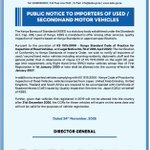
Notice to importers of second hand vehicles.
Effective Jan 1st, 2027, only right hand drive motor vehicles whose year of first registration is Jan 1st, 2020 will be allowed for importation into Kenya.

How can investors convert their bond portfolio into a steady stream of passive income?
That's where bond laddering comes into play.
· Instead of putting all your capital in one bond, spread across bonds
· Ensure that the bonds you select have different coupon payment dates such that your income stream is spread across the year
As always, ensure you are dealing with market intermediaries who are licensed by the Capital Markets Authority (@CMAKenya) whenever you are engaging in the market.
Stay alert, invest smart!
🤖 Made with AI
For the first time in about two decades, the Nairobi Securities Exchange is extending trading hours starting 2027.
How is trading done between the times that the market opens & closes?
Here's a quick 101 on that.
As always, be sure to engage market intermediaries licensed by the Capital Markets Authority (@CMAKenya) whenever you are dealing in the market.
Stay alert, invest smart!
Julians Amboko retweeted

Kenya's collective investment schemes landscape has just crossed the Kes 1.0 trillion (US$7.69 billion) worth of assets under management mark & special funds, holding Kes 252.8 billion (US$1.94 billion) are the main engine driving the growth.
Absa (@AbsaKenya) is the latest entity to make its foray into the special funds landscape with the launch of the Absa Global Multi-Asset Special Fund.
Next on @ntvkenya's #BusinessRedefined, we speak to the CEO, Elizabeth Irungu (@ElizabethIrungu) for a deep dive into the fund & its offering in the market.
Nov 24th, 7:30pm
There has been an interesting, & somewhat confusing, engagement between the National Assembly's Finance & Planning Committee & the Kenya Revenue Authority.
· The Committee asks that "it is alleged that KRA pays bonuses to employees who have exceeded revenue collection targets"
· How can it be "alleged" when on Oct 16th, the Kenya Revenue Authority (Amendment) Bill 2026 was signed into law & among its provisions was an incentive measure for staff at KRA at 3.0% of the revenue actually collected in any quarter of the financial year in excess of the amount estimated to be collected? (See quoted tweet)
· Of course there are bonuses being paid based on what the National Assembly passed & transmitted to the President for signing
· The Chairman then asks an interesting question, how is the excess in revenue collection being attributed. Can Treasury, for instance, lay claim to the excess since the policy measures are essentially their proposals?
· The Chairman's question takes us back to Tax Policy 101. There's a reason why, as global best practise, tying staff bonuses directly to raw revenue surpluses above the set budget target is generally discouraged. Ideally, the leaning for a reward scheme for revenue authorities is balanced scorecards & non-collection performance metrics. But this is an issue that should have emerged on the floor of the House while debating the Bill, not now
The Kenya Revenue Authority (Amendment) Bill 2026 has been signed into law this morning.
A markedly different piece of legislation from the copy we first saw in June (see quoted tweet).
Key additions:
· The law now provides that the funds of the Kenya Revenue Authority shall include an amount not less 2.0% of the revenue estimated in the financial estimates for each financial year to be collected by the Authority
· The law now provides for an incentive measure for staff at the Kenya Revenue Authority at 3.0% of the revenue actually collected in any quarter of the financial year in excess of the amount estimated to be collected
· The law now provides that the Managing Director of the Kenya Ports Authority will be a member of the Board of the Kenya Revenue Authority


Julians Amboko retweeted

You're right, legacy balances is a grey area. Can they be catered for by the amnesty?,
The Revenue Authority has tabled interim outturn numbers for the Finance Act 2026 Amnesty programme.
Details as at Nov 16th are:
1. Amount collected in principal payment: Kes 29.1 billion
2. Interest waived: Kes 31.9 billion
3. Penalties waived: Kes 32.5 billion
4. Fines waived: Kes 11.5 million
Musings:
1. The target for this Amnesty collection was Kes 30.0 billion by Dec 31st, 2026. Effectively, the Authority has realised the target with a month & two weeks to go
2. The third successive amnesty programme closing in on its target with some good runway still ahead should prod us into thinking about reinstating the pre-Finance Act 2023 Sec37 of the Tax Procedures Act which provided for powers for waivers by the Commissioner. This tells us there are still many who need to (& are willing to) regularise their books on tax compliance
3. Of course, No.2 above demands adequate safeguards against abuse
4. The Authority is eerily quiet on the contested legacy balances that stem from the 2014 - 2016 transition to iTax. It is a pretty sticky issue out here. Which way forward as far as the amnesty goes?
5. If anyone is hoping for an extension of this amnesty programme, I don't see it happening. The outturn so far & the last bullet point on the KRA statement suggest so
See quoted 🧵 for a breakdown of the amnesty we had on @FiledPodcast with @KoiKaruga1

Taxpayers in Kenya have just 59 days left before the Tax Amnesty introduced through Finance Act 2026 lapses on Dec 31st.
It is the third amnesty in quick succession with the first having run from Sep 1st, '23 to June 30th, '24 & the second having run from Dec 27th, '24 to June 30th, '25.
The amnesty provides for 100% waiver of penalties, interest & fines subject to settlement of all required principal taxes.
We sat down with Wangoi Karuga (@KoiKaruga1) on @FiledPodcast to break down the amnesty programme & what taxpayers need to know.
A 🧵
Our starting point was:
· What is a tax amnesty?
· What does a tax amnesty seek to achieve?
Julians Amboko retweeted
BUSINESS REDEFINED | Africa's banking opportunities
A conversation with CIB Egypt CFO Islam Zekry.
Full interview: youtu.be/QTqYeBLlZP4
.@AmbokoJH

Kenya's Fiscal Outturn - October 2026
Revenue Side
· Tax collected: Kes 218.72 billion, up 19.77% y/y
· Non-tax revenue collected: Kes 7.27 billion
· Domestic borrowing: Kes 111.64 billion
· External loans & grants: Kes 7.79 billion
· Other domestic financing: Kes 495.54 million
Expenditure Side
· Recurrent spend: Kes 136.33 billion
· Development spend: Kes 62.17 billion
· Equitable Share: Kes 40.66 billion
· Debt service spend: Kes 153.21 billion


Pretty lumpy redemptions (Kes 66.76 billion) in this week's T-Bill auction.
The steepest we have seen in both the current financial year & the calendar year.
Only Feb 9th (Kes 61.29 billion) followed by June 8th (Kes 59.47 billion) come close.


Kenya's collective investment schemes landscape has just crossed the Kes 1.0 trillion (US$7.69 billion) worth of assets under management mark & special funds, holding Kes 252.8 billion (US$1.94 billion) are the main engine driving the growth.
Absa (@AbsaKenya) is the latest entity to make its foray into the special funds landscape with the launch of the Absa Global Multi-Asset Special Fund.
Next on @ntvkenya's #BusinessRedefined, we speak to the CEO, Elizabeth Irungu (@ElizabethIrungu) for a deep dive into the fund & its offering in the market.
On the agenda:
· Portfolio mix & risk profile
· The ETF investment corridor & why
· Minimum entry point & lock in period
· Benchmark applied & anticipated return profile
· The Kes 230.0 million (US$1.77 million) seed capital
Nov 24th, 7:30pm!
What happens when a taxpayer receives an audit notice from the Kenya Revenue Authority?
How should the taxpayer prepare themselves?
My full conversation with @jilnashah797 on @FiledPodcast via link below.
youtube.com/watch?v=z-X6_PM2…
For the first time in about two decades, the Nairobi Securities Exchange is extending trading hours starting 2027.
How is trading done between the times that the market opens & closes?
Here's a quick 101 on that.
As always, be sure to engage market intermediaries licensed by the Capital Markets Authority (@CMAKenya) whenever you are dealing in the market.
Stay alert, invest smart!
It has been a decade ever since Kenya's debut Real Estate Investment Trust (REIT) was taken to market.
Ever since, the market has witnessed growth of this asset class with a total of 6 having been authorized & licensed.
· What is a REIT?
· How do REITs work?
· What do REITs solve for in the capital markets?
· What are the types of REITs?
Here's a quick 101 breaking this down.
As always, before you engage in any product & deal with any market intermediary, be sure that they are licensed by the Capital Markets Authority (@CMAKenya).
Stay alert, invest smart!
The government of Kenya's intention to award the Mrima Hill Niobium Earth Project to Frontier Hills is being challenged.


We've just released the following announcement to the market: RareX Update Regarding Mrima Hill Rare Earth Project Award
Check out the full announcement and join in with the conversation at: rarex.com.au/announcements/7…
#ree

Kenya has moved to ensure that multinational companies with operations in the country pay their fair share of tax.
Through Sec12G of the Income Tax Act & Legal Notice No.189/2026, the country has adopted Minimum Top Up Tax in line with the OECD/G20 BEPS Pillar II framework.
I caught up with @RSM_Global East Africa's @SAMMAINALC to make sense of this tax.
My questions:
· What does the computation look like from an inclusion/exclusion standpoint? Importantly, how does one treat deferred tax in the computation?
· What is the interplay between Minimum Top Up Tax & Country by Country Reporting?
· Does the adoption of Minimum Top Up Tax signal imminent phasing out of Significant Economic Presence Tax?
Link to full discussion on @ntvkenya's #BusinessRedefined: youtube.com/watch?v=xGqfkpI_…

Julians Amboko retweeted
The Tax Laws (Amendment) Act 2024 introduced Minimum Top Up Tax in Kenya targeting multinational enterprise with a consolidated annual turnover of at least €750 million.
Next on @ntvkenya's #BusinessRedefined, we break down all that relates to Minimum Top Up Tax with @RSMTax East Africa's Samuel Maina.
Nov 18th, 7:30pm!
Julians Amboko retweeted

Very difficult for those dealing with agriculture products...we are not able to do etims expenses very scaring and challenging
Julians Amboko retweeted

Ile nolej this great man @AmbokoJH has unlocked for, and given us small business owners about taxes, we will forever be thankful.
In 2025/26, the Kenya Revenue Authority reported having unlocked Kes 35.062 billion worth of revenue by concluding 993 tax disputes through Alternative Dispute Resolution (ADR).
ADR is an alternative method of resolving tax disputes outside the conventional judicial process & quasi-judicial process (Tax Appeals Tribunal).
On @FiledPodcast, I spoke to @jilnashah797 about ADR & how it fits within Kenya's tax dispute resolution design.
Link to full discussion: youtube.com/watch?v=z-X6_PM2…
See quoted 🧵 for more granular breakdown.
An audit by the Kenya Revenue Authority scares many taxpayers.
I sat down with @jilnashah797 on @FiledPodcast to understand just about everything there is about audits by the authority & how a taxpayer should prepare for one.
A 🧵
Our starting point was understanding what an audit is. Two important things to take into consideration here:
· Kenya has traditionally run on a self-assessment based tax regime
· This means the taxpayer determines their taxable income/transactions & declare their income/turnover & tax consequent payable in a return
· That said, Sec59 of the Tax Procedures Act empowers the Revenue Authority to require any person to produce for examination any documents that are in the person's custody or under the person's control relating to their tax liability