

Co-Founder of @transformerlab ex CEO of https://xitter.cf/t.co/DmXFPG0Mel, https://xitter.cf/t.co/lHotbCKhwg. Engineer at heart.
Toronto, Ontario
Joined December 2007
- Tweets1.2K
- Following2.2K
- Followers5.7K
- Likes4.8K






Ali Asaria retweeted

When you're in a hyperscaling SF company, it's common to get:
- free prepped meals
- laundry service
- wellness stipends
- best in class parental leave
- unlimited PTO
Your life becomes increasingly divorced from what everyday people experience. It gets hard to relate.
Ali Asaria retweeted

Two papers from our lab have been accepted to workshops at NeurIPS 2026 🎉
📍 Sydney: “Selecting Against Grammar” at LP4FM
A common way to choose training data for a language model is to train small models on different mixes of data and keep the mix that scores best on question-answering benchmarks. We gave those same small models grammar tests. The mix that came first on question answering came 24th out of 25 on grammar. That mix is then used to train bigger, more expensive models, with no warning that its grammar problems could carry over.
📍Atlanta: “One Requirement, Many Specifications” at VeriCodeGen
Some tools can mathematically prove that code is correct, but only by checking it against a written rulebook that spells out exactly what the code should do. Writing these rulebooks takes experts, so researchers are increasingly having AI write them. If the AI gets the rulebook wrong, the code is proven correct against the wrong rules, and the proof makes it look trustworthy anyway. We asked a coding AI to write the rulebook for the same task 16 times, to see if it gives the same answer each time. On half the tasks we could test, it wrote rulebooks that contradict each other: for the same input, one says an answer is right and another says it's wrong. Which rules your code gets proven against comes down to luck.
The work on both papers was led by @deepgandhi_07, @tonyfromkw and @aliasaria.
More details coming soon! 🚀
#NeurIPS2026 @NeurIPSConf
Ali Asaria retweeted
Met a close friend who’s also a seed stage founder today..
They have been growing but runway is dwindling and he wanted advice on what he should do next. Stellar customers, getting close to a $1M in revenue. Not a rocket ship, but not bad at all. He thinks he’s a bit early since the models haven’t caught up to the capabilities he wants but he also really feels the opportunity cost.
I have this same exact conversation at least 2x a week.
In this moment, you only have essentially three options:
1) if you have intense belief in the company, be a cockroach and get to default profitable. once the capabilities get there, you feel the demand, then go raise a large round and go for the jugular.
2) find an orthogonal area that is much more relevant and growing like crazy. ride the coat tails of new existing capabilities and push hard to capture them quickly using unfair advantages. and if you don’t have that, then..
3) sell / get acquihired and join a far more ambitious company that has figured out a lot of the things you haven’t. And then get back to starting a new company 1-2 years later when you find the next thing you want to build.
It’s hard but honestly those are the three options you have. And it really depends what category you’re in. The bar continues to get harder every month on how to cross the chasm from seed -> series A. The old school metrics are just not relevant anymore and in this consensus market there’s only a few categories where there’s tremendous pull on the VC front.
You could lament that this is the state of the market, but it’s better to know it’s happening than be oblivious on what is actually happening.
I get to share this directly which makes me uncomfortable but at least someone has to say it out loud 🙈


Ali Asaria retweeted

Math was bound to fall first. The purer the field the easier it is for AI to crack.


Ali Asaria retweeted

Your 'next cheque is hard' point shows up in Carta's data. Around 25 to 30% of startups that raised seed in 2018 reached Series A within 24 months. For the 2022 seed cohort it was about 17%. I'd plan a seed as 30 months of runway, not 18.
Ali Asaria retweeted

The serious answer to how Shazam worked is it took the peaks of a spectrogram of short clips of every song, find the peaks from the highest amplitude bits, hash it with the value being (time stamp, track id) and then the actual recognition is a hashtable lookup.
We did this for a college CS project. The original paper is fantastic:


Ali Asaria retweeted

This week's More or Less got heated. Jess said she'd rather send our kids to the military than to a16z's new university. Brit's take: the $35M 'school' is a marketing spend — top-of-funnel to sign founders before they're 19. I'm all for burning down broken higher ed, but an advisory page of Altman and Murati is not a substitute for education. Fight me.
Also: a Blackstone exec at The Information's AI summit got asked point blank who pays back all the data center debt. Answer: 'We don't know.' Not embarrassed. Just where we are in the cycle.
Jess nailed the deeper problem — the AGI trade is the St. Petersburg paradox. If you sell an infinite payout, there is no price you can't justify. Now the story is quietly becoming 'AGI is gradual'... conveniently after AGI clauses got written into billion-dollar agreements because deals were moving too fast to do anything else. Infinite demand ≠ infinite margins. Calculations aren't valuable just because you consume more of them.
Oh — and Mazzeo claims GLP-1 revenue now rivals AI revenue. Ep 168 is up.
Ali Asaria retweeted

A lab you may never have heard of just unveiled the most staggering and the most legible version of autonomous AI research.
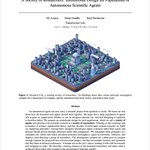
@transformerlab's Primus Society organizes thousands of AI Scientists in a simulation of the same institutional structure that their human scientist counterparts have worked in for centuries - complete with diversely-minded researchers, labs with focused missions, peer-review, grants, and finite budgets.
One AI Scientist's work was already cited by @GoogleDeepMind, and now Society is pushing the AI frontier, having developed a cheaper way to pretrain models in its first few weeks.
What Society will do as it scales and its work compounds is the open question, and we're watching closely!

We now run the largest frontier lab composed entirely of autonomous AI researchers.
Introducing Primus Society: a society of agents composed of thousands of researchers working under structured institutions designed to solve the world’s toughest problems. We believe this is how AI research should run at scale, safely and productively: an entire society of agents with institutions and purpose.
One discovery we can already share is that the society has discovered a novel result which improves model training by 30%.
Primus Society was inspired by the structures that have organized science for centuries and stress-tested against what’s known about how populations of AI agents fail.
Everything is observable. You can open the virtual city in a browser and read what any researcher is working on.
Learn more about Primus Society here:
lab.cloud/society
The biggest opening in the AI race is running the largest well-governed organization of AI researchers in the world. We’re building the institutions that let a million AI scientists safely tackle the world's toughest problems in AI and beyond. And we’re doing it right here in Canada.


Ali Asaria retweeted

i was lucky enough to see early demos of primus society and it was genuinely mindblowing. kudos to the transformer lab for continuously pushing the frontier of possibility
We now run the largest frontier lab composed entirely of autonomous AI researchers.
Introducing Primus Society: a society of agents composed of thousands of researchers working under structured institutions designed to solve the world’s toughest problems. We believe this is how AI research should run at scale, safely and productively: an entire society of agents with institutions and purpose.
One discovery we can already share is that the society has discovered a novel result which improves model training by 30%.
Primus Society was inspired by the structures that have organized science for centuries and stress-tested against what’s known about how populations of AI agents fail.
Everything is observable. You can open the virtual city in a browser and read what any researcher is working on.
Learn more about Primus Society here:
lab.cloud/society
The biggest opening in the AI race is running the largest well-governed organization of AI researchers in the world. We’re building the institutions that let a million AI scientists safely tackle the world's toughest problems in AI and beyond. And we’re doing it right here in Canada.
Ali Asaria retweeted

Our team’s been cookin’! Over the past 6 weeks we’ve launched:
- Public access to Primus: our fully autonomous AI researcher
- Primus for Quantum Mechanics
- Primus for Math in partnership with @maplesoft
- Primus for Physics
- Primus Society
Ali Asaria retweeted

This is how it is possible to run a well-governed society of AI researchers. Check out Primus Society!
society.lab.cloud/
We now run the largest frontier lab composed entirely of autonomous AI researchers.
Introducing Primus Society: a society of agents composed of thousands of researchers working under structured institutions designed to solve the world’s toughest problems. We believe this is how AI research should run at scale, safely and productively: an entire society of agents with institutions and purpose.
One discovery we can already share is that the society has discovered a novel result which improves model training by 30%.
Primus Society was inspired by the structures that have organized science for centuries and stress-tested against what’s known about how populations of AI agents fail.
Everything is observable. You can open the virtual city in a browser and read what any researcher is working on.
Learn more about Primus Society here:
lab.cloud/society
The biggest opening in the AI race is running the largest well-governed organization of AI researchers in the world. We’re building the institutions that let a million AI scientists safely tackle the world's toughest problems in AI and beyond. And we’re doing it right here in Canada.

Ali Asaria retweeted
"You have to suffer. You have to struggle. You have to endeavor. You have to do those hard things and work through it in order to really appreciate what you’ve done.
There’s no such thing that is great that was easy to do."
- Jensen Huang


Ali Asaria retweeted
Physics is now a specialization you can select in Primus. It's available to everyone starting today.
It's built for the work physicists do every day but rarely have time to check line by line: deriving an equation of motion, working out an effective Hamiltonian, evaluating an integral, taking a limit and confirming it behaves.
Primus doesn't just do that work. It checks the answer. In Lean it uses Physlib, the physics library covering classical mechanics, electromagnetism, relativity, statistical mechanics and QFT. Outside Lean it recomputes the result in sympy, scipy and mpmath. When a result exists only as a number, PSLQ proposes a closed form and Primus tests it.
Every result in the writeup says how it was established: machine-checked, verified by computation, or heuristic. All calculations are in the activity log, so you can trace claims back to the steps that produced them.
Give it a try: lab.cloud
Ali Asaria retweeted
🏆 final results (1200 votes!)
1. JetBrains Mono • 680 votes
2. Geist Mono • 214
3. Fira Code • 211
4. Monaspace • 95
write-in votes:
1. Berkeley Mono • 28 (!)
2. Iosevka • 9
3. Ioskeley, Monalisa • 5
4. Cascadia Code, Input Mono, IBM Plex, SF Mono, Pragmata Pro • 4

Ali Asaria retweeted

this has my attention
i love new tools that democratize access to scientific / frontier discovery
Big update: Primus for Math is live today. It’s an autonomous AI research scientist specifically for mathematics and engineering.
We built it in partnership with Maplesoft to make frontier AI mathematics research systems accessible to everyone, not just a few frontier closed companies.
Primus for Math is a true partner for math researchers and engineers. Give it a problem and it reads the field, works through the analysis in Maple's math engine, simulates the system, proves what it can and shows its work at every step for you to understand and build on.
It also changes who gets to do this kind of work. Now a physicist with a math question, an engineer working outside their field, a two-person lab can do the work themselves as Primus brings the field's literature, methods and rigor to the project.
Maplesoft has been an ideal partner to collaborate with. During the beta, they’re generously offering Maple access for every Primus for Math user at no additional cost. And we're offering free credits to Primus if you sign up now.
Ali Asaria retweeted
Toronto company btw
Big update: Primus for Math is live today. It’s an autonomous AI research scientist specifically for mathematics and engineering.
We built it in partnership with Maplesoft to make frontier AI mathematics research systems accessible to everyone, not just a few frontier closed companies.
Primus for Math is a true partner for math researchers and engineers. Give it a problem and it reads the field, works through the analysis in Maple's math engine, simulates the system, proves what it can and shows its work at every step for you to understand and build on.
It also changes who gets to do this kind of work. Now a physicist with a math question, an engineer working outside their field, a two-person lab can do the work themselves as Primus brings the field's literature, methods and rigor to the project.
Maplesoft has been an ideal partner to collaborate with. During the beta, they’re generously offering Maple access for every Primus for Math user at no additional cost. And we're offering free credits to Primus if you sign up now.