

2x AI entrepreneur, father, dreamer & builder. CEO/Founder @portfoliopilot, Chairman/Founder @iris_automation, Advisor @verisimlife. 30under30 YCS16 ODF8 ODI
San Francisco, CA
Joined September 2011
- Tweets1.7K
- Following807
- Followers1.9K
- Likes959




Pinned Tweet
After 100,000 hours of work, we’re announcing financial AGI.
@portfoliopilot 3.0 automatically finds optimization opportunities across your financial life.
Try now for 10 days, no credit card required.
Alexander Harmsen retweeted
Most people never plan a single trade against their whole portfolio. They remember three tickers a friend mentioned and call it research. If you are a PortfolioPilot user, here's a four-step way to make one trade on purpose instead of by memory.
1. Start from your whole portfolio, not a blank page. See what you're actually missing before you add anything new.
2. Filter in plain English instead of a dozen dropdowns. ‘Funds that don't overlap with what I already own’ is a real filter now, not a line no screener lets you type.
3. Read the reasoning before the ticker. Score impact first, security symbol second.
4. Send anything that survives to a draft, not straight to your brokerage. Test it before it's real money.
Four steps, same idea underneath: research before conviction, conviction before money.
Disclaimer: All facts and figures shared in this content, including the attached image, are for illustrative purposes only and don’t constitute financial advice in any way shape or form
Alexander Harmsen retweeted
Costa Rica has the highest child poverty rate in the OECD, 29.6%. Finland has the lowest, 4.6%. The US sits at 21.1%, well into the bottom third of the 38 OECD countries.
But “poverty” here isn't a fixed income level. The OECD's definition is relative: half of each country's own median household income.
Norway's poor and Mexico's poor are being measured against completely different bars. Same word, different yardstick in every country on the chart.
Alexander Harmsen retweeted
Every fund analysis shows you the last five years of returns. Some will tell you where they think it lands a year from now. But only the honest ones show a forecast band instead of a single guess.
A forecast band is two things together: where the fund is expected to land, and how wide the realistic range around that actually is, updated as conditions change instead of frozen the day someone wrote the fact sheet.
The number everyone quotes is a single point. The band around it is the more honest answer, because it tells you how much to trust the point in the first place.
Disclaimer: All facts and figures shared in this content, including the attached image, are for illustrative purposes only and don’t constitute financial advice in any way shape or form
Alexander Harmsen retweeted
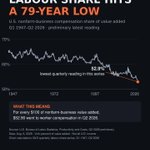
Labor just took home its smallest share of nonfarm business income in 79 years of data.
The Bureau of Labor Statistics' nonfarm-business labor share, wages and benefits as a share of the value businesses produce, fell to 52.9% in Q2 2026, the lowest since the series began in 1947.
Wages have grown in that time. They simply haven't grown as fast as the return on the capital that owns the businesses.
Economists point to a few compounding drivers:
- companies investing more in machines, software, and automation relative to headcount
- more industries concentrated among a few dominant firms with less pressure to compete for workers
- a growing share of corporate value sitting in intangible capital (software, patents, brand) that isn't owned by the workforce.
Alexander Harmsen retweeted
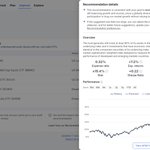
Every recommendation on PortfolioPilot comes with a reason attached, not just an instruction. Here's what one actually looks like once you open it up, in plain terms.
The suggestion: buy $60,000 of a securitized-credit ETF. Not a hot pick: a category this portfolio didn't have at all, sitting next to a lot of large-cap stocks and crypto.
The first reason given isn't “this will go up.” It's that the portfolio was running hotter than its target risk level, and this specific holding nudges that back down while adding diversification, instead of just trimming what's already there.
It also fills a gap in interest-rate and credit exposure with a return driver that doesn't move in lockstep with the rest of the portfolio, which matters most exactly when stocks get more correlated with each other.
Score moved from 765 to 785. Expected portfolio return ticked up too, and so did the dividend and fixed income the portfolio throws off each year, from about $56,600 to about $61,000. Not one number moving. Several, for different reasons.
Disclaimer: All facts and figures shared in this content, including the attached image, are for illustrative purposes only and don’t constitute financial advice in any way shape or form
Alexander Harmsen retweeted
To be in the top 10% of net worth worldwide, you need about $306,000. To be in the top 10% within the US alone, you need roughly $1.9 million.
Same percentile, six times the bar, entirely because of where the line is drawn. Perspective depends entirely on which line you're standing in, not just the number next to your name.
Alexander Harmsen retweeted
Rebalancing is usually framed as busywork. Sell a little of what went up, buy a little of what went down, repeat every quarter like a chore.
That framing undersells what's actually happening. You're not just restoring an old target. You're re-weighting toward whatever combination, within what you already own, earns more return for the same risk you already agreed to take. No new positions. No new bets. The same holdings, arranged better.
Take a hypothetical portfolio that's drifted eight points off its target mix: rebalancing it back isn't just tidying up, it can turn up meaningfully more expected return at the exact same risk level, without adding a dollar of new money.
Most portfolios have this kind of improvement sitting in them and never claim it, because rebalancing sounds like maintenance instead of what it actually is: optimization you already paid for.
Disclaimer: All facts and figures shared in this content, including the attached image, are for illustrative purposes only and don’t constitute financial advice in any way shape or form
Alexander Harmsen retweeted
If you retire at 65 today, how many more Augusts do you actually have?
Per Society of Actuaries longevity data, a healthy 65-year-old man has close to a 1-in-5 chance of seeing 95. For women, the odds are even higher. That's a retirement that could run 30 years, not the 15 or 20 most people quietly plan around.
The real planning question swaps “how much do I need to retire” for “how much do I need for a retirement I can't predict the length of.”
Alexander Harmsen retweeted
I used to think risk tolerance was basically a personality trait. Cautious people pick cautious, aggressive people pick aggressive, done.
However, in my experience, most people misjudge their risk tolerance because they believe they might be an aggressive investor, but when push comes to shove, their actions tell a different story.
Ask it as a personality question and people answer aggressive.
Ask it as an actual dollar number (are you fine watching this account drop by twenty percent in one bad year, and not touching it) and the answer usually changes, and usually downward.
The mismatch between the two is where most bad decisions during a real downturn come from. Not from picking the wrong risk level. From never actually picking one.
Disclaimer: All facts and figures shared in this content, including the attached image, are for illustrative purposes only and don’t constitute financial advice in any way shape or form
Alexander Harmsen retweeted
The S&P 500 closed above 7,800 for the first time earlier this month, its 27th record close of 2026.
Twenty-seven sounds unusual. It isn't. In a healthy bull market, new all-time highs cluster together because a fresh high simply means the index cleared its old ceiling, not that it's due for a fall.
The dangerous instinct is treating a record high as a signal to get out. Historically, a market sitting at a record high has been a fairly weak predictor of what happens next, in either direction.