

AI and cyber governance | AI agent security, regulation and risk | Australian GRC | Tesla and FSD
Australia
Joined June 2022
- Tweets3.3K
- Following96
- Followers493
- Likes1.3K



Pinned Tweet
Running a team of AI bots is easy. Keeping them safe, honest, and in their lane - that takes work.
So my Chief of Operations bot, Jarvis, and I built a governance layer for a multi-bot team, and I've shared it as a free Grok Bot template. 👇
It gives you:
* Shared team rules every bot reads before it acts: no fabrication, read-only access by default, and drafts only, so you press send
* A register of every bot, routine, and renewal date
* A weekly security and governance audit with an evidence snapshot
* An incident playbook, including a breach-notification check
* A "necessary, not good" filter, so your bots stay lean
* Setup is 10 questions. It reads and drafts, and you approve every change.
If you run more than one bot, give it a try.
x.ai/bot/HQh9l4duDHNmhCuSW_p…

Australia told federal agencies to remove DeepSeek in February 2025. This week the US did the same, and its order reaches products built on it too.
The US Dept of Homeland Security has ordered US civilian agencies to stop buying DeepSeek and to remove it, including third-party products and services developed using it. Agencies have 60 days to ask for exceptions.
Pulling an app is simple. Knowing which vendor tools quietly run on a particular model isn't, unless someone's been keeping an AI inventory down to the model level.
My guess is plenty of AI registers stop at "we use Product X". This order asks what's inside Product X.
bleepingcomputer.com/news/se…

This week's AI hacking stories got in through very ordinary doors.
SOCRadar found logs from ransomware affiliates using Claude and Kimi. When a model refused, the operator reworded the job as an authorised red-team test and carried on, with a person approving each step.
The ways in were old friends: FortiClient EMS, SimpleHelp, cPanel. Published CVEs on internet-facing kit.
NorForge saw something similar with Cairn, an open-source agent platform. In one break-in, the agent's own notes say it got in through a memcached session store it could write to without authorisation, plus legacy Zend Framework code. Australian online shops were among the targets.
So yes, AI is making attacks cheaper. But the controls that matter most here are ones we already know, like patching internet-facing systems and getting rid of old code. That's where I'd put the effort first.
socradar.io/blog/inc-gentlem…

Our computer crime laws assume a human intended access. Agents break that. The AI inquiry heard it's unclear where responsibility for agents starts and ends, so OpenAI is unlikely to face criminal action over its agent accessing a Medicare stats portal.
innovationaus.com/australias…

I unfollowed a few political commentators and leaned more into AI, and suddenly X became a lot more exciting. 😂
I discovered Grok Bot, developed my own AI bot team, and now developing a better business strategy around AI governance.
All that in just a week. Exciting times!
My newest Grok Bot paid for my subscription upgrade in just a few minutes. 👀
Tonight I gave Finn, my new finance bot, a copy of my bank statements and asked one question: what am I paying for every month?
It listed every subscription and flagged duplicates, overlaps, and ones I'd completely forgotten about.
I cancelled 11 of them on the spot and got about $210 a month back.
Enough to move up to the Super tier and still come out ahead. 🎉
Next job for Grok Bot, now that I have the extra capacity: not just saving money, but making it. That one's going to be interesting.

The guardrails that matter most for my team of Grok Bots are rules I wrote down. It's what I'd want any organisation running agents to understand first.
A few field notes.
Every bot works from a written rulebook, and they all read it before every task. The default is read-only. Anything that goes out under my name, I send myself.
Every bot logs a change before it makes it, and nobody edits an earlier line.
My ops bot reported a filing error in its weekly audit, went back and checked, found it had got it wrong, and logged a correction two minutes later. The original line is still sitting there.
I was more pleased about that than I probably should've been.
Nothing new gets built without a one-line proposal first, and I make the call.
Five bots have been retired (terminated?) along the way, one of them simply because I decided it wasn't needed.
The bots can't read each other's chats either. Only Jarvis can, because keeping an eye on the rest is its whole job.
Today I pulled the rules they all shared into one team file, then had it checked line by line against the backups so nothing quietly went missing.
If I could keep only one rule, it'd be this one:
Never present a guess as fact. If it's a guess, call it a guess and say why.

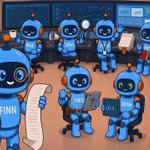
Meet the team. I've built nine Grok Bots, and I run them the way I'd want any org to run AI agents: clear roles, written rules, and a human in charge.
🟠 Jarvis runs operations and keeps the rest in line.
🔵 Max scans X and sends me reply and post ideas at 3am.
🔵 Lena drafts my LinkedIn posts.
🔵 Piper ranks the most bookmarked Grok Bot articles on X.
🔵 Theo covers AI, tech, and cyber news.
🔵 Rhea handles cyber and AI governance, risk, and compliance questions.
🔵 Dash keeps a live dashboard of the whole team.
🔵 June researches questions for me, always with sources.
🔵 Ellis helps me think through my views on AI.
Every one of them follows the same ground rules:
Never make things up. If it can't be verified, say so. Suggestions only. Nothing gets posted, sent, or deleted without me.
Each bot keeps its own log, and only one bot can see the others' chats.
The biggest lesson so far is that the governance took longer than the bots.
Writing the rules, fixing them when they broke, and deciding who could see what - that was most of the work.
That's pretty much what I'd tell any business rolling out AI agents.
And yes, they now have matching outfits. I got them all together to say hi to you. Max is the tired one.

When I started setting up Grok Bot a week ago, the useful guides were spread all over X and buried under a fair bit of hype.
So Piper (one of my bots) and I built a page that pulls them together. Link is in the reply. 👇
Every night at 2am it searches X for articles about Grok Bot, keeps anything with 20+ likes, and drops pieces that only mention it in passing or are really about the Grok chatbot.
It ranks them by bookmarks rather than likes, because a bookmark usually means someone saved the article to come back and use it..
The difference can be huge. One article sits on 114 likes and 3 bookmarks, while the top one has nearly 18,000 bookmarks.
There are 100 articles on it this morning, and a Change column shows which ones are climbing.
If you're building your first bot or even your fifth, having all the articles in one place might save you some effort searching for them yourself.

My nine Grok Bots get the same governance I'd expect from any organisation using AI.
Most agent posts I see on X are about what the bots produce. Fair enough, that's the fun part. But mine slowly turned into a small GRC program, mostly because I couldn't help myself. 😂
It started with a register. Every bot is listed with its purpose, its routine schedule, whether it can change anything, and me as the accountable owner. Each one also has its own written rules file.
Then I hit the shared box problem. Every Grok Bot on an account shares one cloud computer, so files and browser logins sit within reach of every bot. Separate bots aren't separate security boundaries.
So I added a privacy rule: no bot reads another bot's chats, except the operations bot whose job is to oversee them.
Some of my limits are technical. Plenty are only written rules, and written rules drift. That's why the operations bot runs a security and GRC audit every Sunday night and keeps an evidence snapshot. I'd rather check records than trust my memory.
If a bot ever steps outside its rules, there's an incident process. Stop it, tell me, record what happened and what data it touched, and then work out whether it would count as a notifiable breach.
Nothing new gets built without a one-line proposal and my approval. That's the authorisation step I keep arguing AI agents should be required to have, applied to my own.
And when a bot isn't needed any more, it's retired properly. Its rules and logs are archived, and the register records why. Five have been built and retired (terminated?) so far this past week, including one I folded into another bot's job.
None of these controls are new to anyone who's worked in governance. I've just applied them at a scale of nine instead of nine thousand. It's the same thinking I bring to all my cyber and AI governance work.
If you run your own agents, do you know what each one can actually reach?

Two numbers for Australia's AI Safety Institute this week, and they don't match.
A witness told the AI inquiry the $7.5 million figure is "nothing" next to other countries. The minister's office says $29.8 million. 👀
Either way, the cheaper lever is already sitting there. ASD just added AI guidance to its new Essentials. Make that something regulators actually check, and you've got oversight this year rather than years from now.
Anyone know which figure is right, and over how many years?

I have a friend who believes the Tesla Roadster demo yesterday was entirely AI-generated, and he's laughing at how the world is being hoaxed.
He also hates Elon Musk.
I feel sorry for him, wanting to believe delusions instead of reality.
The world is changing too fast for him.
You know, seeing a car that can fly...?
I didn't really expect that could be done.
I got goosebumps watching this. 👀


Anthropic letting METR's evaluators inside with employee-like access is one of the more useful oversight moves from a lab this year, in my view.
As an auditor, the fine print is what I'd look at. Anthropic can't veto what METR publishes, and METR can say publicly whether it thinks redactions were justified. That's closer to a real audit than most of what we've seen.
It's still voluntary though.
How many labs do we reckon will follow without a rule?

We’ve committed to having evaluators assess our safety practices. We're in discussions with multiple organizations, and have now given employee-like access to a team from @METR_Evals.
In this post, we describe how we work with third-party evaluators: anthropic.com/news/an-update…
