
MechE/ChemE Researcher, Lienhard Group (@MITMechE). Prev: @mitenergy Fellow, @TheElimelechLab (@YaleEngineering) & @CEBCambridge. RT,♡≠Approval, he/his
Boston, USA & London, UK
Joined September 2011
- Tweets46
- Following4.7K
- Followers339
- Likes14.6K

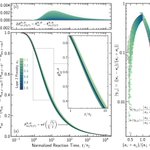






Finally we show how spatial variations in temperature increase change with time for CIP (and interfacial heat fluxes in SFIP, CIP, IMIP). Heat diffuses from the reaction interface into the organic solvent (1) and support (2) before being conducted into the aqueous phase (3) (11/)


Thank you @J_Membrane_Sci editors and reviewers, @mitenergy for fellowship funding, @SymPy for algebraic manipulation, mpmath for numerical series summation and inverse Laplace transforms, and @matplotlib for plots! Details and sources: authors.elsevier.com/c/1iZZM… (12/12)
3
108
Thank you @J_Membrane_Sci for this recognition! I’m grateful for having had the opportunity to work on this exciting project with Prof. Meny Elimelech (@TheElimelechLab, @YaleEngineering) and Prof. John Lienhard (@MITMechE, @jwafs_mit). Share link: authors.elsevier.com/c/1iZZM… (1/)

1st Editor choice article from January issue, from Prof. Menachem Elimelech at Yale University
Composite material and solvent thermal effusivities govern heat diffusion during membrane formation
sciencedirect.com/science/ar…
@TheElimelechLab
@LBandounas
@Rong_SMTCLab
@jerrylinwoods


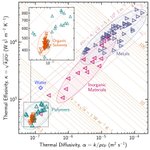
Most polymers have a lower 𝜅 than water, driving a relative increase in interfacial temperature. Many inorganic materials and metals have high 𝜅 values lowering initial interfacial temperature during IP. Duration of thermal impact is proportional to layer thickness^2 / 𝛼. (9/)
1
1
66
We then derive Laplace-domain interfacial temperature expressions (assuming diffusion-limited planar heat release q~1/√t) for 2 (SFIP), 3 (CIP), and 4 (IMIP) layer conduction models and plot transient interfacial temperature for different support and interlayer materials (8/)


1
1
130
Thermal effusivities and diffusivities of porous, water-impregnated support layers and interlayers are highly dependent on their porosity and structure. Here we use Wiener bounds for thermal conductivity to estimate composite thermal effusivities (𝜅) and diffusivities (𝛼) (7/)

1
2
68
Solving transient heat conduction PDEs we see that the magnitude and duration of temperature increase are governed by thermal effusivity (𝜅=√k𝜌c) and thermal diffusivity (𝛼=k/𝜌c) (where k: thermal conductivity, 𝜌c: volumetric heat capacity), shown in this Ashby plot (6/)

1
2
61
In this paper, we setup and solve multilayer PDEs for transient heat conduction (w/planar source), to show how the thermal properties of solvents, support layers (typically polymeric), and interlayers (often inorganic or metallic) impact heat diffusion during TFC formation (5/)
1
1
64
TFCs are often made using support-free IP (SFIP), conventional IP (CIP with a support layer), or interlayer-modulated IP (IMIP with an interlayer and a support). We model these as 2-, 3-, and 4-layer heat transfer systems, with planar heat release at the layer 1-2 interface (4/)

1
2
108
In IP, 2 immiscible solvents (e.g., water and hexane) containing 1 monomer each are brought into contact starting an interfacial reaction that releases heat causing a temperature to rise, which can have a big impact on the chemical structure and morphology of the TFC formed. (3/)
1
2
78
Thin-film composite (TFC) membranes are central to separations across the water-food-energy nexus and there is much exciting innovation designing new TFCs to recover critical metals or nutrients from brines. Most TFCs are made using interfacial polymerization (IP). (2/)
1
2
93
Excited to build computational tools to accelerate the Sustainable Separation of Biochemicals & Biofuels using Membranes with Profs John Lienhard & Nicolas Hadjiconstantinou (@MITMechE @jwafs_mit) as part of the @MITCSConsortium Seed Fund Program!

We are thrilled to announce the recipients of our first-ever 2022 MCSC Seed Awards program! The 20 winning projects will link industry member priorities with research groups across campus to develop scalable climate solutions. news.mit.edu/2022/mit-climat…

Excited to share our @Chem_Eng_J article studying solvent-driven water extraction (SDWE) from hypersaline brines using dimethyl ether (DME): authors.elsevier.com/a/1eRlh…
Part of a collaboration between the Lienhard Group (@MITMechE) and the Chemical Separations Group (@INL). (1/9)
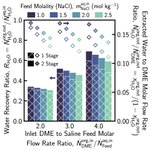
Finally, our analysis demonstrates that DME-driven SDWE can desalinate highly saline brines right down to NaCl saturation (~5.5 mol/kg NaCl in water-DME-NaCl mixtures) for ZLD, motivating future work on solvent-driven fractional precipitation for critical material recovery. (8/9)

Massive thank you to the PIs leading this project: Prof. John H. Lienhard (@MITMechE, @jwafs_mit) and Dr. Aaron D. Wilson (@aarondoylewils1, @INL), and to coauthors: Zi Hao, Caleb, Hyeon, and Chris. Excited to move this work forward to the next stage as part of @NAWIhub. (9/9)