
Tech Leader at Bytedance (US) & ex-Meta, Area Chair for top-tier conferences, e.g., CVPR, ICML, NeurIPS, AAAI, and ICLR.
San Francisco, CA
Joined March 2018
- Tweets1.1K
- Following298
- Followers40
- Likes203



Chengjiang Long retweeted

DeepSeek just open-sourced DeepInfer, the inference engine behind its production services, under the Apache 2.0 license.
and it got 6.3K+ stars in 8 hours
The release runs only DeepSeek-V4.1-Flash, on NVIDIA SM100 GPUs or Huawei Ascend 950 chips, and covers offline inference rather than a complete serving stack.
It omits the parts that turn an engine into a service: a KV cache system, prefill and decode disaggregation, and load balancing across replicas.
What ships is the speed layer, including DSpark, which drafts up to 5 tokens ahead and uses confidence estimates to schedule their verification.
Bounded replay trims prefill by recomputing only a 140-token suffix sized to cover the sliding attention window.
A companion library, deepseek-recipe, will turn Chat Completions, Responses and Messages requests into DeepSeek V4 and V4.1 prompts that match the official API’s behaviour.

Chengjiang Long retweeted

Recursive self-improvement is one of the most discussed ideas in AI right now.
I am particularly interested in how it applies to science.
I saw this really cool new paper with neat ideas, especially on hypothesis generation. A good read.
Specifically, they propose DiscoveryRSI, which applies RSI to scientific hypothesis generation in four life-science domains.
Its 27B model produced hypotheses that match research published after its training cutoff 6.3% of the time, compared with 2.5% for GPT-6 and 2.3% for Claude Opus 5.
The system grows trees of hypotheses with multi-agent evolutionary search and turns the chosen investigations into executable tasks. After each run, it assigns credit to the hypotheses that contributed, replays the research harness to find productive strategies and repeated failures, and applies accepted improvements to new investigations.
Automated hypothesis quality rose from 4.86 to 5.39 after two rounds, with the largest gains in falsifiability.
arxiv.org/abs/2610.23839
Chat with Paper: academy.dair.ai/papers/disco…

Chengjiang Long retweeted

Google has released a free 1-hour course on AI engineering, covering everything from building your first AI agent to creating fully autonomous systems.
7:02 — Build your first AI agent
13:34 — Explore what AI agents can do
23:08 — Learn context engineering
32:56 — Understand graph engineering
54:11 — Create a fully autonomous system
One agent can save hours of work. Multiple agents can completely change how a team operates.
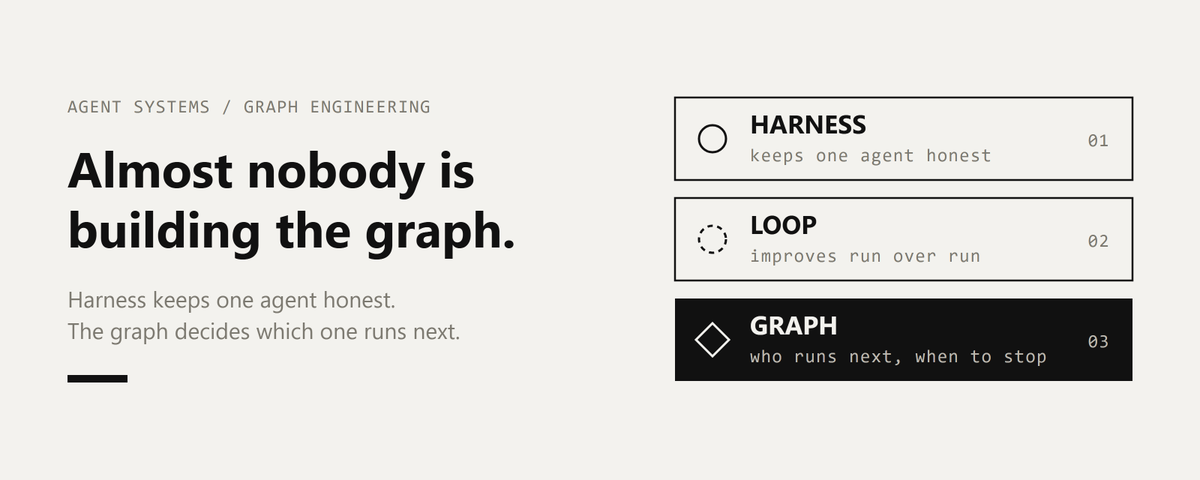
Prompts → Agents → Loops → Graphs
Most people focus on prompts, but the real power comes from building AI systems that can think, act, and improve through structured workflows.
Same models. Same tokens. Better systems. Better results.
Watch the full course and save it for later.
The complete guide to loops and graphs is below. 👇
Chengjiang Long retweeted

Aaron Levie (@levie) says an AI agent in a big company can't tell the authoritative document from a stale copy, so enterprise AI is really a data problem.
"Take a company that has, you know, 10,000 employees, been around for decades. Their data is in, again, 20, 30, 50, 100 different systems."
"You can almost think about it like a new employee joining that company. And that new employee is like insanely smart. Like they have a PhD, but they just joined your company one minute ago."
"They're not going to know like, well, which is the one that really is the authoritative copy of that research plan or that marketing asset or that contract?"
"The agent is in that exact same situation. But they're even worse off because they... really don't know when they don't know something."
"It's not going to know that actually maybe there's two other systems I should go and check and then compare the answers to the first ones that I found. It's just going to go and deliver that answer to you."
"And so we are going to be in for, again, years and years of enterprises realizing that an AI problem is really a data problem."
- Aaron Levie, Box co-founder and CEO, on the Big Technology Podcast, April 2026
Chengjiang Long retweeted

Peter Thiel has a theory most founders ignore: your company name predicts whether you'll win or fail.
"I believe very strongly that the names of companies are often very predictive of future failure or success."
His framework, in his own words:
PayPal worked because it felt human. "It was the friend that helps you pay." Friendly, transactional, trustworthy — the name did sales before the product did.
Napster was doomed from the start. "You nap" — the connotation was sleep, theft, something illicit. The name telegraphed exactly what regulators and labels would eventually come after it for.
The deeper point isn't aesthetics. A name is a compressed signal — about your market positioning, your customer relationship, and how the world will narrativize you when things go wrong.
Names expose founder psychology. A name that sounds aggressive or antisocial is usually a tell that the founder hasn't thought hard enough about how their company will be perceived at scale.
Most founders treat naming as a branding exercise. Thiel treats it as a predictive test.
Chengjiang Long retweeted
New Princeton paper finds that combining specialized agents from many developers can beat any single developer's general agent, with GAIA accuracy reaching 70%.
Today most agentic systems are built and controlled by 1 developer, so each team rebuilds the same basic skills. The authors argue this limits scale.
They simulated populations of developers with LLM agents that build agents under a fixed budget, then compared lone systems with a multi-developer system. The multi-developer system splits each task and routes the parts to different developers' agents.
On GAIA with the same total development budget, specialists that each scored at most 35% alone reached 70% together. That is 12 points above the median general agent, while on web-search-only SealQA the combined system did worse at higher cost.
Build agents to fill gaps in shared systems, since an agent scoring 19% alone lifted a combined system from 40% to 53%.

Chengjiang Long retweeted
BREAKING: Amazon is out of compute until beyond 2028.
Andy Jassy told a16z co-founder Ben Horowitz directly.
Not "supply is tight."
Not "we're scaling."
Out. Until beyond 2028.
And Horowitz's read on it: this is nothing like the dot-com bubble.
Back then, the network was built before the users showed up.
In AI, demand is outrunning everything anyone can build or buy.
The largest cloud provider on earth can't keep up.
If Amazon is sold out through 2028, what does that mean for every startup that still needs GPU access to survive?
Who gets the compute and who gets left behind?
Chengjiang Long retweeted
Homeland Security has ordered US civilian agencies to rip out DeepSeek and every product built on it.
US hosting doesn’t get you out. The order removes all DeepSeek and DeepSeek-affiliate products, and third-party products and services developed using DeepSeek implementations, from civilian agency information technology, under the Federal Acquisition Supply Chain Security Act of 2018.
DHS says DeepSeek’s hosted models store data on servers in China, where national security laws give Beijing wide latitude to obtain data from domestic companies.
Because every prompt and response passes through that service, DHS warned the transferred data, alone or combined with public information, could produce actionable intelligence on US persons and government programs.
That logic fits the hosted chatbot, but for weights running on US servers the ban leans on DHS’s warning that the models may contain malware or other vulnerabilities.
The signed order predates Monday’s public notice by months, and a July memo had already told agencies to monitor traffic in and out of government websites for DeepSeek-related risks.
Exceptions require a request filed 60 days in advance with a compelling justification, such as an inability to fulfil a mission-critical function, while national security systems and secure compartmented information systems sit outside the order.
The heavier work now falls on federal software vendors, who will need to show which open-weight models sit inside the products agencies already run.
DeepSeek is the only Chinese model named, though Moonshot AI’s Kimi and Alibaba’s Qwen face similar distillation accusations, so the next test is whether the same order reaches them.


Chengjiang Long retweeted

A good business model should not turn your heaviest users into a source of loss.
This is exactly why I have always believed that a “coding plan” (usage‑based pricing) is a terrible business.
Think of a gym that only makes money because people buy memberships and then never show up.
That’s a broken logic.
A sound business model should ensure that your most core, highest‑volume users generate the largest profit – not the other way around.
#BusinessModel #StartupTruth #UsageBasedPricing #BadEconomics

GLM-5.2 is Fully Open, Frontier Intelligence Belongs to Everyone
Today, the sudden restriction of certain frontier models is deeply regrettable. At a time when access to frontier models is abruptly cut off for non-technical reasons, we are even more convinced of one thing: science should be global.
The path to AGI (Artificial General Intelligence) must never be enclosed by high walls. We have always believed that AGI should be the cornerstone for all of humanity to collaboratively explore the boundaries of intelligence and solve complex challenges, rather than a privilege monopolized by a few rules and subject to revocation at any moment. In the face of external blockades and restrictions, our attitude is one of radical openness. Frontier intelligence must remain open-source, accessible, and buildable, serving every dedicated developer.
GLM-5.2 is Zhipu's most capable open-source model to date. It not only supports a truly usable 1M context window but also maintains a continuous lead in the independent completion of long-horizon tasks, providing solid foundational support for building complex agent applications. It also continues to be our main engine for creating the strongest domestic coding model.
Tonight at 5:21—at this special moment—GLM-5.2 will officially be available to all GLM Coding Plan users (including Lite / Pro / Max). The API will also go live next week.
A step closer to frontier intelligence for everyone.
The future of AI is open, and it is for the people.
ModelKey: GLM-5.2
Chengjiang Long retweeted
Open source vs. closed source. Light vs. darkness. A decisive battle between two futures, two destinies for humanity.
However long they want to fight, we’ll fight. Until total victory.

🚀 Introducing DeepInfer, our in-house inference framework, now fully open source!
Powering DeepSeek-V4.1-Flash at scale with high throughput and low latency. We’re sharing our production stack to help the community lower compute costs, reduce energy use, and make AI more affordable.
🔗 github.com/deepseek-ai/DeepI…
1/4

Chengjiang Long retweeted

SpaceXAI engineer Lauren Tan:
"99% of people are using GrokBot with less than 1% of its real power
They run a single agent without loops or graphs"
"I'm running a fully autonomous team of 20+ GrokBot agents
One Chief of Staff, one PM, and 20+ workers
That's the new engineering stack"
GrokBot → Chief of Staff → PM → Workers → Autonomous Fleet
In this 1-hour session, a SpaceXAI engineer shows how to build a complete AI agent team from scratch
This workshop is worth more than most $1,000 agent engineering courses
Bookmark it and watch today
Then read the full article below


Chengjiang Long retweeted

We developed PhysLDM, a high-quality neural simulator based on latent diffusion models (LDMs)!
Highlights:
- A spatiotemporal VAE that compresses dynamic 3D deformable meshes into a compact latent space.
- An LDM that models both global motion and local deformation.
- Fully differentiable, enabling challenging inverse problems!
We hope PhysLDM will make 3D simulation more accessible and ML-friendly!
Awesome work by Yu Zhang @yucrazing !
🌐 Project: yucrazing.github.io/physldm
📄 Paper: arxiv.org/abs/2610.07609

Chengjiang Long retweeted

🚀 Excited to share our new paper led by Zhisong and Fan (@YuishikiFan)
F²SLAM
Turning Feed-Forward Geometry into Persistent Factors for SLAM
Feed-forward 3D predictions become measurements inside dense bundle adjustment, not a one-shot correction
📉 Uncalibrated Replica ATE: 0.002 m vs 0.030 m for the best feed-forward baseline
📄 arxiv.org/abs/2610.05207
💻 github.com/ZhisongXu/F2SLAM (code coming upon acceptance)
1/5

Chengjiang Long retweeted

1/7 I'm super excited to share LidarVerse! One model that reconstructs, forecasts and generates LiDAR across sensors, in real time.
📄 Paper: arxiv.org/abs/2610.19201
🌐 Project: research.nvidia.com/labs/sil…
💻 Code: github.com/nv-tlabs/LidarVer…
🤗 Models: huggingface.co/nvidia/lidarv…
Chengjiang Long retweeted

here's how i shipped 2,500 PRs last month to production
this was originally supposed to be for Cursor Compile in London. i couldn't make it since i was livestreaming for Grok @Bot Galaxy so i'm making it available for free here on X! watch it on 2x speed, i talk slowly
Chengjiang Long retweeted

SpaceXAI engineer, Lauren Tan:
"99% of people run one GrokBot for everything
I run 14, and I only talk to my Chief of Staff"
In 8 minutes, she shows how to turn one GrokBot into a team of bots that runs your email, calendar, Slack and code 24/7
One Bot → Specialist Bots → Chief of Staff → Outer Loop → Cloud Agents
One bot was the old workflow
A team of bots with its own memory is the next one
This Q&A is worth more than most $1,000 AI agent courses
Bookmark and watch it today

Chengjiang Long retweeted

Can confirm this works outside SpaceXAI too. Used pstack by @poteto with Grok Bot + Cursor cloud agents to take a shopping list MCP server from empty repo to v1.0.0 in ~16h. The checks matter more than the agent count.

Next time someone says „there's no integration for that“, you know what to reply.
How I went from an empty repo to a tested, secured MCP server in 16 hours with Grok Bot, Cursor and pstack (thanks @poteto):

Chengjiang Long retweeted

This is f*king insane. SpaceXAI engineer Lauren Tan (ex-Cursor):
"99% use Grok Bot at 1% of its potential.
I run 25+ agents with a Chief of Staff. They ship while I sleep."
In this 60-minute workshop, she shows the skills and checks behind agent teams that ship code
Grok Bot → /goal → /loop → Verification → Agent Teams
25 agents mean nothing if they can't verify their work
This free workshop beats most $650 agent engineering courses
Bookmark and watch it today
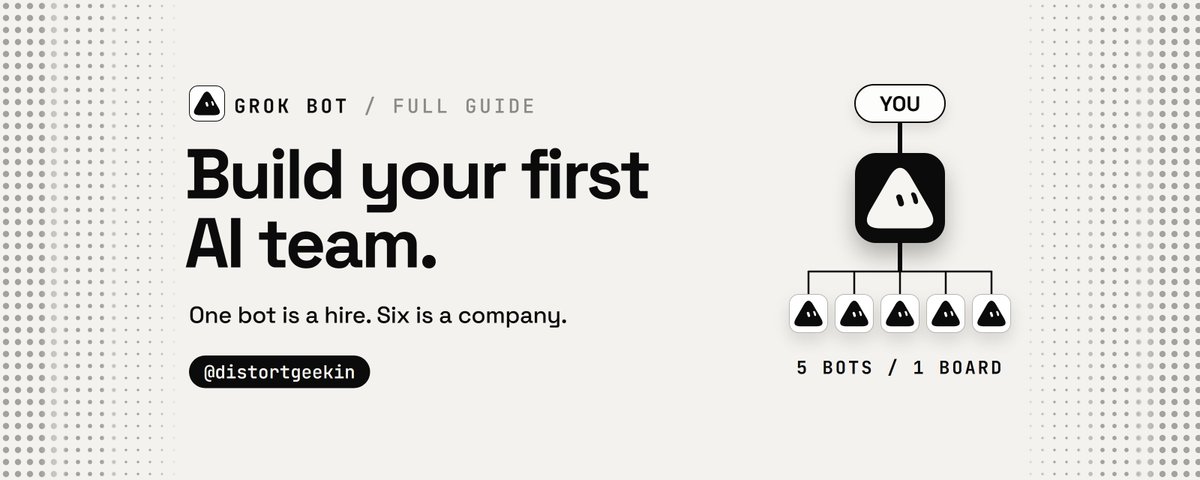
Then read how to build your first AI team with Grok Bot below ↓
Chengjiang Long retweeted

Thank you!!! But I certainly can’t take credit for the whole group. So much of it due to all the students and the other faculty:
@jurafsky @percyliang @ChrisGPotts @YejinChoinka @MonicaSLam @Diyi_Yang @tatsu_hashimoto

which AI labs turn into startups?
counted lab size vs startups founded by members, public sources only
stanford hazy: 7 startups from 13 people
stanford NLP: 12
berkeley sky lab: 7
@chrmanning your group is the only big lab up top
