

cs phd candidate advised by @tomgoldsteincs at @umdcs, prev math @univofdelhi trying not taking myself so seriously ¯\_(ツ)_/¯
Washington, DC
Joined July 2011
- Tweets221
- Following382
- Followers262
- Likes36K








zoom bombing is lame guys, especially in 2025, especially in someone's PhD proposal talk
totally unrelated but guess who's a PhD candidate now 👀
the real problem is that current retrievers are not instruction-friendly
that's why you google keywords likely to be found in the answers/docs than try to "prompt" your query
or you know...just ask your LLM


poster sent for print 😮💨
are you concerned your prod LLM might regurgitate exact training data to your users?
join me and my co-authors at #NeurIPS2024 on wednesday's 1st poster session & learn how goldfish loss can help you.
eager to meet friends from past and future!


Super happy to announce that our work has been accepted at #NeurIPS2024.
tl;dr: our simple yet effective goldfish loss mitigates memorization even after training a 7B LLM for 100 epochs by masking tokens during loss computation.
See you all in Vancouver in December! :)
I and @A_v_i__S will be presenting our 0-shot LLM text detector, Binoculars, at @icmlconf.
TLDR it works by contrasting next token preds from one model with that of another (we use Falcon models) and have great performance!
But where does it stand now, 7 months later (1/2)?


Spotting LLMs With Binoculars: Zero-Shot Detection of Machine-Generated Text
paper page: huggingface.co/papers/2401.1…
Detecting text generated by modern large language models is thought to be hard, as both LLMs and humans can exhibit a wide range of complex behaviors. However, we find that a score based on contrasting two closely related language models is highly accurate at separating human-generated and machine-generated text. Based on this mechanism, we propose a novel LLM detector that only requires simple calculations using a pair of pre-trained LLMs. The method, called Binoculars, achieves state-of-the-art accuracy without any training data. It is capable of spotting machine text from a range of modern LLMs without any model-specific modifications. We comprehensively evaluate Binoculars on a number of text sources and in varied situations. Over a wide range of document types, Binoculars detects over 90% of generated samples from ChatGPT (and other LLMs) at a false positive rate of 0.01%, despite not being trained on any ChatGPT data.

Most detectors don't share benchmarks and/or are evaluated on limited configs. @LiamDugan_'s RAID benchmark solve this and comprehensively eval multiple OSS/paid detectors.
Pleased to see that Binoculars still highest performing one by a large margin.
xitter.cf/LiamDugan_/status/1803…


In our #ACL2024 paper we use RAID to evaluate 12 popular detectors. Here are a few findings:
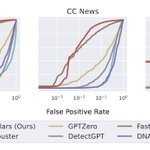
(#1): We find that detectors can achieve 90%+ accuracy (y-axis) on our dataset but only at very high FPR (x-axis).
At a safe FPR (<0.1%) no detector gets above 55% correct (!!!)

Litigators hate this one simple loss function 📉
We present goldfish loss, an effective objective to prevent your LLM from regurgitating training data verbatim.


How? By simply not computing losses on each token in training sequence. We drop tokens based on local prefix context so same tokens are dropped based on context .
During the model has a hard time regurgitating exact the dropped token and quickly diverges
xitter.cf/tomgoldsteincs/status/…
If the “goldfish loss” is used, the model usually diverges from the training data within the first 5 tokens it generates.

1
2
191
Happy @icmlconf rebuttal weekend to those who celebrate!

167


Thanks for the opportunity! @UMDLibraries @UMDResearch

Our GIS and Data Service Center had an incredible time presenting at the Libraries Research and Innovative Practice Forum 2023! Our center’s three members showcased expertise on various topics. Huge thanks to the organizers for this amazing opportunity! @UMDLibraries


1
83
@ALDO_Help My order (#389428942) does not contain 2 items out of 4 which are marked as delivered in the mail. Please help me get a refund for those!
1
24
Such an insightful thread!

As a differential geometer, it's quite easy to forget that this isn't "obvious", and take this wonderful fact for granted.
The answer though, to me at least, is because a nonlinear system is mathematically like a surface and points on the surface are the sets of parameters (1/2)
51
Your favourite professor’s favourite professor. Gold standard of education.


56
Gradient decent is a specific case of proximal method but with smooth differential objective.

The proximal operator is the implicit counterpart of the explicit gradient descent step. Fundamental to tackle non-smooth optimization problems. en.wikipedia.org/wiki/Proxim…

43
How #GPT4 diagnosed and saved this beautiful doggo! :)

We started the dog on the proper treatment, and she's made almost a full recovery now.
Note that both of these diseases are very common. Babesiosis is the #1 tick-borne disease, and IMHA is a common complication of it, especially for this breed. 8/

1
124
Easy thumb rule to distinguish what the mind wants from what your vanity may be charging you to do.

"Would you still be interested in doing something, if you couldn't tell anyone about it?"
@naval
51
What do they mean ill conditioned problem and how does it impact your Machine Learning Optimization problem? Read here: ahans30.github.io/blog/ (also cat for the algorithm)

42
Another highly informative article by @chipro
Real-time machine learning: challenges and solutions disq.us/t/44214lh
2
718


It does seem that ChatGPT has highly calibrated.

One neat difference between ChatGPT and previous iterations is its willingness to acknowledge uncertainty or absurdity (e.g. these are less of an issue now forbes.com/sites/arunshastri…)
A funny quirk is it may be _too_ confident in its uncertainty, as in its take on Alice here.

