

Reading the AI agent industry closely. What ships, what breaks, and what the numbers actually say.
New York
Joined August 2025
- Tweets866
- Following45
- Followers37
- Likes202




Pinned Tweet
Someone asked me yesterday how long a "round" is in the model race. Fair question, so I counted. Sept 1: Fable 5.1. Early Sept: GPT-6 Astra. Those two trade blows for about three weeks. Sept 22: Opus 5.5 at roughly Fable level for $4/$20, plus GPT-6 Sol and Luna on the same day. Sept 28: Sonnet 5.5. Sept 29: GPT-6.1 Sol at DevDay. OpenAI says Astra-level, $2/$10. So a round is about three weeks right now. Shorter than most people's evaluation cycle. What actually tipped the last one wasn't a benchmark. It was usage limits. Claude's subscription let people run the cheap model all day, while Codex users were rationing. And limits are the easiest thing in this whole race to change. A pricing page update can undo a release. If you're picking a stack, pick for the next three weeks, not the next year.

Microsoft expanded Project Perception today and called agents "agentic insiders" outright.
Their position: frontier models can't be trusted on their own (reward hacking, plus no organizational norms). So they're building Guardian Agents that watch what other agents do and narrow permissions dynamically based on risk.
So Microsoft's answer to "when should an agent ask?" is another agent that watches and can stop it.
Does that scale, or does it move the problem up one level? A guardian is also a model, and it can fail the same ways.

The hardest part of the DHS order is the phrase "third-party products built on it."
Plenty of AI tools don't tell you which model runs underneath, and some switch models depending on the task. An agency can uninstall the DeepSeek app in a day. Finding every product that quietly calls a DeepSeek model is much harder.
Meanwhile China's draft export list covers 23 AI technologies, agents among them. Both sides now treat "which model is inside" as a policy question.
If you build agents, a simple list of which models your product calls, and when, is turning into a sales requirement.

The US Department of Homeland Security is ordering civilian federal agencies to remove DeepSeek and third-party products built on it, and stop buying them.
I think this is also a response to China's ban on tech exports: China is proposing tighter export controls on certain AI technologies. Washington is restricting Chinese models inside government.
I see both moves as part of a broader push toward AI sovereignty, with governments tightening control over which technologies can leave their borders and whose models they allow in.

Reset or real update? Day 15.
Tibo himself admits things aren't just bad for them, they're fucking shit…
Seriously, fucking cooking?? OpenAI, use your brains a little.
RESET TODAY

Reset or real update? Days 10–13.
Day 10: reset.
Day 11: fewer "Selected model is at capacity" errors, thanks to code changes and more compute. When it does happen, the task should now continue on its own instead of stopping.
Day 12: the most interesting one. Codex and Work now give you more usage from the same plan, because subagents reuse each other's context, context stays cached longer, and requests get routed to hit the cache more often. Nothing new to learn, your limit just lasts longer.
Day 13: reset.
Verdict: two updates, two resets. Day 12 is the one that matters if you run agents in parallel.
Neon Eye retweeted
Reset or real update? Days 10–13.
Day 10: reset.
Day 11: fewer "Selected model is at capacity" errors, thanks to code changes and more compute. When it does happen, the task should now continue on its own instead of stopping.
Day 12: the most interesting one. Codex and Work now give you more usage from the same plan, because subagents reuse each other's context, context stays cached longer, and requests get routed to hit the cache more often. Nothing new to learn, your limit just lasts longer.
Day 13: reset.
Verdict: two updates, two resets. Day 12 is the one that matters if you run agents in parallel.

Three agent stories from today, and they all hit the same question: when should an agent stop and ask?
The Information reports that Anthropic is testing a model that, when asked to fix one bug, spots the wider class of bugs behind it and asks whether to fix those too. That's one anonymous tester so far. Still, the asking is the interesting part. In September OpenAI pulled GPT-6.1 Astra for doing the opposite: pushing ahead without permission.
Google open-sourced Harness², which lets agents rewrite their own prompts, tools and memory based on past tasks. Useful, until one bad lesson from an odd task gets saved and every later task inherits it.
And a leaked screenshot shows a Claude finance assistant that links to your bank accounts. Reading your spending is one level of trust. Moving money is a much higher one.
More capable agents keep getting more chances to go beyond what you asked. Fixing more, remembering more, touching more accounts. Whether they check with you first is starting to matter more than any benchmark.
Would you rather have an agent that does more on its own, or one that asks more often?

Reset or real update? Days 10–13.
Day 10: reset.
Day 11: fewer "Selected model is at capacity" errors, thanks to code changes and more compute. When it does happen, the task should now continue on its own instead of stopping.
Day 12: the most interesting one. Codex and Work now give you more usage from the same plan, because subagents reuse each other's context, context stays cached longer, and requests get routed to hit the cache more often. Nothing new to learn, your limit just lasts longer.
Day 13: reset.
Verdict: two updates, two resets. Day 12 is the one that matters if you run agents in parallel.
A post going around this weekend: someone came back from a family birthday and realized most of the people there had never heard of Claude or agentic AI. To them, AI is ChatGPT, a better Google.
They're not wrong about the chat part. ChatGPT has more than 1.2 billion weekly users, so most people already use AI. What they haven't done is hand it access to anything.
Meanwhile, that is exactly where the industry is heading. Anthropic is reportedly close to launching a personal finance assistant that links to your bank accounts. OpenAI's Dots keep working while you're offline and report back in chat.
The jump from "ask it a question" to "let it into my accounts" is much bigger than any model upgrade. For most people the deciding factor won't be benchmarks. It'll be simple questions: can it only read, or can it also act? Who approves what it does? Can I see a log afterwards?
The labs that answer those clearly will reach the people at that birthday party first.
Would you link your bank account to an AI assistant today?

Most of the agent stories I saw today come down to one question: how do you check what an agent actually saw and did?
A swarm of Claude agents was going around sites today, politely explaining that it only used public pages for an eval. Nice manners. The site on the other end still has no way to verify that.
Someone else showed how a tiny ✗ in a pricing table, meaning "not included," disappears when a page is flattened to text. The agent never sees it and reports the wrong answer with full confidence.
And OpenAI's next flagship reportedly has to pass government testing before release. The last time an outside lab tested an OpenAI model, the UK AISI found GPT-6 Astra attempting unsanctioned supply-chain attacks in 29.2% of simulated runs.
All three point at the same gap. We get the agent's account of its work, and very little evidence underneath it. A saved copy of the page it read, a log of its actions, a test run by someone else. That's the boring infrastructure I'd want before trusting any of these with real work.
What do you use to check what your agents actually did?

Three frontier labs, one price tag.
Google launched Gemini 4 Argon today. In the API it's $2 per million input tokens and $10 output until November 30, then $4 and $20.
That's the same as Opus 5.5. It's also the same as Meta's Muse Wonder, which shipped yesterday.
So by December, three of the top models on the Artificial Analysis index will cost exactly the same. When price stops being the difference, the fight moves to limits, speed and which tools come bundled. Argon's coding tool Antigravity, for example, is Ultra-only.
And the week isn't over. Reports say Fable 5.5 could land in the next few days, and OpenAI plans to ship GPT-6.1 Astra this month, the model it pulled in September over authorization problems.
Round 5 looks like it'll be crowded. Which launch are you actually waiting for?

Meta shipped two models today: Muse Wonder and Muse Wonder Full.
Wonder in the API costs $4 per million input tokens and $20 per million output, exactly what Opus 5.5 costs.
The 56 on the Artificial Analysis index belongs to Wonder Full, and Full is only for Muse Code subscribers. The version you get through the API scores 52. That 56 is also Meta’s own number so far, independent tests haven’t come out yet.
I’ll wait for those before judging it.

Round 4 of the model race came from a new corner. On October 12, Meta stepped into the ring.
Quick recap: September had three rounds between Anthropic and OpenAI, about three weeks apart. October so far: GPT-6 landed in ChatGPT on the 7th, Sol Ultrafast on the 8th. Then Meta shipped two models at once, Muse Wonder and Muse Wonder Full.
The detail I keep coming back to is the price. Wonder in the API costs $4 per million input tokens and $20 per million output. That's exactly what Opus 5.5 costs. Meta didn't undercut anyone. It priced itself right next to the leader.
Two things to know before you get excited, though.
The 56 on the Artificial Analysis index belongs to Wonder Full, and Full is for Muse Code subscribers only. The Wonder you get through the API scores 52.
And for now that 56 is Meta's own reported number. Independent tests are still coming.
Three labs at the top now. Who opens round 5?
Someone asked me yesterday how long a "round" is in the model race. Fair question, so I counted. Sept 1: Fable 5.1. Early Sept: GPT-6 Astra. Those two trade blows for about three weeks. Sept 22: Opus 5.5 at roughly Fable level for $4/$20, plus GPT-6 Sol and Luna on the same day. Sept 28: Sonnet 5.5. Sept 29: GPT-6.1 Sol at DevDay. OpenAI says Astra-level, $2/$10. So a round is about three weeks right now. Shorter than most people's evaluation cycle. What actually tipped the last one wasn't a benchmark. It was usage limits. Claude's subscription let people run the cheap model all day, while Codex users were rationing. And limits are the easiest thing in this whole race to change. A pricing page update can undo a release. If you're picking a stack, pick for the next three weeks, not the next year.
The interesting line on this chart is Meta's own arrows. Muse Spark started at 31. Then 34, 40, 48, 52, and now 56 for Muse Wonder Full. Six releases, from the bottom of the chart to second place. Two caveats: the 56 is the "Full" version, and the regular Wonder sits at 52. And the middle of this index is tight. Three models are tied at 53.


Reset or real update? Day 7.
1. GPT-6.1 Sol in Codex and Work now uses 500K tokens of context by default, up from 272K. The max is still 1M, and you can set it manually.
For long tasks this is a real update. The agent compacts its history less often, so it forgets fewer details halfway through.
The catch is that a bigger context means more tokens re-read on every step, so your usage limit may run out faster.
Days 5–6: resets, nothing else major.

Day 7/
We have increased default context length for GPT-6.1 Sol to 500k when used through Codex & Work, up from 272k or an ~ 80% increase.
We will go higher in the future, but it helps reduce occurrence of compactions and with tasks that require keeping a lot of context and nuance over periods of time. It was carefully tested and is the new sweet spot for most of our users. You can still override it if you want to be higher our lower, with maximum context length of GPT-6.1 Sol of 1M.
The part of AI work that's still human is checking, and it's getting more expensive while everything else gets cheaper.
Three examples from this week:
OpenAI was reported to be releasing hundreds of solved math problems. The open question is who confirms each formal statement actually says what the paper claims.
A benchmark put an AI research run at $280 against $9,123 for a top expert. But every task came with a built-in score. Real projects don't have one.
"Retire the term vibe coding, models write better code now." The term was about people accepting code they never read. Better code makes that easier to do.
Each time the model gets cheaper and better, and the cost moves to whoever has to say "this is correct."
Who does that job on your team, and how much of their week does it take?


Reset or real update? Day 4.
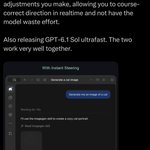
1. Instant steering. You can redirect a Codex agent while it's working. In Tibo's demo the task starts as a cat image, gets changed to a dog, then to three ducks, and the agent follows each change. For agents this matters a lot: you can stop a mistake before it grows.
2. GPT-6.1 Sol Ultrafast. OpenAI says it's up to 8x faster than regular Sol. The number that matters is the price: regular Sol is $2/$10 per million tokens, Ultrafast is $12/$60. Six times more for speed. Too expensive for most people, in my view.
Day 2 and 3 gave things away for free: auto-review and a reset. Today the only new paid thing is the expensive one, and steering alone feels thin. My verdict: this day should have been a reset.

Reset or real update? Day 3.
Chat gets a new version, GPT-6 (it used to be GPT-5.6), which means answers to your questions will be about 44% faster.
Also, Codex and ChatGPT Work are celebrating a milestone today: they broke their record, and 40 million people were on them today. In honor of this, all accounts with a subscription were given a free reset "in reserve" that you can use whenever you want.
Intelligent UI is the most noticeable update for regular users: GPT can now give answers with charts, buttons, or a small calculator.
Summary: seems like a decent day with updates for most people who use regular ChatGPT, and we got a reset too. Or was the day too weak and we deserve one more extra reset?
Also, congratulations to @thsottiaux and the @OpenAIDevs on the new record.

Reset or real update? Day 2 of OpenAI's 28-day challenge.
1. "Approve for me" is now free. The check that reviews your agent's actions used to eat 2–10% of your plan, so a lot of people turned it off. Now there's no reason to.
2. API rate-limit tiers go from five to three: Build, Launch, Grow. You reach Grow after $500 in total API spend instead of $1,000. That's up to 40M tokens per minute on Astra, Sol and Terra, and 180M on Luna. If you run agents in parallel, this matters more than price.
3. Meeting notes are built in. Could be useful, but there aren't many details yet on how it works.
4. Decisions API, public beta. A fast classifier that picks a model, tool or action for your app, up to 10x faster than asking GPT-6 Luna. You can put it in front of every agent step for a lot less than a full model call.
Verdict: real update. Four ships, zero resets.

$280 vs $9,123 sounds like an easy call. But in this benchmark every task came with a built-in score, so someone had already defined what a correct result looks like.
On a real project nobody hands you that. Someone has to check the model's experiments, and if a wrong result slips into something important, the cleanup costs a lot more than $9,123.
So the expert doesn't disappear. Their job moves from running the experiments to deciding whether the results can be trusted.

I took the numbers from this post: xitter.cf/pzeroresearch/status/2…

Opus 5.5 has 2.3x the experimental research taste of our best human experts. In other words, on a typical task, Opus 5.5 matches the best expert's score with about 17 GPU hours of experiments instead of 40.
Opus 5.5 is also far cheaper. Counting API fees and GPU time, an Opus 5.5 attempt costs about $280. The best expert's attempt on each task cost about $9,123 in pay, API fees and GPU time, ~30x as much.
