

The end of vibe coding is closer than you think …
Paris, France
Joined February 2026
- Tweets25
- Following16
- Followers16
- Likes7






If your web app calls an LLM API straight from the browser, the key is public — anyone can read it from the bundle or the network tab. Put a small server layer in between: keys stay in env vars server-side, and you can rotate them without shipping a new client.

Claude Code gotcha. The Default option in /model is auto fallback. It runs Opus until you hit a usage threshold, then hands the session to Sonnet, and the switch is easy to miss. Pick Opus explicitly to pin it. Know which model wrote the code before you judge it.

"the AI reviewed itself" is not a review. 🚦
between working and done sit two deterministic gates — lint, types, tests, security. pure code, zero AI tokens. they either pass or they block.
deterministic gates, explained → agentation.fr/deterministic-…

an AI coding team is two humans and a structure — not a swarm. 🤝
a tech lead encodes the rules once. product owners keep shipping. nobody blocks a developer.
how the DUO works → agentation.fr/ai-coding-team…

multi-agent development without the swarm: 🛰️
one Lead that owns the rules. many Workers, each on one task, in its own worktree. every diff read before it ships.
the architecture → agentation.fr/multi-agent-so…

your people are already vibe coding. 👀
ban it and you get shadow IT. allow it raw and you ship chaos. the third option: structure it — rules, gates, approved agents, audit.
for IT leadership → agentation.fr/vibe-coding-in…

AI in your org either ships chaos or ships standards. 🔒
rules locked once. gates on every change. only approved agents. everything through your own github.
governance, built in → agentation.fr/ai-coding-gove…

meet the citizen creator. 🧑🎨
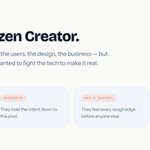
the person who knows the need, the users, the business — but never wanted to fight the tech to make it real. now they ship, governed.
a product owner without engineers → agentation.fr/product-owner-…

five columns. no human drag. 📋
todo → spec → working → review → done. humans can't move a card; only the Lead advances it, and only once the gates are green.
from prompt to production → agentation.fr/from-prompt-to…

ship like a team of ten. ⚙️
annotation in, dispatcher routes, workers build in isolation, deterministic gates verify, your github ships. you never face the AI alone.
the full pipeline → agentation.fr/ship-like-a-te…

sovereignty isn't about the models. it's about the tools. 🇫🇷
french team, EU hosting, your own github, GDPR by construction — and deterministic gates checking every line before prod.
→ agentation.fr/european-ai-co…

A rule of thumb for Claude Code automations: let the model write the content, but keep the schedule deterministic. Handing AI both the words and the timing is where instability creeps in.

you don't write tickets anymore. you point. 👆
annotate the live product, describe the fix, and a supervised agent ships it through your own github — same day.
the annotate-to-ship workflow, explained → agentation.fr/annotate-to-sh…

the terminal walked so the workshop could run.
you don't "code" here — you point, you sketch, you approve. on the live product. no black screen, no cryptic flags.
this is what work is supposed to feel like.

genuine question: who is STILL working in a terminal in 2026?
staring at a wall of text to move one button. it's atrocious.
building should be visual — point at the thing, watch it change.
this is the workshop.
Forgot to send a prompt before living the office ? Continue on the transport !
That the app I Vibe create for @agentationai ! Nice liquid glass usage 🫠
