

Co-founder, CEO of Talus Bio structure-free discovery for frontier drugs
Seattle, WA
Joined December 2008
- Tweets766
- Following429
- Followers966
- Likes1.2K




Alex Federation retweeted

Build at DNAForge’s AI × Biology Hackathon.
November 14th · Berkeley · $1,500+ in prizes
With @modal @boltz_bio @tamarindbio @talusbio @gxl_ai @benchflow_ai @SynphonyDev @GabriCorso @xdotli @Atelfo
Priority: October 25th
Apply in under 5 minutes:
dnaforge.com/hackathon

Alex Federation retweeted

We’re hearing two kinds of voices on the potential of AI to cure all disease:
One says AI will cure everything, but without a concrete path to get there.
The other says biology is too complex to ever tame, but underestimates the power of the tools that will unlock the full potential of frontier intelligence.
At Manifold Bio, we see a path and we’re already building it: a high-throughput interface into living system biology. Millions of protein designs, measured directly in vivo, to learn how molecules behave in the body and ultimately predict what they’ll do before they reach a patient.
Today we share mBER-2, the latest iteration of our AI protein design model that is a core piece of this mission.

Today, we’re announcing mBER-2, our latest AI protein design system, and sharing a bit of how we use it to explore biology in vivo at scale.
For a long time, we’ve been working on what I think of as “frontier problems” in medicine and biology. We know a lot about the targets involved in disease, but there is still an enormous amount of biology we haven’t explored, and potential uses for that biology we haven’t discovered.
One of those problems is drug delivery. There are thousands of potential targets, and most receptors remain unexplored as routes for delivering medicines. We want to understand which ones we can use, where they can take a drug, and what kinds of molecules make that possible.
Ultimately, we need to test these molecules in vivo to understand what they actually do. We’ve spent the last six years building measurement technologies that let us generate millions of measurements in living systems.
mBER-2 is an AI protein design system built for that scale of in vivo measurement. Our goal is to generate binders across the full range of targets we care about, while systematically exploring the possible binding sites on each one. It’s not just what you bind, but where and how you bind that determines whether a molecule performs it's function. mBER-2 lets us probe those differences at massive scale.
We’re also sharing a look at some of our in vivo data. We’ve designed more than 50 million molecules across over 4,000 targets, and screened millions of molecules in living systems. By probing hundreds of receptors, we’ve found new pathways for delivering genetic medicines into fat that outperform industry benchmarks by a large margin.
This is just the beginning. We call the space of all bindable sites across proteomes the EpiTome. As we explore it, we’re building the data to connect AI design, receptor binding, and what a molecule actually does in a living organism.
Much like the idea of a virtual cell, we envision a Virtual Organism that helps us design medicines with specific properties in mind. The foundation is our own in vivo data, connecting molecular design to outcomes measured in living systems.
The endgame is to use AI to explore more biology, measure what happens, and use what we learn to design better medicines. Every round should deepen our understanding of biology and improve our ability to build molecules that do what we need them to do.
Alex Federation retweeted

This is fun.
1. Mango Banana - banana on the outside, mango on the inside. Enough said.
2. Plant machine interfaces - we should be able to trade plants N,P,H2O for reduced carbon compounds. Do to them what they did to chloroplasts
3. Solution phase self assembly of 3D memory chips using designed self-assembly of macromolecules - do we really get protein design
4. A brain the size of a building. - what would it be thinking?
5. A five assed monkey - bc South Park
6. Self growing housing - the rent is too damn high
7. Obviously brain machine interfaces - I will judge this by when I can browse the web by thinking about it.
8. Dinosaurs.
9. Cats with dog personalities.
10. A nice smelling microbiome

In light of the progress in mathematics, we at Edison Scientific and FutureHouse have assembled a set of Millennium Problems for Biology. They are chosen to be very hard to solve but very easy to validate in a simple laboratory environment. Any of these, if solved, would mark a major advance in biotechnology, and most of them would contribute materially towards curing disease. These are, in some sense, the “last reasonable eval” for AI in biology. This was work primarily by @MichaelaThinks and myself, with contributions from many others.
Short descriptions below. The full descriptions of the problems with acceptance criteria are at the Bio Millennium Problems website, linked in the next post. Share more if you have ideas. If they meet our criteria, we’ll add them to our list (with attribution and permission).

Alex Federation retweeted

1/
What could we discover if we had a binder for every protein in the human proteome?
We are excited to introduce the Bindome, an open and free resource of over 300,000 designed protein binder candidates against over 8,000 human target proteins.
🧵


Alex Federation retweeted

When you actually look at global biotech companies, the number of interesting molecules is very thin. Discovery and early stage has been disregarded for so long because of the biotech bear market. In the end, the funnel has to be better broadly distributed and early stage assets/novel targets are where the big wins are at. Both for patients and profits. $XBI

Discussion w the senior BD leaders at big pharma and one surprising point made is that more than one said that they are focused on earlier stage and are comfortable with clinical risk. They don’t seem to be shaken up by avidity/$NVS recent post deal setback. “In BD, risk is your friend. If you don’t take risk. You’ll pay what others think it’s worth” talking about transacting phase 2 or earlier, pre readout $XBI $IBB
Alex Federation retweeted

I've attempted to map everything in oncology in a public website and open source repo for all.
The site is trying to get all cancers, products, technologies, bottlenecks, people, startup opportunities with 1000+ ideas for upgrading the field.
If you have a loved one with cancer and you are technical or can engineer, go take a look, file improvement requests or bugs or help with the open repo and make this the best open and free info resource for individuals, researchers and educational use.
This should save people time, aid AI oncology projects and generate positive action. If you are not technical just complain in this thread about broken or annoying or things you want and I'll fix them live.
Some of the interesting pages:
Treatments: onco.cc/drugs
A gallery of the molecules being used onco.cc/molecules/
And targets: onco.cc/targets/
The technologies in oncology: onco.cc/technologies/
1100 ideas for helping oncology: onco.cc/ideas/
Bottlenecks on oncology: onco.cc/bottlenecks/
Open questions (LETS GO RESEARCH PEOPLE) onco.cc/open-questions/
Startup requests (LETS GO STARTUP PEOPLE) onco.cc/startup-requests/
Mechanics of cancer: onco.cc/mechanics
Battlefronts: onco.cc/fronts/
Isotope supply: onco.cc/isotopes
Key papers: onco.cc/key-papers
Pipeline funnels: onco.cc/pipeline
Cancer by type: onco.cc/cancers/
Institutional rankings: onco.cc/institutions/
The startups: onco.cc/startups/
Heros and heroines : onco.cc/heroes/
Key medical people: onco.cc/people/
Here is the project roadmap: onco.cc/roadmap/
Models and data sets: onco.cc/models/
There are other views as well, take a browse.
Try making a PR if you have an upgrade to this on the repo here: github.com/judegomila/OnCo
If you are biologically/medically minded and something is wrong, file a bug as well or say on the thread and we will get it fixed live.
If this is a useful project star the repo and help get it calibrated.
I've tried to add some other languages but I cannot speak them so tell me if that doesnt work well.
I believe we will crack oncology and having total information dominance is key to the problem.
Let the feedback flow!


Alex Federation retweeted

Every tech VC wants to believe that drug discovery is now a function of compute. They think if we throw enough H100s at the problem, tokenize enough dead sequences, and scale virtual cells, biology will be 'solved'.
They are wrong.
Drug discovery is not a function of compute. It is a function of measurement.
Alex Federation retweeted

Five pharma companies just fine-tuned OpenFold3 in a federated setting on 20,000+ structures...
... raising correct ligand-pose predictions from 29% to 47%

Alex Federation retweeted

the moat isn't the model anymore, it's the data nobody else has

An AI system trained on more than 20,000 protein structures from pharmaceutical companies outperforms AlphaFold-like models that use only public data
go.nature.com/4gTSLaA

Alex Federation retweeted

Every so often, a major event happens in your life to validate years of work. SRRK’s ISEMBYLD was FDA approved. Having participated in its development from basic science to approval, as a physician-scientist, this is one of my best days. Happy for ISEMBYLD to help SMA patients.
Alex Federation retweeted

while 95% of my feed is sloppy RPGs made by Astra I'm burning my all credits into understand how to fight aging and death
Alex Federation retweeted

We raised a $40M Series A to build the automated lab for agentic biology.
Last week, we shared the work we did with @Anthropic: Claude designed proteins, sent them to our automated wet lab, and got real experimental data back.
We believe this is where biology is going: AI agents designing experiments, running them in automated wet labs, learning from the results and iterating.
But AI can only move as fast as the experiments behind it. To use the potential of AI to cure all diseases, we need to build high-throughput wet lab infrastructure: a “biological gigafactory”.
That’s exactly what we’re doing at Adaptyv.
Over the past year we’ve grown our lab throughput by over 5x and onboarded more than 100 customers, ranging from bio AI labs like @chaidiscovery and @boltz_bio to pharmas like @Roche and @novonordisk to dozens and dozens of new startups that use AI to radically speed up drug discovery.
Alex Federation retweeted

How Anthropic's new results post would read without the PR:
Claude orchestrated open-source protein design models, PXDesign, RFdiffusion, Genie, BoltzGen, from a 30k-token expert prompt and 12,500 H100-hours of compute, and designed binders against 14 of 15 targets. Hit rates of 22–35% against a 10–15% baseline, where some of those tools already report similar numbers on their own.
The orchestration is genuinely impressive. But the open-source models did most of the lifting, and they came from the Baker lab, Columbia, MIT, ByteDance Seed, and most of them were already wet-lab validated before Claude touched them.
Which also sets the ceiling. All these generators share a single PDB-shaped training distribution, so calling four of them doesn't diversify away the blind spot, since they fail together. The targets that worked are the well-studied ones.
So the valid claim is that an agent can now drive this stack competently in the regime where the stack already works.
Instead, we got this announcement:

Many drugs work by binding to a specific target in the body and blocking or changing what it does. An important first step in the drug development process is designing a molecule that can bind tightly to its target. Traditionally, that's meant weeks or months of expert work per target, sifting through a large number of candidates to identify the few that work.
We wanted to test if Claude could successfully design novel protein binders from scratch (also called de novo design). With a protein design prompt written by a human expert, Claude autonomously designed protein binders against 14 out of 15 targets.
We then worked with Adaptyv Bio and Twist Bioscience, who independently built and tested the proteins Claude designed.
Alex Federation retweeted

Here’s the thing about Altos Labs. Klausner & Bob Nelson love to put these big names together. The more big names, the merrier. They haul them in with big checks and equity and teams and a beautiful lab and workspace that’s obscenely expensive. It’s like trophy fishing for the biggest names you can find in a research sector. And then the trophies all argue over which program and which strategy is most important at the company. They each have their approach. A company is not the NCI. It’s not Fred Hutch. It might work for a time but eventually it grates on them that they have to convince the board that their program will be first to clinic. Or even make it to the clinic. So they go back to their academic halls where they can do their own thing, where they can at least publish their work.
Just think about how much brilliant science those teams did within the black box of biotech that will never see the light of day.
Alex Federation retweeted

Every protein designer knows that producing & testing designed proteins is a foundational capability for our field, & this is still pretty challenging for a lot of folks. This is why I'm delighted to share our work to make high-throughput protein production more accessible.
🧵👇

Alex Federation retweeted

Drug candidates that form covalent bonds with their targets were historically avoided because of toxicity concerns. However, covalent drugs with controlled reactivity are now recognized as promising agents that combine manageable safety with substantial advantages, including enhanced potency, prolonged target residence times, and access to challenging targets.
This shift is reflected in recent covalent drug approvals, particularly those targeting protein-phosphorylating enzymes (kinases) and cancer drivers such as the oncogenic protein KRAS. A central feature of these drugs is a “warhead” reacting with an amino acid residue in the target protein to form a covalent bond. Yet the repertoire of drug-like, chemically accessible reactive moieties remains limited.
In a new Science study, researchers report streamlined access to an underexplored warhead type with well-tempered reactivity that can be appended to complex scaffolds late in synthesis, enabling practical use in drug discovery.
Learn more in a new #SciencePerspective: scim.ag/4gZKvqa

Alex Federation retweeted

More grad students/post-docs should start deep tech companies by applying for grants.
1. you are good at writing grants -- a motivated undergrad is not good so you have an advantage vs people running on pure startup hustle.
2. it's non-correlated to what VCs are into at the moment so in case your niche of deep tech isn't in vogue (almost always the case!!) you can still get started building.
3. it's non-dilutive - you'll own more of your company
4. you are used to living on not much money (grad school!) so can get a lot done w/ it.
First $3-5M into @ginkgo when we started out of grad school before we did @ycombinator came from grants. you just make a C-corp, get a bench somewhere, and you can apply! Founders of Ginkgo were co-PI on a DARPA grant with David Baker like a year out of grad school. Even if we'd ended up going into academia it would have been better than doing a post-doc over the first couple of year of ginkgo. Do it!
Congrats @cheyava_falls and @deleon_omics!

I never thought I'd be a Principal Investigator of a federal grant only 1 year out of grad school.
I'm honored to say NSF believes in our mission and is helping us enable low-cost, at-home biochemical testing. Our dream is to make precision health a reality, and to vastly expand human healthspan. But first, we start in precision wellness and build an incredible consumer product that users love.
If you want to learn more, visit deleon.bio and pre-order Otea. If you're interested in collaboration, reach out to me here or via our site.

Alex Federation retweeted

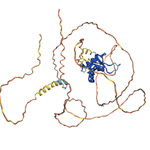
Z for Zinc Finger: This video features the zinc finger protein ZNF260. As it interacts with genetic material, its fingers insert into the major groove of the DNA to recognize and bind specific nucleotide sequences.
Alex Federation retweeted

哺乳類が失った再生能力は、消えたのではなく「眠らされていた」だけかもしれない。Scienceの研究は、ウサギが耳を再生できてマウスができない差が、レチノイン酸の合成酵素Aldh1a2にあることを突き止めた。この遺伝的スイッチをオンにすると、マウスの再生能が甦った。
圧巻は、ウサギのエンハンサー1つを入れるだけで再生が戻った点だ。進化で無効化された回路を、ピンポイントで再起動できる。ヒトが失った再生能力も、原理的には「呼び覚ませる」可能性がある。再生医療の発想を、移植から「自己再生の再点火」へ広げる成果だ。
出典: Science(2026)
science.org/doi/10.1126/scie…
