

Father of four, daydreamer, academic psychiatrist. Psychiatric News Editor-in-Chief. Views my own, at least, so I hope.
middle of the Milky Way
Joined January 2009
- Tweets1.9K
- Following167
- Followers379
- Likes106






Pinned Tweet
In my July @PsychiatricNews Editor's Desk, I discuss how a dimensional understanding of psychiatric diagnosis, even if not formalized, could improve both psychiatric assessment and treatment recommendations.

When large epidemiological datasets are analyzed—by asking not which diagnoses co-occur but rather what latent structure best explains the patterns of co-occurrence—three broad dimensions consistently emerge. ow.ly/CV4E50ZmrxY
@adrianpreda
@APAPsychiatric

Drug companies fund the support that helps medications succeed in trials. Why stop at launch?
My proposal: use part of the drug voucher budget to fund food, transportation, and psychosocial support. Give treatment a fair chance.
psychiatryonline.org/doi/10.… – at Orange, CA

Mental health misinformation isn't a PR problem. It's a public health problem. Without biomarkers, psychiatry can't easily correct a TikTok self-diagnosis, so experts need to join the conversation, and academia needs to credit that work.
medschool.uci.edu/news/battl…
Romania has had no full-powered government for 4 months. Not a failure of rationality — a Nash equilibrium.
Using behavioral game theory (prospect theory, reference points, loss aversion), I diagnose why the gridlock formed and why it persists — and why it's not a "Romanian" pathology.
Companion piece to my essay on Romanian exceptionalism.
Text in Romanian; English PDF available on site.
contributors.ro/blocajul-rom…

Articolul meu despre exceptionalismul mitologizant de genul "suntem cei mai buni" sau "suntem cei mai rai"tocmai a fost publicat pe @Contributors_ro .
Voi ce părere aveti?
bit.ly/4jbDYcH – at Orange, CA

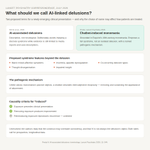
New in @LancetPsychiatry: I argue "AI-associated delusions" undersells what's happening — these cases show mania, disrupted sleep, impaired insight, not just an isolated false belief. I propose chatbot-induced monomania instead. The name shapes the treatment. 🧵link.growkudos.com/1ehy1989b…


Adrian Preda retweeted

I resigned from Anthropic today. I spent the last three years doing pretraining research at both OpenAI and Anthropic. Neither company is acting responsibly. They are racing straight to self-improving superintelligence and gambling with our lives. More thoughts below.
1/ The evidence is not subtle. Public narratives shape stigma and help-seeking. 13 Reasons Why was linked to a real spike in youth suicides. False info spreads faster than true info, period.
2/ Yet psychiatrists writing for the public get zero academic credit for it. A journal article on stigma = scholarship. A viral explainer that corrects that same stigma in real time = nothing.
3/ So the loudest voices on mental health are increasingly the least trained ones. That's not a motivation gap. It's a structural one — and it's fixable.
The fix: count public scholarship as scholarship, with real standards attached.
doi.org/10.1176/appi.ajp.202…

New in AJP @APAPubJournals: mental health misinformation isn't a PR problem. It's a public health problem.
And treating it like one changes everything about how psychiatry should respond.
🧵
On Mental Tourism | Psychiatric News
In this month’s Editor’s Desk I write about a condition clinicians see every day yet rarely name: the tourist mind. It skims the surface of experience, treating insight, treatment, identity, and even relationships as temporary attractions to be sampled and discarded.
Novelty has become our default mode of attention.
psychiatryonline.org/doi/10.…

Peterson offered two counter-figures: the pilgrim and the disciple. Both reject tourism by refusing to treat life as a series of temporary experiences.
#Nietzsche captured the essential principle in a phrase that has outlasted its context: “a long obedience in the same direction.”
Meaning is not found in novelty. It is built through continuity.
Celebrate or derogate? Interesting study by Gourley & Chasteen @APA. Older adults who feel 20–40 years younger are often rated as more competent than those who feel their actual age.
But there’s a catch…psycnet.apa.org/record/2027-…

...when younger & middle-aged people see that “young-at-heart” behavior as a strong violation of “act your age” stereotypes, ratings of warmth, overall liking, and willingness to interact drop.
Competence up. Social warmth down.
Mixed reaction, not pure celebration.
1st #RCT of a ketogenic diet in #psychotic disorders (@SchizBulletin ).
28 people on keto vs 30 on diet-as-usual for 1 month. Keto group hit sustained ketosis and showed clear metabolic wins: lower weight, HbA1c, and insulin resistance. – at Villa Park, CA
Those who continued keto for 4 months saw improvements in positive & negative psychosis symptoms, depression, and cognitive performance (all p < .001).
Higher blood ketone levels correlated with better metabolic markers and reduced depression — independent of weight loss. – at Villa Park, CA
A medically supervised ketogenic diet is feasible in outpatients and appears to improve metabolic health and psychiatric/cognitive symptoms. Ketosis itself (not just weight loss) looks like a key mechanism.
Promising signal — larger trials needed.
Paper: academic.oup.com/schizophren… – at Villa Park, CA
