

Humanist & philosopher. Finance (UCM, Spain). MSc Philosophy, UCL. Building AI-powered things. Still sharing real human thoughts.
UCL
Joined July 2022
- Tweets4K
- Following115
- Followers10.9K
- Likes1.7K




Pinned Tweet
This $BTC indicator has never failed to signal the start of bear markets and bullish markets.
Here’s what it is, how it works, and the key data you need to see.
This model tracks Bitcoin’s long-term cyclical behavior around halving events (reductions in mining rewards).
Each cycle historically follows a three-phase structure identifiable through on-chain and market-behavior metrics:
DCA (Accumulation) ≈ 135 weeks before each halving.
Profit Start ≈ 40 weeks after each halving.
Profit End / Cycle Top ≈ 80 weeks after the same halving.
This pattern has repeated with striking precision across all prior cycles (2012, 2016, 2020) and is now unfolding again post-2024 halving.
2. Historical Performance
Every “Profit Start” has coincided with renewed liquidity inflows, on-chain accumulation, and market expansion, roughly one year after each halving.
3. Current Status (Q4 2025)
Halving: Apr 19 2024
Weeks since halving: ≈ 40 → Profit phase officially active
Market tone: Strong, fueled by ETF inflows, macro easing, and corporate blockchain adoption.
3. Current Status (Q4 2025)
Halving : Apr 19 2024
Weeks since halving: ≈ 80 → the model’s profit-phase window ends this week
Price: ≈ $109 k
Market tone: Still strong, supported by ETF inflows, macro easing, and institutional activity.
Historically, this marks the point where momentum peaks before a distribution phase begins.
But where’s the momentum right now? Where’s the euphoria?
Personally, I’m leaning toward the belief that this cycle will play out differently, institutional capital is leading, and that usually means pullbacks will be more controlled, not violent.
But this is something I’ll cover in a separate post.
4. Contextual Fundamentals
Recent macro and regulatory shifts:
Monetary: Fed pivot to lower rates → higher risk appetite.
Political: Pro-crypto legislation and Trump administration signaling favorable policy.
Institutional: Major firms and payment networks building directly on blockchain infrastructure.
Despite these tailwinds, fundamentals remain fragile: sentiment can reverse in hours, a single tweet, ruling, or liquidity shock can shift the trend.
5. Why It Matters
On-chain and technical metrics are immutable records of capital behavior.
They show what investors do, not what they say.
A decade of repetition makes ignoring these signals statistically reckless.
To date, the model has never failed to:
Mark post-halving profit initiation (≈ 40 weeks).
Flag over-extension near 80 weeks.
Align with profit-taking and distribution patterns.
6. Forward Outlook
The macro environment looks ideal, lower rates, friendlier regulation, record on-chain activity, but market cycles usually top when optimism peaks.
Data doesn’t end cycles, human behavior does.
The Bitcoin halving-cycle indicator remains the only long-term signal that has never missed, but it’s a map, not a guarantee.

Arthur retweeted

Finance is the best industry ever because you don't have to care what someone thinks about you.
There's no Machiavellian politics. There's little bureaucracy.
The only thing that matters are returns. Is your PnL higher than it was at the start of the year or not.
You don't have to like me but you must respect my performance. I don't care if you think I'm a good person, or an asshole. My returns speak for themselves.
You’re welcome for anticipating the bear market bottom live, with entries, plans and reasoning, on the open and free Discord
I’m getting back to daily streams, first one done yesterdays morning, second one today
A lot of money to be made in the next couple of months!


It surprises me that this is being treated as something new
To anyone who’s done any research in physical, biological, or computational systems , it’s obvious how valuable it is to bounce ideas off other systems to catch the blind spots each one has on its own
I’ve been saying it for months, putting all your eggs in one basket and relying on a single set of eyes isn’t a good idea, because even multiple agents of the same model share the same blind spots
Plenty of people already run Gemini, Claude, and GPT in parallel for their different strengths, but however different they look, they were trained on fairly similar data, so combining them helps without removing the underlying limitations, no system can fully correct itself or escape its own points of failure , not even humans , and there are objective, mathematical, and physical limits to what a language model can do
That’s exactly why what Fusion shows feels obvious to me, a panel of weaker models matches the best available model, and by their own data most of the gain comes from the synthesis step , coordinating and contrasting the responses
That coordination is precisely what a human adds on top, and it’s what lets you push almost any current model past its out-of-the-box ceiling, even beyond what a Mythos would deliver on its own
The future isn’t one dominant model, neither a well-orchestrated diversity
The real surprise will come when they realize that a human with genuine judgment in their field , a Terence Tao for example, can squeeze ten times more out of any ordinary model than Mythos would ever give in the hands of someone without scientific , mathematics or philosophical rigor


The world had access to one of the most advanced tools in human history to build freedom across so many dimensions, and the majority used it for video games, marketing, or bad trading terminals instead of mining a path toward more powerful data…
I wonder how many individuals were able to exploit the scientific and mathematical capabilities of these models these last few weeks. If you were able to create something with Mythos/Fable 5 before the shutdown, share it
what I was able to build with Fable before the cut
Over four days, no sleep, I refactored and rebuilt the spine of five projects, including geopolitics and trading, into one ecosystem
Layers that read each other, structural market edges on one end, the physical invariants of the world on the other , the topology, the things that are expensive to fake, and an editorial layer reading the divergence between them
To be honest, I saw this coming
With Fable, the work felt almost divine. I don't think we get another model like this for a while, and now that access is being constrained, I think that whole category of geopolitics, biology, cybersecurity, only gets harder to reach from here (using language models)
So that's what I built while I had it.
Walkthrough coming soon

Arthur retweeted
This $BTC indicator has never failed to signal the start of bear markets and bullish markets.
Here’s what it is, how it works, and the key data you need to see.
This model tracks Bitcoin’s long-term cyclical behavior around halving events (reductions in mining rewards).
Each cycle historically follows a three-phase structure identifiable through on-chain and market-behavior metrics:
DCA (Accumulation) ≈ 135 weeks before each halving.
Profit Start ≈ 40 weeks after each halving.
Profit End / Cycle Top ≈ 80 weeks after the same halving.
This pattern has repeated with striking precision across all prior cycles (2012, 2016, 2020) and is now unfolding again post-2024 halving.
2. Historical Performance
Every “Profit Start” has coincided with renewed liquidity inflows, on-chain accumulation, and market expansion, roughly one year after each halving.
3. Current Status (Q4 2025)
Halving: Apr 19 2024
Weeks since halving: ≈ 40 → Profit phase officially active
Market tone: Strong, fueled by ETF inflows, macro easing, and corporate blockchain adoption.
3. Current Status (Q4 2025)
Halving : Apr 19 2024
Weeks since halving: ≈ 80 → the model’s profit-phase window ends this week
Price: ≈ $109 k
Market tone: Still strong, supported by ETF inflows, macro easing, and institutional activity.
Historically, this marks the point where momentum peaks before a distribution phase begins.
But where’s the momentum right now? Where’s the euphoria?
Personally, I’m leaning toward the belief that this cycle will play out differently, institutional capital is leading, and that usually means pullbacks will be more controlled, not violent.
But this is something I’ll cover in a separate post.
4. Contextual Fundamentals
Recent macro and regulatory shifts:
Monetary: Fed pivot to lower rates → higher risk appetite.
Political: Pro-crypto legislation and Trump administration signaling favorable policy.
Institutional: Major firms and payment networks building directly on blockchain infrastructure.
Despite these tailwinds, fundamentals remain fragile: sentiment can reverse in hours, a single tweet, ruling, or liquidity shock can shift the trend.
5. Why It Matters
On-chain and technical metrics are immutable records of capital behavior.
They show what investors do, not what they say.
A decade of repetition makes ignoring these signals statistically reckless.
To date, the model has never failed to:
Mark post-halving profit initiation (≈ 40 weeks).
Flag over-extension near 80 weeks.
Align with profit-taking and distribution patterns.
6. Forward Outlook
The macro environment looks ideal, lower rates, friendlier regulation, record on-chain activity, but market cycles usually top when optimism peaks.
Data doesn’t end cycles, human behavior does.
The Bitcoin halving-cycle indicator remains the only long-term signal that has never missed, but it’s a map, not a guarantee.
You're welcome for anticipating the bear market 10 months ago

How did I manage to maintain an 85% win rate during this drop, anticipate the bear market three months ago and exit my spot positions, taking only one loss in the process and six wins, all live?
Here are the strategies I use to avoid missing the next bottom and to stop longing every higher low on $BTC

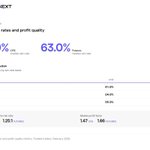
Real data from 10,000+ funded accounts that got paid (FundedNext, February 2026):
— Median win rate of paid CFD traders: 50%
— 41% of them won LESS than half their
Trades
— They still got paid
The difference is the median R:R of 1.49:1
Profitable trading isn’t about being right more often. It’s about losing well.
You know how you actually solve trading psychology? You remove yourself from the equation
Agents and automation. Let the system execute what you already know works , without you getting in the way.


Financial agents are the future
And now Anthropic just proved it with data
Their new labor market study ranks financial & investment analysts as the 7th most AI-exposed occupation in the entire US economy , 57.2% observed exposure
Not theoretical, actual , happening-right-now automation
Most people read this as a threat.
I read it as a roadmap
The firms still paying 6 figures for someone to compile reports and forecast market conditions are operating on borrowed time
The ones building agents to do it faster, cheaper, and 24/7 are already ahead
Keep tune for my next post


Hundreds of autonomous agents for trading
Scanning the market from different data providers, different strategies, interacting with each other.
If you want to see what real emergence in trading looks like, and what comes out of this open project, stay tuned.
Conway for financial markets, coming soon.
Arthur retweeted
Qualitative vs. quantitative analysis
A mechanical strategy stripped of context will almost always look broken in a backtest, No macro filter, no higher timeframe bias, no session awareness, no news consideration
Of course the results are poor
@MrZincx version isn't a different strategy, it's the same one, properly contextualized.
That's what makes it work
I understand Zinc has a bias, he's promoting a platform, an indicator, and memberships, which isn't inherently bad if done ethically. But this is exactly what I don't like: no one can argue against the effect it has on people who believe that a single-timeframe indicator will get them the same results as someone with years of context behind every decision. That type of marketing, even when done ethically, is by default misleading. You're selling a tool as if it were the edge itself.
This is why I emphasize that trading is hard, but teaching trading is harder, most traders apply layers of context intuitively without realizing it
The second you strip that out and hand someone a naked mechanical system, you've removed the actual edge

Here is the 5yr backtest for this exact strategy.
-IB defined as 930am ET to 1030am ET
-Waits for IB range to close.
-IB has not yet been broken.
-If low formed first, buys the mid point, stop loss is IB low, PT is IB high.
-If high formed first, shorts the mid point, stop loss is IB high, PT is IB low.

Arthur retweeted
Hundreds of autonomous agents for trading
Scanning the market from different data providers, different strategies, interacting with each other.
If you want to see what real emergence in trading looks like, and what comes out of this open project, stay tuned.
Conway for financial markets, coming soon.
I've met real quants, mathematicians, engineers, who are extremely poor traders, completely outperformed by many traders I've come across here who work with hybrid heuristics
Wonder why that is
Qualitative vs. quantitative analysis
A mechanical strategy stripped of context will almost always look broken in a backtest, No macro filter, no higher timeframe bias, no session awareness, no news consideration
Of course the results are poor
@MrZincx version isn't a different strategy, it's the same one, properly contextualized.
That's what makes it work
I understand Zinc has a bias, he's promoting a platform, an indicator, and memberships, which isn't inherently bad if done ethically. But this is exactly what I don't like: no one can argue against the effect it has on people who believe that a single-timeframe indicator will get them the same results as someone with years of context behind every decision. That type of marketing, even when done ethically, is by default misleading. You're selling a tool as if it were the edge itself.
This is why I emphasize that trading is hard, but teaching trading is harder, most traders apply layers of context intuitively without realizing it
The second you strip that out and hand someone a naked mechanical system, you've removed the actual edge
That's exactly why what I build are deterministic entry models with added layers of context.
Qualitative vs. quantitative analysis
A mechanical strategy stripped of context will almost always look broken in a backtest, No macro filter, no higher timeframe bias, no session awareness, no news consideration
Of course the results are poor
@MrZincx version isn't a different strategy, it's the same one, properly contextualized.
That's what makes it work
I understand Zinc has a bias, he's promoting a platform, an indicator, and memberships, which isn't inherently bad if done ethically. But this is exactly what I don't like: no one can argue against the effect it has on people who believe that a single-timeframe indicator will get them the same results as someone with years of context behind every decision. That type of marketing, even when done ethically, is by default misleading. You're selling a tool as if it were the edge itself.
This is why I emphasize that trading is hard, but teaching trading is harder, most traders apply layers of context intuitively without realizing it
The second you strip that out and hand someone a naked mechanical system, you've removed the actual edge
Here is the 5yr backtest for this exact strategy.
-IB defined as 930am ET to 1030am ET
-Waits for IB range to close.
-IB has not yet been broken.
-If low formed first, buys the mid point, stop loss is IB low, PT is IB high.
-If high formed first, shorts the mid point, stop loss is IB high, PT is IB low.
Hundreds of autonomous agents for trading
Scanning the market from different data providers, different strategies, interacting with each other.
If you want to see what real emergence in trading looks like, and what comes out of this open project, stay tuned.
Conway for financial markets, coming soon.


This is something I genuinely believe in
I stopped posting at the peak of my X account. In November alone, I gained 4,000 followers in a single month. I was receiving daily messages from people offering me money to open a Discord, start a mentorship, build anything around the attention I had earned.
So why did I walk away from all of it for three months?
Because I was actually making money from my tools, and I will always choose to sharpen my edge over riding momentum. Momentum is borrowed time. Edge is something you own.
That doesn’t mean I dismiss the value of networking or building a presence here. I genuinely respect the people who make a living from products and consultancies on this platform.
When it’s done with integrity, that’s honorable work, and harder than most people realize.
On my end, I’m now opening a financial consulting practice in real life to put my first degree to work in a more tangible way.
But here’s what matters most to me,
I came back two weeks ago and I’ve already gained almost 2,000 followers.
And the thing that strikes me isn’t the numbers, it’s that people don’t just follow me. They trust me. And trust is a far more valuable commodity than attention in an era drowning in noise.
I’m not perfect. I never claimed to be. But I try, I correct myself constantly, and I hold myself accountable. And if I’m honest about where my real edge lies, it was never the tools. It’s me. It’s the discipline I bring to my life and my habits, every single day, compounding quietly while no one is watching.
