

Founder @isotopes_ai Past life: CTO, @scale_ai, CPO, @cloudera. Co-Founder/CPO, @Hortonworks. Engineer sheepdog. Self-confessed old soul.
Never still, mostly move ahead
Joined May 2009
- Tweets12.9K
- Following238
- Followers17.6K
- Likes2K


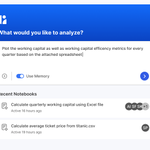

Reproducibility is important for analyzing data (with or without AI). However, it’s completely distinct from “verification” of the analysis. This is particularly so for Finance teams.
We saw this firsthand when an accountant reviewing a reconciliation found a $3,813.58 difference between two analyses of the same 3,144 transactions. The issue wasn't the data or the math. It was how one word in the original request, "discrepancy", had been interpreted.
@isotopes_ai's approach treated negative differences as errors and added them. The accountant's workpaper treated them as adjustments and netted them. Both were reasonable interpretations of an ambiguous request.
Running the analysis again would have reproduced the same interpretation and returned the same answer.
That's why I don't think verification is about adding a better checkmark to AI-generated analysis.
The person reviewing the work needs to see the reasoning, sources, assumptions, and corrections behind the number, without needing an engineer to unpack it for them.
If AI is going to do more analytical work, verification has to make that work easier for humans to interrogate, not harder.
More on how we’re we approach verification: isotopes.ai/blog/trust-but-v…

Arun C Murthy retweeted

Open weights are having a moment. Better models, cleaner licenses, more ways to tune and serve.
Exploring Inkling @thinkymachines for a focused loop in Neocortex raised a simple question. Do you really get the same experience?
isotopes.ai/blog/everyone-is…

Arun C Murthy retweeted

Most AI analytics tools answer questions.
The harder question is: what do they actually know, how do they know it, and what happens when they are wrong?
That’s why we built Neocortex, the self-learning model behind aidnn.
Read more:
isotopes.ai/blog/neocortex-s…


In a world with abundant intelligence, every enterprise runs on two kinds of capital: the human capital of its people's judgment, and the cognitive capital of the reasoning ability it builds and owns about the business. The second is new, and it is where durable advantage accrues.
White-collar work in the enterprise forms a natural hierarchy.
→ At the base sit the *systems of record*: the warehouses, lakes, ERPs, and CRMs that hold the data.
→ Above it comes *knowledge work*: the assembly, reconciliation, and verification that turn scattered records into a trustworthy answer. It is procedural even when it's hard, and it's staffed today by armies of analysts and outsourced teams.
→ At the top comes *judgment work*: weighing trade-offs when systems disagree, owning the answer when challenged, the part that was always the key for world class decisions.
Software increasingly absorbs the knowledge work. It still needs the judgment work. Cognitive capital accrues from both knowledge work and cognitive work.
Today @isotopes_ai is introducing *Neocortex*, the self-learning system behind aidnn. Each answer it produces draws on a set of experts from your organization's verified knowledge, and shows you every expert who contributed and every belief it relied on. We built it the way the brain learns, by doing rather than by being instructed:
→ It holds what your organization believes
→ It learns how your organization does the work
→ It judges that work and learns from how you judge it
→ It consolidates every answer into durable cognitive capital
A critical difference from existing approaches: Neocortex learns from doing the work, not from instructions you write down for every task. Every correction shows it how the work should be done, and the one thing it does better than any tool you've used is this: it never needs to be told twice. The verification layer within aidnn lets Neocortex *learn* the nuances that matter and, just as important, *unlearn* them as business realities change.
The payoff: the reasoning your best people do today stops evaporating after each question and starts compounding into an asset you own.
Interested in learning more?
We are happy to show you Neocortex with *your* data:
isotopes.ai/contact-us?sourc…
Interested in more technical details?
Go forth and gorge on: isotopes.ai/neocortex

To learn more about Neocortex, you can read our blog:
isotopes.ai/blog/neocortex-s…
AI can produce an answer in seconds, but if your data is scattered across systems and the output hasn't been reconciled or verified, you're still spending all your cycles on verifying (data, context, accuracy etc.) before you can act.
That gap, between a fast answer and a decision-ready one, is where most "chat with your data" tools break down.
📅 Join me and the @isotopes_ai team for our webinar on Thursday, 4/23 | 9:30am PDT to learn:
→ Why the warehouse-as-single-source-of-truth model breaks down in practice
→ How aidnn assembles, reconciles, and verifies data across disconnected systems
→ Real customer examples of true self-service analytics
If your team is still spending weeks on reconciliation work that should take minutes, this one's for you.

The real bottleneck isn't getting answers faster. It's that the data needed to answer them is fragmented across systems, and it needs to be reconciled and assembled before it can be analyzed. Then the answers need to be accurate to make better decisions.
In the upcoming @isotopes_ai webinar, we'll walk through why fragmented enterprise data breaks traditional analytics, why chat-with-data tools paper over the problem instead of solving it, and how a verification-first, multi-agent approach with aidnn delivers answers you can actually act on.
Join us April 23rd @ 9:30am PST to learn how you can make better business decisions with verified answers before your competition.
Register today to join me: isotopes.ai/webinar/verified…

Excited for @isotopes_ai to be at @HumanX 2026 in San Francisco next week!
Come find us at Booth #507. We'd love to connect and give you an invite to our exclusive rooftop event. See you there!
#HumanX2026 #AI #IsotopesAI #aidnn #aianalytics #analytics #agents


Arun C Murthy retweeted

The work can now speak for itself.
The ability to send your boss a session and have the agent answer "Why did you assume that?" instead of pinging you back on slack required making agents play multi-player.
Most AI products give you a chatbot. You ask, it answers. But that doesn’t work for serious analytical work.
Your team doesn't watch every step. They start an analysis, go to meetings, come back the next day.
Colleagues need to understand what happened.
Sometimes you need to rewind and try a different path.
A chatbot can't do any of that.
So we threw out the chatbot model and rebuilt around one idea: the event stream.
Every action aidnn takes is emitted as a structured, ordered event. That single decision unlocks everything:
→ Teammates jump in, ask questions anchored to specific moments, and keep going
→ Close your laptop, come back tomorrow — zero lost progress
→ Branch from any checkpoint and compare results
→ See assumptions and reasoning before execution, not after
The result feels less like querying a black box and more like working with a teammate who documents their work and can be reviewed for methods, not just results.
Full breakdown on the @isotopes_ai blog:
blog.isotopes.ai/building-a-…
Getting phenomenal feedback, and resonance, from the Isotopes AI "Team of Rivals" technical paper published in arXiv.
Here is the summary from DAIR.AI:
"The paper introduces the idea of organizational intelligence for AI:
→ 50+ specialized agents organized into teams (planners, executors, critics, experts)
→ Hierarchical veto authority; critics can reject outputs entirely, triggering internal retry
→ Pre-declared acceptance criteria established before any work begins
→ Remote code execution keeps raw data separate from reasoning context
→ Different model providers for writers vs critics to avoid monoculture
It turns out that coherence emerges from opposing forces.
Planners push for clarity, executors push for pragmatism, and critics push for correctness. Their conflicting incentives create boundaries that prevent drift in the system."
lnkd.in/gZ9hR3yQ
It's great to see how this idea is intuitively resonating with many folks - for this is the best way to make reliably accurate, and consistent, multi-agent systems for production.
Needless to say, we are excited to actually have this in production *today* unlike anyone else! Head over to isotopes.ai/signup to try it out!
Meanwhile, geek out on actual production traces of multiple analysis with multiple teams of agents... each blue box is an sub-agent and the sequence diagram represents the interaction between them.
Arun C Murthy retweeted

Specialized agent teams organized to achieve clear goals, utilizing a remote code executor to separate data transformations from reasoning. Agents execute code remotely, returning only relevant summaries, thereby maintaining a separation between perception and execution.
We recently talked about the "Team of Rivals" architecture which we bring to bear @isotopes_ai to scale sophisticated AI Agents, here is our paper on @arxiv:
arxiv.org/abs/2601.14351
Discuss: news.ycombinator.com/item?id…

Arun C Murthy retweeted
We just published our whitepaper on building production-grade agentic AI.
Core thesis: analytics isn’t a chatbot problem - it’s an orchestration problem.
Get the whitepaper → isotopes.ai/whitepapers/orch…

We just published our latest whitepaper "The Orchestration Imperative for AI Agents" and this one is especially interesting for leaders who want to learn about the next evolution of AI.
Here's the core insight: Production-grade AI Agents aren't a chatbot problem. They are an orchestration problem.
Most multi-agent AI systems fail for predictable reasons—coordination overhead scales nonlinearly, context gets contaminated and rots progressively, and debugging becomes impossible.
We've watched teams spend months building "agentic" solutions only to hit these walls.
This whitepaper distills the principles @isotopes_ai uses to make sophisticated AI agents work in production: structured workflows, plans as contracts, hierarchy that tames complexity, and humans owning the "what" while the system handles the "how", and more.
If you're evaluating any agentic AI for your business - or building one - this is definitely worth a read!
Get the whitepaper to learn more → isotopes.ai/whitepapers/orch…
We recently talked about the "Team of Rivals" architecture which we bring to bear @isotopes_ai to scale sophisticated AI Agents, here is our paper on @arxiv:
arxiv.org/abs/2601.14351
Discuss: news.ycombinator.com/item?id…
Many thanks to several folks who gave incredible feedback on several iterations of the paper: @goldenkatepark, RSM (@Meta), SMS and more!
Arun C Murthy retweeted
This idea that "AI models will not keep scaling" was conjecture in Nov 2024 when we wrote the first prototype.
Through 2025, we have built a system which does not depend on context windows growing and lossy compactions, but go faster with lots of fast flash LLMs
Orchestrating a Team of Rivals
We @isotopes_ai just published our in-depth technical paper on how aidnn achieves production-grade reliability!
Model scaling is slowing down. But AI impact doesn't have to plateau.
The path forward isn't faster clock-speeds. It's multi-core. Instead of waiting for a single smarter model, aidnn orchestrates multiple LLMs with opposing incentives.
No business relies on one employee to handle critical operations. We shouldn't architect AI systems around single-agent execution either.
aidnn deploys 50+ specialized agents organized as specialized teams:
* Planners create execution strategies
* Executors perform the work
* Critics validate outputs with veto authority
* Remote code execution keeps data isolated from reasoning models
Each of these agents are coding agents resulting in a highly repeatable & reliable agentic system.
We call it "orchestrating a team of rivals." Multiple agents with different failure modes catch what individual models miss. Hierarchical veto authority prevents errors from propagating.
The result: 90%+ error prevention through layered validation. And your data stays secure.
This is the architecture behind financial close automation at Invisible Technologies and others — turning weeks of manual work into hours of validated analysis.
Read the full technical paper here:
isotopes.ai/technology
Arun C Murthy retweeted
architecture behind aidnn: agentic teams with opposing incentives validating each other’s work.
This is how we’re getting production-grade reliability for financial analysis.
Read more → isotopes.ai/technology
Orchestrating a Team of Rivals
We @isotopes_ai just published our in-depth technical paper on how aidnn achieves production-grade reliability!
Model scaling is slowing down. But AI impact doesn't have to plateau.
The path forward isn't faster clock-speeds. It's multi-core. Instead of waiting for a single smarter model, aidnn orchestrates multiple LLMs with opposing incentives.
No business relies on one employee to handle critical operations. We shouldn't architect AI systems around single-agent execution either.
aidnn deploys 50+ specialized agents organized as specialized teams:
* Planners create execution strategies
* Executors perform the work
* Critics validate outputs with veto authority
* Remote code execution keeps data isolated from reasoning models
Each of these agents are coding agents resulting in a highly repeatable & reliable agentic system.
We call it "orchestrating a team of rivals." Multiple agents with different failure modes catch what individual models miss. Hierarchical veto authority prevents errors from propagating.
The result: 90%+ error prevention through layered validation. And your data stays secure.
This is the architecture behind financial close automation at Invisible Technologies and others — turning weeks of manual work into hours of validated analysis.
Read the full technical paper here:
isotopes.ai/technology