Postdoc @LowellObs working on small body astronomy. ActivityPub/Mastodon/etc: @qicheng@cometary.org = https://xitter.cf/t.co/Nhp285xTH1
California, USA
Joined June 2009
- Tweets181
- Following96
- Followers321
- Likes159
I'll be giving a public talk here next Friday at 3-4 pm, so anyone in the area interested in the science of great comets and viewing the upcoming display of C/2023 A3 (Tsuchinshan-ATLAS) should come by the Capitol Reef Visitor Center then!
One week away! The 14th annual Heritage StarFest begins next Friday! Hosted by Capitol Reef and community partner, Entrada Institute, this year's events will take place next week on Sept. 27 and 28. For more: nps.gov/care/planyourvisit/h….
Qicheng Zhang retweeted
Attention night sky and astronomy enthusiasts! The 14th annual Heritage StarFest is two weeks away! Hosted by Capitol Reef and community partner, the Entrada Institute, this year's events will take place on Sept. 27 and 28. More info: go.nps.gov/wrxrkk
Asteroid (3200) Phaethon paid another visit to the Sun last weekend, when its sodium emission brightened into view of SOHO's LASCO C3 coronagraph for the 20th time. More details on the science, from a paper published earlier this year: iopscience.iop.org/article/1…
Comet C/2023 P1 (Nishimura) was only discovered two weeks ago on August 12 by Hideo Nishimura, but STEREO-A actually saw the comet a month earlier through its HI1 camera. Here's a short animation of the comet brightening in July.
Here's a peek at the approaching Oort cloud comet C/2023 A3 (Tsuchinshan-ATLAS) by the 200-inch Hale Telescope at Palomar Observatory last month. Coma was at an r' magnitude of ~16.3.
Mercury reaches inferior conjunction today. While not a "proper" transit, Mercury's lack of a substantial atmosphere makes it dark at high phase angles, which lets @MissionSOHO's LASCO C2 coronagraph see it silhouetted as a black dot against the bright solar corona.
Qicheng Zhang retweeted
#USNRL scientists continue to break ground using the Large Angle and Spectrometric Coronagraph (LASCO) telescope. The 27-year-old telescope is making new discoveries about the properties of asteroids and comets near the sun.
nrl.navy.mil/Media/News/Arti…
Asteroid (3200) Phaethon brightens and grows a tail like a comet near the Sun. Thanks to @MissionSOHO, we now know that activity is not from comet-like dust as previously assumed, but from sodium atoms escaping the asteroid under intense solar heating: iopscience.iop.org/article/1…

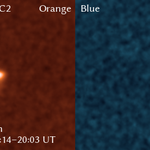
ALT SOHO LASCO C2's view of asteroid (3200) Phaethon's orange-colored sodium emission, which is clearly visible through the Orange filter (left) with a short tail, but not through the Blue filter (right). The ☉ (circled dot) indicates the sunward direction (up), while the +v indicates the direction of Phaethon's motion (lower right).
Here's a nice summary from @esascience: xitter.cf/esascience/status/1650…
☄️ @MissionSoho observatory has overturned 14 years of thinking about the strange Sun-skirting ‘rock comet’ known as Phaethon that could reopen the mystery of how the Geminid meteor shower was born 💫
Full story👉esa.int/Science_Exploration/…
And from @NASASun: xitter.cf/NASASun/status/1650885…
Asteroid Phaethon is weird. It forms a comet-like tail near the Sun and sheds debris for a meteor shower seen each December.
Scientists thought dust from Phaethon was to blame. But NASA solar observatories show that its tail isn’t dusty.
What's going on? go.nasa.gov/3LebMng
Now officially confirmed as C/2023 A3 (Tsuchinshan-ATLAS): minorplanetcenter.net/mpec/K…
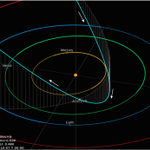
Interesting new comet candidate A10SVYR on the PCCP to keep an eye on. Looks like it will pass almost directly between the Earth and Sun in 2024 October, where forward scattering could make the comet fairly bright in twilight if it survives to that point: catalina.lpl.arizona.edu/css…
Comet 96P/Machholz has now re-emerged into the predawn sky. Here it was this morning from Pasadena, at ~2 degrees above the horizon and ~14 degrees from the Sun, with a hint of the first ~5' of its dust tail. Very rough photometry gives a coma r' magnitude of ~7.
Qicheng Zhang retweeted
There's a thin, persistent dust trail both behind AND ahead of 96P in its orbit! This was assumed to likely be there but never directly imaged until recently! You can download the full movie, and read more, here: soho.nascom.nasa.gov/hotshot…
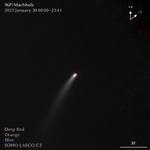
Comet 96P/Machholz has just reached its perihelion, at only 0.12 au from the Sun. Here's the view from the SOHO spacecraft's LASCO C3 coronagraph, which has been running a special program observing the comet through several color filters over the last couple days.
And here's an animation. Less badly compressed version here: cometary.org/@qicheng/status…
Took the 60 mm refractor out to the Panamint Valley last weekend, and spent some time observing Didymos again. The head is now essentially back to the baseline r'~15.5 mag, but the #DARTMission ejecta tail remains visible thanks in no small part to the very dark sky.
After yesterday's #DARTMission excitement, I decided to have a try at imaging Didymos from Pasadena this morning. At r'~13 mag, it was ~4x brighter than baseline, so still lots of dust/ejecta around, though it's all pretty much unresolved with ~5" seeing under LA light pollution.
Another icy visitor from the Oort cloud has been reduced to rubble by the Sun: Our observations with the @LowellObs Discovery Telescope show that all that remains of comet C/2021 O3 (PANSTARRS) is a pile of dust/debris left over from the recent disintegration of its nucleus.
(NEW) ATel 15358: Disintegration of Near-Sun Comet C/2021 O3 (PANSTARRS... astronomerstelegram.org/?rea…