

AI Creative Technologist
Greece
Joined May 2022
- Tweets2.3K
- Following951
- Followers773
- Likes4.4K


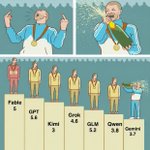




This is something I encountered very often while working as a 3D artist in architecture. Some clients preferred a photorealistic look, while others wanted something more like conceptual 3D. Photorealism isn’t always what people want, you need to know who the end viewer of your work is.

One more time about the DLSS and unnecessary hysteria around it. This is Katherine from KCD. She is the well-known Czech actress Kristýna Leichtová. The first image shows a photo of her. This is how we 3D-scanned her. We then manually adjusted her appearance and textures, because we don’t use any makeup during the 3D scan, and the in-game model has to meet a whole range of parameters. The second image shows her appearance in the vanilla game, the third shows DLSS5 when it’s set correctly (in my opinion), and the last one shows what happens when random idiot sets all the sliders to max. We can discuss whether you prefer the slightly “smoothed-out” original look from image 2 or the more natural one from image 3; in any case, in image 3, the in-game model is clearly the most similar to the real actress who plays Katherine and whom we scanned. It’s also much better lit, and the details of the nose, eyes, hair texture, and subtle shadows, or the bones on the neck definitely look more natural and realistic, and DLSS5 isn’t adding anything artificial there. Those details are present in both the model and the texture; it’s just that due to the engine’s lighting, they aren’t as visible, and DLSS5 “fixes” this fairly accurately based on the normal map and other factors. On top of that, this particular technology will not steal anyones job. So, for me, Image 3 is an improvement and much closer to how I’d wanted the lighting to work from the start and it was not possible. If we had this tech two years ago, and I would like the character to look "younger" but with DLSS5 shadows and lighting, we would tweak the model and made it so. Of course, this raises the issue of the uncanny valley. It sometimes starts to look almost too realistic—similar to the “soap opera” effect in movies when you turn on frame interpolation on a TV. As creators, we’ll have to deal with that. But it’s a new technology, and I’m absolutely certain it will improve.

Nano Banana Pro went from being a great image-editing model to being completely useless in production. I don’t know what Google is thinking, but client expectations will always grow beyond today’s limits, so it’s a strange strategy to nerf the Gemini models.

The best thing about Greece is visiting the seaside when the tourist season is over. You can enjoy the warmest sea, beautiful weather, and almost complete silence.
Remember today’s date, because it’s over for 3D artist job as we knew it. I’ve been a 3D artist since 2004. What’s shown in this video is already beyond the skill level of many 3D artists, they can’t even build 3D models at GPT Astra’s level.


Google just killed its dedicated AlphaFold research team. Remember the guy who designed an mRNA vaccine to cure his dog's tumor? Why shut down such a great tool? Because giving away Nobel-winning AI to independent researchers doesn't pay the bills but multi-billion $$ Big Pharma deals with Isomorphic Labs do.
The future of AI drug discovery isn't open source.
The prices of AI-generated images are getting close to what clients are willing to pay, which is squeezing service providers’ margins.
For example, a client looking to produce 5 million images may be willing to pay $1 per image. AI generation can easily cost $0.30–$0.45 per production-ready image. After adding company overhead, that can leave only around $0.10–$0.20 in profit per image.
Fun fact: in Athens, Greece, most businesses shut down completely for vacation between August 8 and 25.

the impact of AI labeling in the EU will be negative for companies. The economy is already struggling, and many companies simply do not have the budgets to hire studios to produce ads and marketing for their products. As a result, they may choose not to do it at all.
Living in Greece isn’t only about the sea and beaches. It also means facing devastating wildfires that can spread extremely quickly in strong winds.

🔥 A wildfire W of Athens 🇬🇷 has burned over 10k hectares, triggering evacuations & a large-scale emergency response.
🛰️ This #CopernicusEU Sentinel-2 #ImageOfTheDay captures the burn scar and a 70 km-long smoke plume.
🔗 eu-space.europa.eu/explore-e…

🇪🇺 Today, 2 August, the EU AI Act’s transparency rules start applying.
I’ve already seen one misconception everywhere:
“Only AI companies need to care.”
That’s not wha…
Do fines applies?
Yes.
how fines are calculated.
Companies can be fined up to €15M or 3% of worldwide turnover.
Individuals don’t have “worldwide turnover,” so only the fixed maximum can apply.‼️
So here’s the takeaway.
❌ The AI Act does not say every AI post must be labeled.
❌ It does not exempt individuals.
✅ It creates transparency obligations for specific situations defined in Article 50.
Official guide:
digital-strategy.ec.europa.e…