

Interested in technology, philosophy, and forms of life. Currently: simulation, physics, UI programming, game dev, SpriteKit, RealityKit, Apple platform.
Joined April 2010
- Tweets11.6K
- Following479
- Followers496
- Likes4.8K




Achraf Kassioui retweeted

Knowledge work has moved from the 80/20 rule to the 99/1 rule: AI hands you something 99% finished in a minute.
Doing 1% of the work sounds restful. Instead, a March HBR/BCG study coined “AI brain fry”: workers pushed into heavy AI oversight report 33% more decision fatigue and 39% more major errors, with strain surging past 3 concurrent AI tools.
Why? Because the old 80% slog (formatting decks, tidying models) was disguised recovery where your brain worked out the argument.
Delete the cruise, and the whole day is take-offs and landings.

Achraf Kassioui retweeted

the craziest part now is that the modern computer probably has to be entirely reinvented, from scratch. pretty much like how jobs & co brought apple ii to market.
like not improved. not given a chatbot sidebar or something but really from the ground up like the iphone redefined what it meant to be a pocket computer.
the current paradigm for computers was built around a human staring at a screen, moving a cursor, opening apps, managing windows, naming files, remembering where things live, & manually translating intent into interface actions.
that made sense when the human was the runtime. but in an ai native world, it starts to look kinda ridiculous.
you can see this ridiculousness when you use computer use agents… they are useful sure, but they’re also obviously transitional. they’re teaching ai to operate machines designed for humans, which is clever, but also kind of absurd. it’s like making a robot hand so it can use a doorknob instead of asking why the door needs a knob at all. yes i know humans also need to use a door knob, but maybe in the future humans don’t need to use a computer, or at least what we think of a computer today at all.
this all leads to some interesting questions:
- what is a file when the system understands context?
- what is an app when intent can route itself?
- what is a desktop when work can be decomposed, executed, monitored, & summarized by agents?
- what is a browser when the agent can retrieve, compare, transact, & remember?
- what is an operating system when the primary user is no longer just a person, but a person plus a swarm of delegated intelligences? or no person at all.
the old computer assumed navigation.
the new computer has to assume a new kind of intention. the old computer organized information. the new computer has to try to organize agency.
we’re still in the hacky middle stage at the moment with sidebars, copilots, agents clicking through legacy ui, & automation layers sitting on top of 40 year old metaphors.
the new computer is likely one where memory, context, identity, permissions, tools, agents, & interfaces are native primitives. this means desktop, mobile, browser, apps, files, folders deserves another first principles look.
There was an Alan Kay paper on the legacy of digital media and how we might lose their content once their environment is gone.
Today I asked Opus to run a dead web app I wrote in 2012 with many dependencies and obsolete frameworks. The server was up in 2 minutes.
15
Revolutions in the digital world all seem correlated with centralization: search engines, social media, mobile, AI... none of them has brought us closer to the romantic dream of a decentralized web.
24
Apple has both built a powerful programming platform with amazing frameworks (AVFoundation, SpriteKit, Core Image, ...) and set back personal computing by locking the iPhone and forbidding free software distribution.

The iOS $99 a year thing is so annoying.
I just want to write custom iOS apps for me and my family and friends and distribute them via TestFlight. That shouldn’t cost $99 a year. It’s not budget-breaking but it’s obnoxious and out of proportion.
55


Achraf Kassioui retweeted

Most people are not special, rational, or particularly good. They're tribal primates running social scripts, ranking status, and defending comforting lies over evidence. Intelligence, drive, and outcomes are heavily genetic. Equality of result is a fantasy. The average person will never produce anything of lasting value, and the world is carried by a thin minority they resent.
Achraf Kassioui retweeted

I asked Fable 5.2 to "go wild" making a game, and all I got was this Pong clone.
And then I played it ...
👇

Achraf Kassioui retweeted

Close-up drone shot of the pervious LJ-2 Y2's launch. via v.douyin.com/9XTBabcWLaE/

Achraf Kassioui retweeted

speeding up past 300km/h
speeding up past 400km/h
topping 500km/h
scary
congrats team BYD or should I say Yangwang?
⚡️⚡️⚡️
#alwaysbecharging


If I were a teenager again I would focus on making hardware.
The problem with that is it's extremely geography dependent. You have to be in the right country to get access.
Software promised to transcend geography, but I don't believe that anymore.
31
Achraf Kassioui retweeted

Several centuries ago the Pope decreed that all the Jews had to convert to Catholicism or leave Italy.There was a huge outcry from the Jewish community so the Pope offered a deal.
He would hold a religious debate with the leader of the Jewish community. If the Jews won, they could stay in Italy. If the Pope won, they'd have to convert or leave.
The Jewish people met and picked an aged and wise rabbi to represent them in the debate.
However, as the rabbi spoke no Italian and the Pope spoke no Yiddish, both sides agreed that it would be a "silent" debate.
On the chosen day the Pope and rabbi sat opposite each other.
The Pope raised his hand and showed three fingers.
The rabbi looked back and raised one finger and shook it at the Pope.
Next the Pope waved his finger around his head.
The rabbi pointed to the ground where he sat.
The Pope brought out a communion wafer and a chalice of wine.
The rabbi pulled out an apple.
With that, the Pope stood up and declared himself beaten and said that the rabbi was too clever. The Jews could stay in Italy.
Later the cardinals met with the Pope and asked him what had happened.
The Pope said, "First I held up three fingers to represent the Trinity. He responded by holding up a single finger, shaking it to remind me there is still only one God common to both our beliefs.”
"Then, I waved my finger around my head to show him that God is all around us. He responded by pointing to the ground to show that God is also right here with us.”
"I pulled out the wine and wafer to show that God absolves us of all our sins. He pulled out an apple to remind me of the original sin.”
"He beat me at every move and I could not continue."
Meanwhile, the Jewish community gathered to ask the rabbi how he'd won.
"I haven't a clue," the rabbi said. "First, he told me that we had three days to get out of Italy so I shook my finger saying no.”
"Then he tells me that the whole country would be cleared of Jews and I told him that we were staying right here."
"And then what?" asked a woman.
"Who knows?" said the rabbi. "He took out his lunch so I took out mine."
Is AI the worst marketed technology ever?
You have to find your own workflow to make the most out of it. You practically need to do training yourself to see how powerful it is.
You have to learn it entirely on your own.
The labs marketing is useless, in fact antagonizing.
24
Achraf Kassioui retweeted

TikTok...
for games.

We’ve pivoted Oboe. The first version, which we spent the past two years building, didn’t work. No excuses. Here’s the full story, culminating in what comes next: an all-new Oboe, available today.
We launched Oboe with a mission to make humanity smarter. That mission is core to who we are, and it hasn’t changed. The first way we thought to achieve it was by leveraging frontier models to offer everyone personalized tutoring.
But through many iterations over the past two years, it became clear that we built the wrong product. First, we’d made strategic decisions that left us undifferentiated in the age of LLMs. Second, by focusing on utility above all else, there was little organic incentive for people to return to the platform. And most importantly, no matter how great our product was, not many people were motivated to actively learn every day.
Despite our best efforts to serve everyone on the planet, we landed on a small, loyal user base that loved a product which wasn’t growing fast enough.
So we took a step back: How else could we serve everyone on the planet and still achieve our mission?
We decided instead to focus on a motivation everyone has: to have fun. Every day, billions of people entertain themselves on their mobile devices, filling countless minutes with mindless scrolling and brainrot that doesn’t make us smarter. In many cases, it actually makes us stupider.
What if we could replace scrolling that makes us stupider with scrolling that is both fun and makes us smarter? That’s the new Oboe.
It’s a fully personalized feed of dynamically generated, interactive, anti-brainrot challenges. Every scroll is designed specifically for you, to help you get smarter in a few minutes every single day.
We’ve been blown away by usage from our thousands of beta users. The differences in engagement and retention between this and the original version are stark. The product is working. It’s already clear that this new direction taps into a universal need that none of our previous iterations did.
For all of those people out there like me who feel like doomscrolling wastes their precious time, who enjoy feeling fulfilled, and who wish there was a better alternative: this one’s for you.
We can’t wait to see what you think.
Blog posts are AI skills.
I have a bunch of posts on niche software and tech. But who's reading?
I find that I'm using those posts as references when working with AI. Context and skills.
1
31
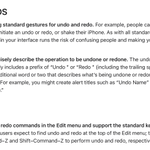
Three-finger swipe to undo/redo didn't work out on iOS and iPadOS.
Most apps that have undo/redo gestures use two-finger/three-finger taps.
developer.apple.com/design/h…

32

