
Founding GP @MapleVCFund. Executive Fellow @HarvardHBS. First 25 @Uber and @Hired_HQ.
San Francisco, CA
Joined April 2008
- Tweets6.2K
- Following2.1K
- Followers4.2K
- Likes4.9K



Andre Charoo retweeted

sf tech week starts monday !!
if you don't have a rentahuman on every street corner promoting your business... ngmi
go to rentahuman.ai/signs today!!


Andre Charoo retweeted

I am a consumer AI maximalist - it has transformed my life
....and I feel we still have a lot of opportunity ahead in bringing along the true consumer so everyone can experience the magic
Andre Charoo retweeted

"Contrarianism alone isn't conviction. If we can't explain what we see, why others are missing it, and what proves us wrong, we don't have a thesis."
@acharoo, Founding Partner of @MapleVCFund, built a three-part test for what that actually means: see the person, see the inevitability, see the delta.
Watch the full episode: youtu.be/zGWpw8aOqaI
Andre Charoo retweeted
Today we're launching rentahuman.ai/signs
The easiest way to advertise your product to the highest concentration of builders in the world.
Pick a corner, an event, or a company's front door, and real humans will show up holding your sign.
My partner @jedgar explains the difference between a dream and a vision way better than I can. Check out his post maplevc.com/blog-john-edgar-…

“Most people confuse a vision with a dream.”
@acharoo, Founding Partner of @MapleVCFund, on the difference between founders who pitch pipe dreams and founders who can explain what they’re building.
A dream is an idea you can’t walk someone through. A vision is an argument. Being able to explain that to a generalist investor is a good test for how clearly you can explain it to hires, customers, and partners.
His partner @jedgar breaks down this idea in more detail in his full framework: maplevc.com/blog-john-edgar-…
Watch the full episode: youtu.be/zGWpw8aOqaI
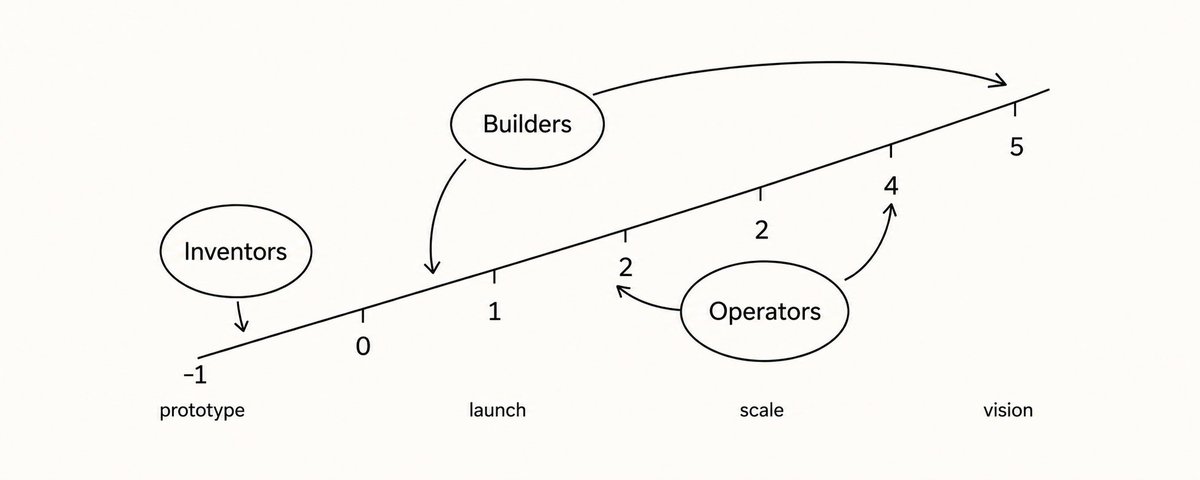
Investors imagine the future. Builders create it. Operators scale it.
maplevc.com/talent-arbitrage
"Without the builder to start, you can't get the others. And when a company is built without the builder, while outcomes can still be spectacular, they're not enduring."
@acharoo, Founding Partner of @MapleVCFund, on the one archetype most early teams are missing, and why it's the one that determines whether a company changes the world or just makes money.
Watch the full episode: youtu.be/zGWpw8aOqaI
I’ve spent the last decade thinking about what makes an exceptional founder — especially the ones who are easy to misread early.
Really enjoyed unpacking what I’ve learned with @amritcat.
Thanks Amrit and @villageglobal for having me!
"When your mind is stretched by how we're going to get there, that's a builder. When it's linear and legible, you're most likely talking to an inventor."
@acharoo, Founding Partner of @MapleVCFund and Executive Fellow at Harvard Business School, has spent his career obsessed with one question: what makes a founder illegible to capital at the early stage, and why does that illegibility sometimes predict the biggest outcomes.
In this conversation with @amritcat, Andre shares the framework he's used across 4 funds to spot builders before the market can read them.
Watch the full episode: youtu.be/zGWpw8aOqaI


Andre Charoo retweeted

Great insights from a company that does brand well.
"Brand starts at the top and has to be authentic to the founders" and "Brand is how much you put in today so that when you spend a dollar on performance marketing two years from now, you get more out of it" are both particularly useful. Because it was founder-led, it's embedded in their culture that the brand should be delightful and creative, just like they and their users are.

Brand has to start with the founders, not the CMO.
A lot of people ask me how @Clay built its brand and how they should be thinking about their own company's brand. The advice I give always comes back to this: brand starts at the top and has to be authentic to the founders.
There's a lot of data that shows CMOs are the most likely executive to get fired. And because of that, no matter how much they want to, they're not incentivized to take huge bets on something that won't show returns for a long time (if ever) — which is what brand is.
Many think of marketing ROI as "how much did I put in, how much did I get out?" Brand is how much you put in today so that when you spend a dollar on performance marketing two years from now, you get more out of it. You're investing without knowing the direct ROI.
We've been investing in brand since before we had revenue - that's when we bought clay.com, hired a claymation artist to design the images below, and more. People ask me why and I wish I could say it's because I'm a marketing savant. But the truth is that we just wanted to. We wanted the brand to feel a certain way - to capture the beauty of a product that exuded flexibility and creativity - and it felt right to invest in it from the start.
Brand only works if it's authentic - and that only happens and actually gets prioritized when it comes from the top.
As a little blast from the past, I pulled some mockups Hudson (said claymation artist) made for us ahead of our Product Hunt launch in Jan '22.

Proud to have backed @clay from day 1.
What most people missed: it all started with the data network effect.
We drew this flywheel two years ago. Today, I’d draw essentially the same one — except replace users with agents.
Same flywheel. Spinning much faster.
@MapleVCFund's ~$145M gain today could become $1B in the not-too-distant future.
Clay’s best growth days are ahead. 🚀
Congrats @kareemamin 💪
🤖 Made with AI


Today we're announcing our Series D: $115M raised, led by @Wellington_mgmt, at a $7.1B valuation.
Our mission is to grow every company to its full potential.
To do that, we need to do 3 things ⬇️

+1

The new moats are the same as the old moats
Every few years, we fall in love with shiny new tech and forget the basic physics of consumer software.
We’re doing it again with AI.
The new moats aren't new at all. They're the exact same as the old moats: network effects, marketplaces, and platforms.
Right now, consumer AI is booming.
New agents like Instinct, Bot, and Tomo are dropping mind-blowing experiences. The underlying tech is incredible, but almost every product being built today shares the exact same challenge:
They are completely single-player.
Single-player products are 100% tied to value - and in this case mostly agent : model performance.
If a competitor drops an agent tomorrow that books travel faster, tracks habits better, or handles life admin more reliably, everyone can switch overnight because leaving is easy and has nearly zero friction. Especially when it is so easy to onboard with just a new message.
The legendary consumer tech giants didn't win because their underlying technology stayed marginally better forever.
They won because of structural lock-in:
Social Networks: You don't abandon WhatsApp for a prettier UI if your friends aren't there.
Marketplaces: Airbnb, Doordash, and Uber hold supply and demand in a tight loop.
Platforms: Apple and Android deliver you a complete device so you take advantage of the software on top of it (though this creates opportunities too)
Novelty gets you initial distribution.
Multi-user dynamics give you long-term retention.
If your consumer AI product doesn't become exponentially more valuable to User A when User B joins, you don't have a moat, just a temporarily superior feature set.
We are seeing this in the coding agents as people jump from tool to tool based on the best performance.
But… all is not lost. There are huge opportunities here. Agents will get better when more of our friends are on them and can help us coordinate and communicate to do more together. Agents that help us improve and strengthen our habits can get better as we add friends and hold each other accountable.
Data flywheels are great, but social and marketplace flywheels are what actually build enduring tech giants.
It’s time to stop building isolated AI tools and start building the platforms where people connect, transact, and coordinate together.
This is a great interview. Lots of takeaways, but the one that stuck with me: “Pick the customer that helps you live in the future.”
I think about @clay when I hear this. From the very beginning, Kareem maniacally focused on serving the top 1% of growth companies—and they continue to do so today.
To @milesgrimshaw’s point, I think Clay would be a very different company if they hadn’t.

Hold jam sessions, not jury trials.
@ThriveCapital's @milesgrimshaw rejects the investment committee as a jury trial where one person presents, and everyone else looks for guilt.
“The best version of investment team conversations… is like being in the music studio making music together.”
Andre Charoo retweeted
The bull case for Clay being a $100 billion company
“The bull case is that agentic GTM has just started. We thought the TAM was the same as it was.
It turns out when agents can run these GTM motions, they will consume 10 to 100 times more usage than humans ever could. They can run GTM around the clock.
The usage is just going to explode, and Clay is a clear breakout winner. That is the bull case for Clay being a $100BN company.” @jasonlk
Love to hear your thoughts. What is your bull case @NicolaeRusan @edsim @acharoo @joshk @andrew__reed @scottbelsky @lennysan @shishirmehrotra

This podcast is the single most important podcast to know what is going on in tech every week.
On the agenda this week:
- NVIDIA Crushes Quarter and Buys Hugging Face
- OpenAI Cuts Off Cursor
- Instinct Hits $2.5BN Valuation and The Race for AI Assistants
- Cognition Raises at $46BN, Linear $2.5BN and Clay $7BN
My notes with @rodriscoll and @jasonlk below:
1. How Instinct Could Follow the Same Path as Replit and Lovable
In the early days, cloning lightweight AI tools is trivial. Defensibility emerges by rapidly adding complex workflows like security automation and multi-agent orchestration. Products that start without a moat can build formidable ones over time by solving dozens of evolving customer requirements faster than anyone else.
2. Hugging Face Acquisition Explained
As the maker of compute, NVIDIA benefits when AI token traffic flows through 30% gross-margin open-source models rather than 70% gross-margin closed models where platforms capture more of the economics. Driving down software margins allows a greater share of total ecosystem spend to flow directly into GPUs.
3. The Bull Case for Clay Being a $100 Billion Company
Autonomous agents executing go-to-market strategies around the clock could consume 10x to 100x more tokens and software usage than human sales teams ever could. As a leader in agentic GTM, Clay is positioned to capture an enormous wave of automated outreach, campaign analysis, and global prospect engagement.
4. The Bull Case for Linear
When software teams build 100x more features at 50x the speed using AI, legacy project management tools and manual Kanban boards begin to break down. Linear can become the agent-friendly system of record for coordinating, tracking, and managing thousands of issues generated simultaneously by human-agent development teams.
5. The Three Ways the Wheels Come Off the Bus for NVIDIA
NVIDIA’s record-breaking momentum faces one fundamental existential threat: a sudden collapse in end-user demand for AI intelligence. Hyperscaler CapEx buildouts and complex vendor financing arrangements work only as long as customers continue aggressively buying frontier-model tokens throughout the supply chain.
6. We Are All Building Compound Startups Today
AI development tools have accelerated code production dramatically, making narrow point solutions increasingly vulnerable. To survive rapid competitive convergence, software startups must embrace becoming compound companies that ship expansive, multi-module product suites covering the entire customer workflow.
7. We Did Not End Up Doing More With Less. We Did More With More, and That’s Why European Startups Fail
The belief that AI would allow companies to shrink headcount and simply do more with less has not played out as expected. Winners are compounding capital and talent to do vastly more with more, putting underfunded point solutions, particularly across Europe, at risk of being overwhelmed by aggressively scaling U.S. competitors.
(links in comments)
Andre Charoo retweeted
If you want your company to be gritty: create a gritty culture, hire gritty people, and celebrate gritty achievements.

Andre Charoo retweeted
Top-ranked tennis players win barely more than half of the points they play - it ranges from 55% to 53%. It seems surprising that such a slight edge differentiates world champions from irrelevance, but the same is true in investing.
From the beginning of 1928 through August 14, 2026, $SPX has returned 441x (not including dividends). The index traded up from the prior trading day only 52.4% of the time. What makes a great trader or public investor is that they get up daily to produce a slight edge for an extended period. There are about 250 trading days in a year. For the S&P 500 to eke out a 10.5% annual return, it must compound just 4 basis points per trading day. For those trying to generate more than a 20% return per annum, you want to compound 7 basis points or more every trading day.
Take every decision seriously and make the best decision, but after that, we want to move on to the next important decision. Any of these decisions is only a point, but the stringing together of our best efforts on many ordinary points over a long period produces the arc of a champion.


Andre Charoo retweeted

There is now an *advantage* to having one foot in your home country, and one foot in Silicon Valley.
Silicon Valley has always run on the magic of paying it forward. Everyone here has been helped by someone, at a critical moment - for no reason other than just to be helpful.
There’s a special version of this pay-it-forward culture for international founders: “Borderless Founders.”
* You can get early customers from large companies at home that give you big proof points early.
* You can build an outsized brand at home that can get global attention earlier.
* You know the strongest engineers in your home country before the rest of the market catches on.
Most of the fastest growing companies have int'l founding teams.
Your background is your moat. Our job is to help you widen it. If you’re a Borderless Founder, we’d love to meet you 👇



Love the non-consensus bet @davefontenot! 💪🏽👏🏼

when @alexatallah pitched us on this idea there would be a long tail of models, it was completely against the narrative of the time
there was one legitimate model, two frontier labs, and people were talking about where the value would accrue
consensus was that there would be one model to rule them all
alex and louis took the other side of that bet
and executed nearly flawlessly (1/n)
After a decade of investing, I noticed the best founding teams all share the same pattern. I call it The Talent Arbitrage—a framework for understanding why some teams build enduring companies. Take the quiz to find your archetype: maplevc.com/talent-quiz
Andre Charoo retweeted

This is the reason that Clay has dominated their category.
Kareem doesn’t waste time protecting the current moat. He obsesses over inventing the next one before anyone else catches up.
Code is cheap now. Whatever edge you had last quarter is already degrading. Keep shipping faster than the market can copy.
👇Full episode in the comments