


absorbguo retweeted

Residual connections can be considered one of the great milestones that made the “deep” in deep learning possible. In recent years, after improving Transformer architectures in just about every other way, researchers have finally turned their attention to residual connections, giving rise to many interesting modifications. So I put together this brief blog. There may well be omissions or even mistakes, and any corrections or additions are very welcome!
The English version was translated from the original Chinese by GPT-6 Astra. If you can read Chinese, I recommend reading the original notes.
PDF:
[Chinese (CN)](github.com/Purshow/Purshow_N…)
[English (EN)](github.com/Purshow/Purshow_N…)

absorbguo retweeted

A lot of hype around OpenAI's Astra model here on my timeline today. Apparently, this goes back to a new article from The Information, which said Astra is a "recurrent depth or looped transformer".
It's always interesting to read about new or different approaches (including rumors about what the closed labs may be up to), but let's debunk this a bit.
About 2 months ago, I shared the architecture details of Nanbeige, for example, where "Nanbeige4.2-3B is pretrained from scratch on 28T tokens with a Looped Transformer that reuses the layer stack to increase capacity without adding parameters."
Yes, that's it. The looped transformer idea is just reusing layers in the transformer block.
In the case of Nanbeige, the main idea is to reuse the same 22-layer stack (=transformer block) twice instead of once. So, effectively it extends the 22-layer architecture to 44 layers, but without duplicating the weights.
In simple terms, this roughly doubles the size of the model (if we ignore the embedding and output layers for a second). But instead of requiring 2x the storage and RAM to host this model, it stays at the same size since we reuse the components. However, it's almost 2x as expensive in terms of compute, because we run the embedded text through almost 2x as many layers.
Why? In the Nanbeige 4.2 technical report, the researchers found that two passes gave the best trade-off and retained about 75% of the token efficiency of a standard architecture. (More passes gave barely any gains but made the training much slower and much more expensive.)
While, as far as I know, Nanbeige 4.2 is the first notable open-weight model that adopted this approach, the idea goes back to the NeurIPS paper "Mixture-of-recursions: Learning dynamic recursive depths for adaptive token-level computation". Actually, this paper proposes a mechanism that is a bit more sophisticated by adding a learned router that determines whether each token receives one, two, or more passes. So, easy tokens can exit early while harder tokens receive additional computation.
In sum, Astra may be a really good model, but this shouldn't be about this "looped transformer aspect," which is just a tiny architectural tweak.
Also, the statement "the new technique works in a way that obscures some or all of the AI's reasoning, otherwise known as 'chain-of-thought'" is not necessarily true with respect to the looped transformer method. It's possible that The Information journalist refers to some other technique or misunderstood the looped transformer method.
Reusing layers does not by itself suppress visible chain of thought. It adds computation in hidden states before the next token is emitted, just as ordinary transformer layers do.
But based on the information we have, the only plausible interpretation here is that if a model uses more of these recurrent passes, it may need to generate fewer intermediate reasoning tokens. So then more of its computation happens in latent activations that cannot be read as text. But we would get the same effect if we were scaling up the model size, like GPT 5.6 Luna -> GPT 5.6 Sol.

absorbguo retweeted

El ingeniero que CREÓ Claude Code soltó un video de 28 minutos
Olvídate de copiar prompts genéricos.
Acá te muestra CLAUDE.md, memoria permanente y sesiones paralelas.
Pagué cursos de 300 dólares que ni llegan a la mitad
de lo que explica en los primeros 10 minutos.
Y es gratis.
no importa si estás empezando o si programas todo el día.
Después de esto usarás la IA de una forma que no sabías que existía.
Guárdalo💾 Querrás volver.
absorbguo retweeted

Banger paper from Google.
If you maintain a skill library for your agents, you might want to check this out.
(bookmark it)
This work separates three things that skill-evolution systems usually collapse into one. Raw execution traces, a persistent wiki of accumulated knowledge, and the executable skills themselves.
Experience gets consolidated into the wiki, and every later skill update builds on that wiki instead of on a scattered optimization history.
Ablations confirm the wiki is what carries a lot of the gain. Two results stand out in particular. Smaller models with evolved skills beat substantially larger models without them. And skills evolved by one model transfer across families, where skills evolved elsewhere sometimes beat self-evolved ones.
Paper: arxiv.org/abs/2608.27454
Chat with Paper: academy.dair.ai/papers/wikis…


absorbguo retweeted

Google's team just dropped a 9-page PDF on Harness Engineering - one formula replaced prompt engineering:
the twist: same Claude Sonnet, same benchmark - change only the harness
the formula: Agent = Model + Harness
here's the playbook in 6 steps:
step 1 → add guides - AGENTS.md, rule files, constraint docs - each line is a past agent failure turned into a permanent fix
step 2 → add sensors - linters, tests, validation scripts the agent runs on its own output before a human sees it
step 3 → build the agentic loop - plan, execute, verify, fix - bounded retries, budget caps, escalation when stuck
step 4 → externalize memory - the model forgets every session. the harness remembers state, decisions, and artifacts across all of them
step 5 → enforce permissions - which tools, how many writes, what needs approval. the model doesn't enforce safety. the harness does
step 6 → wire observability - track every tool call, cost, retry. trip wires fire when behavior drifts
the result: your agent stops being a demo and starts being infrastructure - every failure makes the system permanently better, not just the next conversation
this 9-page PDF is what comes after prompt engineering and context engineering
bookmark and build the full system from the article below ↓


absorbguo retweeted

When training a specialized LLM with midtraining / CPT, there are several important dimensions of the training process that need to be tuned…
Data mixture. Midtraining should emphasize high-quality data from domains that matter for downstream use cases (e.g., math, code, science, or instruction following). However, we usually want to retain some general data rather than switching entirely to a specialized distribution. The optimal mixture can be found empirically with small-scale mixture ablations.
Training duration. More training is not always better. Gains from midtraining can saturate relatively quickly, and excessive training on a specialized distribution can cause diminishing returns, forgetting, or overspecialization (although this can be mostly mitigated by tuning the data mixture properly). For this reason, the token budget itself should be treated as a hyperparameter rather than simply maximizing the amount of training.
Timing / stage ordering. When should specialized data be introduced during training? The optimal data distribution is not fixed throughout pretraining. In practice, many successful recipes progressively shift toward higher-quality / specialized data later in training. Midtraining can also interact with other stages like long-context training, so the ordering of these stages matters.
Interestingly, the best settings for midtraining also depend on when it is applied. In particular, the optimal data mixture actually changes depending on the stage of the pretraining / midtraining process and how much the model has been trained. Models that have undergone less training tend to be able to train on high ratios of specialized data while still performing well.
Sequence length. Longer sequences are substantially more expensive to train on. Training at shorter context lengths can be more efficient, but doing so may deteriorate previously learned long-context capabilities. Often this is handled by putting a long-context training phase at the end of pretraining, but some papers show that inserting midtraining after this phase actually leads to the best results (despite slightly deteriorating long context performance). We can achieve the best of both worlds by running a short long-context restoration phase afterwards.
Post-trainability. The best midtrained checkpoint is not necessarily the one with the highest immediate benchmark performance. Midtraining builds knowledge and reasoning capabilities that downstream RL can exploit, so we should evaluate midtraining recipes based on their final post-trained performance as well. Usually, this is evaluated by just running a lightweight post-training phase (e.g., SFT) on each model checkpoint before performing evals.
Put simply, midtraining / CPT is more complex than just continuing pretraining on better data. Data composition, sampling ratios, training duration, sequence length, and placement within the overall training pipeline are tunable design choices that impact final performance.
For more details, see my recent writeup: cameronrwolfe.substack.com/p…

absorbguo retweeted

MOSS-VL: real-time video understanding that perceives while speaking
OpenMOSS released MOSS-VL, an 11B open vision-language model that keeps watching live frames while answering — proactive silence and dynamic self-correction built in.

absorbguo retweeted

两万字长文!从第一性原理理解Diffusion & Flow Matching (SDE、ODE的大一统视角)
2026 年,我相信几乎没有CVer不知道 Diffusion。不管是做 AIGC 生成,还是做具身智能里的 policy learning,Diffusion 都已经成为绕不开的核心技术。
第一次学 Diffusion 时,你是不是也遇到过这种开场:先给出一条“原信号乘一个系数,再加上高斯噪声乘另一个系数”的公式,接着介绍噪声日程,然后就开始训练网络,公式怎么用说得很清楚。
再往后,SDE、反向 SDE、概率流 ODE、DDIM 一个接一个登场。你可能还听过“Diffusion本质是SDE和ODE”,“DDIM 可以视为欧拉法采样”,或者“换个求解器就能减少采样步数”。这些话各自都有条件和来由,可一旦省略中间的因果链,知识就容易变成一地散落的钥匙。
这个Blog想把中间那根线补上。我们会从一个第一性原理式的问题出发:从“生成究竟是什么”开始,到“为什么需要中间路径”;从“随机扩散过程”走到“确定性 ODE”;再从“沿速度场生成”自然过渡到 Flow Matching。我相信不管大家是不是理解这些内容,沿着文章的思路串一遍都很有帮助。
所谓“生成”,在概率上究竟要完成什么?
qingkeai.online/archives/Dif…


absorbguo retweeted

Don't waste 2 years learning to build self-improving AI agents.
Stanford just dropped a 3.5 hour course on building them from scratch.
0:00 - self-improving agent basics
1:06:29 - multi-step reasoning in agents
2:20:08 - agents learning from feedback
look at the third one, because that is where the whole thing turns.
Attempt → Signal → Correction → Better attempt
an agent cannot improve from its own opinion of its work. the signal has to come from outside it, or the loop just reinforces whatever it already believed.
self-review is the old workflow. external correction is the new one.
that is the difference between a system that gets better every week and one that gets more confident every week.
Anthropic pays $750,000 a year to engineers who can build this.
bookmark and watch it today, then read the eval setup below


What the West Gets Wrong About China | Alice Han & Trevor Noah youtu.be/5w4mYeWGVc8?si=9OTz… 来自 @YouTube
absorbguo retweeted
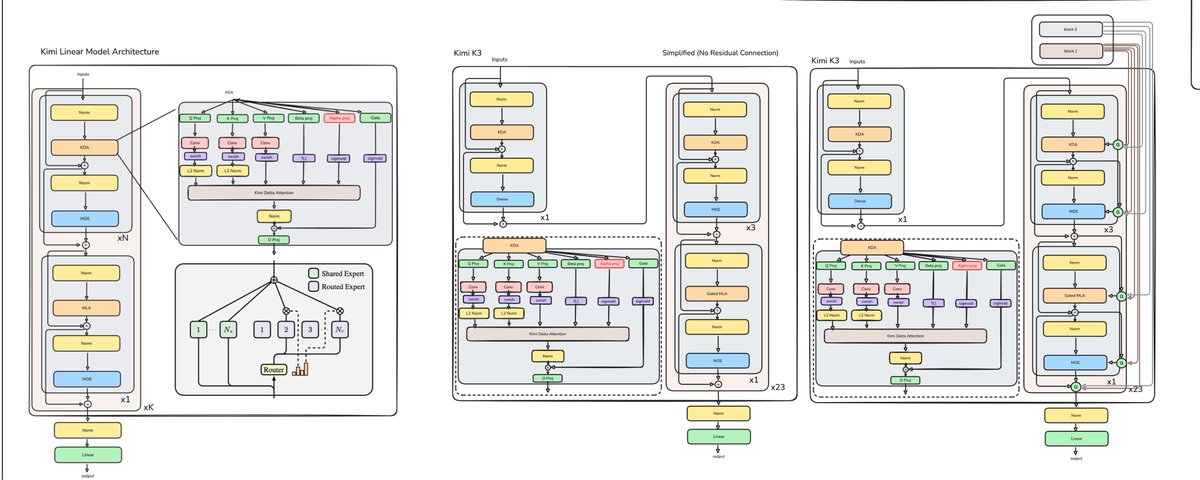
The Kimi K3 architecture figure for yesterday's big open-weight model release, along with some observations and thoughts.
1. Yes, it looks relatively complicated, but it's essentially a scaled-up production version of their Kimi Linear model they released last year (scaled up from 48B -> 2.8T; K3 is by far the biggest open-weight model right now)
2. The one new component compared to Kimi Linear is the LatentMoE. I omitted it in the figure below since it's already very crowded, but that's essentially the same LatentMoE as in Nemotron 3 Ultra (you can find it in my LLM Architecture Gallery if you are curious). The idea here is to compress (down-project) large linear layers similar to multi-head latent attention.
3. Kimi K3's overall trend (similar to Nemotron 3, DeepSeek V4, and others) is also towards better inference efficiency. That is, there are many components that replace existing components with efficiency-tweaked versions. I.e., MoE -> LatentMoE, regular attention -> multi-head latent attention and Kimi Delta Attention. (I also have short tutorials and write-ups in my gallery if you are curious about additional details).
4. The one component change that is not an efficiency tweak is attention residuals. Like DeepSeek V4 improved the residual path with mHC (manifold-constrained Hyper-Connections), attention residuals are a way to improve the residual path, but it works a bit differently. I.e., mHC made the residual path wider. Attention residuals (also already part of Kimi Linear) connect the residuals across layers; the connection itself uses an attention score for an important/contribution weight. According to the report, it improves the validation loss and downstream performance (a bit) consistently and adds about 4% in training cost and 2% in inference cost.
5. Interestingly, Kimi K3 got rid of all RoPE layers and uses NoPE (No Positional Embeddings) everywhere instead. (Again, this is inherited from Kimi Linear). In other architectures, the recent trend was towards RoPE in local attention layers (like sliding window attention) and NoPE in the global layers. There were a few architectures that only used NoPE everywhere, but this is the first frontier-level one as far as I know.
6. Kimi K3 now also has native multimodal support, which is great!
There are several other interesting training tidbits in the technical report, but that's it from the architecture front so far. A really great release overall.


absorbguo retweeted

A Visual Introduction to Information Theory
(bookmark it)
Information Theory is such an beautiful and powerful subject.
In the era of AI, it's worth spending time learning about it.
Here is a highly-recommended read for anyone who wants real intuition for entropy and mutual information.
It's a visual, intuition-first guide to information theory.
It assumes only familiarity with basic probability, so it stays accessible while still reaching the fundamental limits of compression and transmission.
Paper: arxiv.org/abs/2206.07867
Learn to build effective AI agents in our academy: academy.dair.ai/


absorbguo retweeted

AI 教育的底层外挂来了!
这个人刚刚将整个小学阶段的超级知识图谱彻底开源。
它将 8 大学科拆解为 1590 个核心概念和 3221 条逻辑链路,精准对标英美顶尖教育标准。
高度结构化的 JSON 格式,明确的权重与评估标准,你可以让算法一键计算出最完美的个性化学习路径!
xitter.cf/lionel_mora/status/207…
absorbguo retweeted

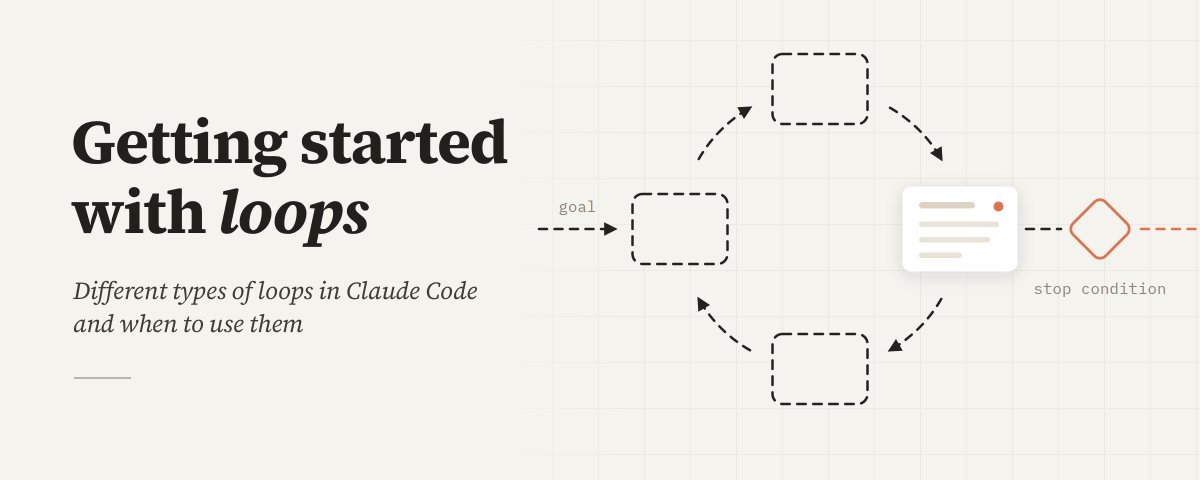
Claude 官方写了一篇关于 Loop Engineer 的入门文章。
其实现在我们所说的 Loop Engineer,所有的底层逻辑在提出这个概念以前就已经具备了,甚至这些工作流程也是大家一直在用的,只是被套上了一个新的概念。
在这篇文章中,他们把 Loop 分成了四种类型:
回合制循环(Single-turn Loop)
这是最基本的 Claude Code 工作方式。你发出的每一个提示词(Prompt)都是一个循环,在这个循环中你不需要额外干预。Claude Code 完成这个循环后会给你输出,它的具体步骤是:收集上下文、采取行动、检查工作、重复,直到它认为你的提示词任务已经完成,或者觉得需要你介入时才会停止。
基于目标的循环(Goal-oriented Loop)
也就是 GOAL 模式(如 Codex、Claude Code 等工具都支持该模式)。有时候单回合不足以完成复杂任务,系统就会进行多次迭代,直到达成那个更大的目标。
基于时间的循环(Time-based Loop)
也就是 Claude Code 中的 loop 命令。你可以设置在指定的时间间隔自动触发某一个提示词,去运行特定任务,比如定期进行 PR 合并等。
主动循环(Active Loop)
你只需要设置一个事件,一旦该事件发生就会自动触发循环,完全不需要人工干预。例如,一旦 GitHub 上有了新的 Issue 或 PR,AI 就会自动进行审核和记录。
此外,官方还针对 Loop 给出了一些优化建议:
循环的质量取决于系统:你需要保证代码库本身的质量,比如完善的文档、严格的代码审查以及保持代码库的简洁等。
管理你的 Token 消耗:像 GOAL 这种基于目标的模式,对 Token 的消耗是非常巨大的。因此,你需要给循环设置明确的界限,比如什么时候该用大模型、什么时候该用小模型,以及明确的启动和结束条件。否则,一旦系统自己无限制地跑下去,不仅容易跑偏,还会消耗大量的 Token。
这些循环模式,本质上都是由我们现在 Agent 常见的各种能力组合而成的,比如前面提到的 GOAL 模式、Loop 模式,以及常见的 Skills 和 Hooks 等。


absorbguo retweeted

Absolutely beautiful blog from @thinkymachines with so many random alpha gems, made me forget how expensive the iced coffee is in Zurich
