
In here I write about Iron Age and Historical era steppe nomads' aDNA and archeaology.
Joined August 2022
- Tweets275
- Following47
- Followers1.9K
- Likes2.6K


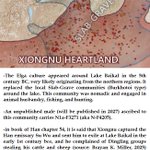




a new linguistic paper supports a largely accepted opinion that the Core layer of the Xiongnu empire was Turkic-speaking.
About a half-year from now, a major aDNA paper will also confirm that the 'core Xiongnu' ethnicity was indeed Turkic, using Y-DNA links.


A professional article by Emre Yavuz about three historical Chinese reports of Ashina clan origin.
Nearly all Chinese reports point to Xiongnu origin of Ashina, that aligns with the nominated Ashina Y-DNA; R1a-S10885 (Kok-Pash)
Temporary post.


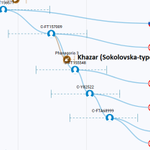
New Khazar samples!
Two new females along with previous C-Y10428 Khazar male (same site) has been newly analysed (no raw data for females)
Similar to other Khazars, they exhibit 40-60% East Asian ancestry, equates with 45-65% Core Xiongnu ancestry (see Daniel Tabin's poster)

Very special; a new Khazar male dated to 700 AD shares exact C-Y10420>FT156571 subclade with Chepni clan in Turkey with 500 AD TMRCA, strongly suggesting the Chepni clan has Khazar ties before joining Oghuz confederation.


New Ghalichi 2026 Elite Pazyryk (Berel 16) male has Q1b-L330 on ftDNA (very likely B287>BZ93 subclade, a Yeniseian-related subclade common in Berel/Bulan-Koby- ftDNA).
His profile is regular Eastern/Central Saka (40_50% Khövsgöl_LBA, 40-50% Sintashta, and some BMAC)

ALT New Ghalichi 2026 Elite Pazyryk (Berel 16) male has Q1b-L330 on ftDNA (very likely B287>BZ93 subclade, a Yeniseian-related subclade common in Berel/Bulan-Koby- ftDNA). His profile is regular Eastern/Central Saka (40_50% Khövsgöl_LBA, 40-50% Sintashta, and some BMAC)

Amazing X. Chang et al. 2026, full aDNA of Ningxia. Interesting is Zhou period (2.7 - 2.1k BP) nomadic part, mostly derived from Slab-Graves and all males are Q1a-M120, this is the same stock as Ordos culture that is long called Scythian but aDNA says otherwise

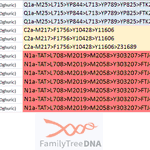
a Y-DNA update for Slab-Grave and Deer Stone cultures of BA Mongolia (Source: ftDNA)
-SG nomads had mainly Q-M120 in early/middle period but N-M2019 became dominant in late period
-DSKC nomads had a founder effect on BZ181 subclade of Q-L330

ALT a Y-DNA update for Slab-Grave and Deer Stone cultures of BA Mongolia (Source: ftDNA) -SG had mainly Q-M120 in early/middle period but N-M2019 became dominant in late period -DSKC nomads had a founder effect on BZ181 subclade of Q-L330
Who is closest to the famous DA39 (R1a-PRX4) in current Xiongnu set?
CHN010 (Chandman site, C2a-Y10420) shares 93 cM IBD (4 long segments) with him (Özdemir 2026). 85% in 3-2nd cousin range
(Bonus: for a reason, in 2027, Modu dynasty can be ascribed to C-Y10420>MF175677)

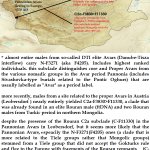
Korgantas is said to be from Slab-Grave horizon (source: img). It has all SG Y-DNAs but lacks C2a-Y10420.
Korgantas moved to Kazakhstan around 400_350 BC, it 'probably' means they were forced to move by a new wave in Mongolia. Likely by JAG-type wave.
(Temporary post)


This quoted post is unavailable.


